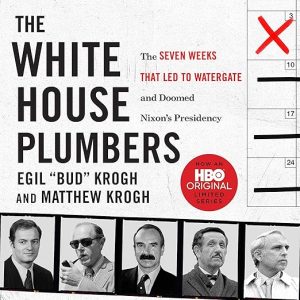
Watergate has a shelf of its own by now, which makes the case for a four-hour audiobook harder to argue and, in this instance, easier to win. Egil Krogh was the young lawyer summoned to a closed-door meeting on July 17, 1971 by his mentor John Ehrlichman, expecting to discuss a drug control program in Vietnam and leaving instead with a file and responsibility for the Special Investigations Unit. The unit became known as the Plumbers. Krogh and his co-director David Young hired G. Gordon Liddy and E. Howard Hunt, who ran the break-in at the office of the psychiatrist treating Daniel Ellsberg, and everything after that belongs to the national record.
A Shared Surname Macmillan Audio Never Explains
The credit block asks a question the listing never answers. Peter Krogh reads a memoir written by Egil Krogh, and nothing on the record explains what the shared surname means. Macmillan Audio has put two people with the same family name on two lines and left the connection unstated, which for a confessional memoir is not a trivial omission: whether the voice you are hearing belongs to a relative changes what the reading is doing. Take it as an open question rather than an answered one, and let the performance rather than the surname carry it.
What the book is, one grader captures precisely: an account written by one of the criminal actors in the Nixon conspiracies, offering daylight on one of them, in which a young lawyer pleads his case at short length. Pleads is the correct verb. This is testimony from inside a wrongdoing, delivered by a participant who served a prison sentence for it, and every claim in it arrives with an obvious interest attached. That does not disqualify the account. It sets the terms on which you should receive it.
The July 1971 meeting is the scene the whole memoir hangs from, and Krogh treats it as such. He was handed a file by a superior he trusted and told the work was critical to national security. He did not ask what the unit was authorized to do. The description's word for the motive is loyalty, and the book's argument is that loyalty running ahead of principle is the specific mechanism by which a competent person does something indefensible, one procedural step at a time.
Four Hours, Eleven Minutes, One Long Afternoon
The prose stays out of the way. A five-star response praises the author for relaying historical fact as a true story rather than as a textbook, which is exactly the risk any Watergate memoir runs: the material comes pre-loaded with names, dates, committees and acronyms, and it can calcify into a chronology very quickly. The Plumbers, the SIU, the Pentagon Papers and the Fielding break-in all arrive here inside scenes with people in them.
Reactions to that approach run warm. One grader calls the firsthand account enthralling and describes it as a wild read for someone who enjoys conspiracy and government intrigue, adding that the perspective is both revealing and introspective. That combination is the memoir's real selling point. Insider accounts are often one or the other, either a document dump or a self-examination, and this one is attempting both inside a very short frame.
The frame is the strongest practical argument for the audio. Four hours and eleven minutes is a single long afternoon, roughly the length of a feature film and its sequel, and it is a remarkably compact way to acquire an insider's version of how the Nixon presidency began to come apart. Nothing about the runtime is padded, and nothing in the description suggests the book attempts a general history it does not have room for.
One Review Is Marketing Text Wearing a Grade
Caution arrives from the best-informed grader in the column. A four-star response from someone who has read nearly everything available on Watergate, watched the 1973 hearings testimony, and read Krogh's earlier book reports being slightly disappointed, while confirming the book's central contention that the Fielding burglary is what made the later cover-up necessary. That is the honest ceiling on this memoir: if you already know the sequence, you are buying the interior view rather than new facts, and the record links no other title by this author to help you place it.
The response column has a defect worth knowing about before you weigh the score. One three-star entry reproduces the publisher's description word for word as its review body, and takes its headline from the same copy. Nothing in it reports on reading or hearing the book at all. On a record showing 4.0 across 76 ratings with five written responses attached, one of those five is marketing text wearing a grade, which is worth subtracting before you draw conclusions from the average.
The description itself opens with a promotional line about a five-part HBO series and its two lead actors, which sits above the summary and has nothing to do with this recording. A sentence further down is also missing a word, leaving the Plumbers with ill-conceived plans stop the leaking of the Pentagon Papers. Neither defect touches the book, and both are the kind of thing a shopper should be able to ignore, but the television billing at the top does set an expectation of dramatization that a four-hour first-person memoir will not meet.
The Ordinary Chain of Small Permissions
Listeners drawn to the mechanics of institutional wrongdoing, the ordinary chain of small permissions by which a career lawyer ends up authorizing a burglary, will find this an unusually direct case study, told by the person who signed off. Anyone who came to the story through the television version and wants the participant's own account will find it here at a length that costs one evening. Readers of political memoir who value the confession over the exposure are the core audience.
Skip it if you want the full architecture of the scandal. The tapes, the committee, the resignation and the wider conspiracy sit outside this frame, and four hours cannot hold them. What is on offer is a point of view rather than a revelation, and specialists who have already worked through the literature should price it accordingly.
Is four hours long enough for a Watergate audiobook?
It is, because the scope is deliberately narrow. Four hours and eleven minutes covers one participant, one unit and one decision rather than the whole scandal. If you want the tapes, the hearings and the resignation, you need a general history alongside it.
Does the audiobook require prior knowledge of the Nixon administration?
Some helps. The description assumes you know what the Pentagon Papers were and why leaking them mattered, and names John Ehrlichman, G. Gordon Liddy and E. Howard Hunt without much introduction. A listener with a general outline of the scandal will follow it comfortably.
Who published the recording, and when did it come out?
Macmillan Audio released it on December 27, 2022, in a production drawn from the St. Martin's Press edition. The timing put it just ahead of renewed public interest in the Plumbers, which the description leans on heavily in its opening line.
Does the book cover what happened to Krogh after the prosecution?
Yes. The description states that the account includes his prison sentence and the rebuilding of his life afterward, and frames the whole memoir around integrity recovered rather than blame deflected. That later stretch is what separates it from a straight account of the break-in.