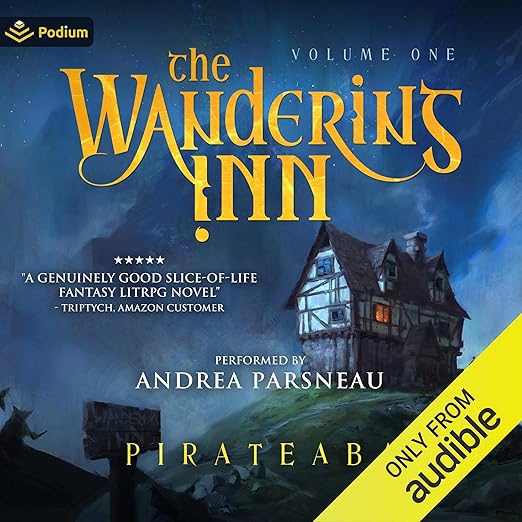
Quick Take
- Narration: Andrea Parsneau is the best possible choice for this material. Her warmth and range across a massive ensemble cast is what turns 48 hours from an endurance test into an invitation.
- Themes: Found community, the ordinary person in an extraordinary world, the mundane as heroic
- Mood: Cozy slice-of-life with emotional sucker punches arriving without warning, then giving way to genuine epic stakes
- Verdict: One of the most unusual debut audiobooks in recent fantasy: starts as small as a meal and earns something enormous before the credits roll.
Forty-eight hours is a commitment that most audiobook listeners will balk at, and I understand why. When I queued up The Wandering Inn during a period when I needed something I could disappear into for a while, I was not prepared for what happened. By hour six I had stopped thinking about the runtime entirely. By hour fifteen I was rearranging my schedule to find more listening time. Andrea Parsneau’s narration deserves significant credit for that, but so does pirateaba’s refusal to write the book that readers familiar with LitRPG conventions expect.
Erin Solstice arrives in a world she does not understand through means the book does not rush to explain. She is not a warrior, not a mage, not destined. She runs an inn. She serves pasta with sausage, blue fruit juice, and dead acid flies on request, the last being a delicacy in her new world rather than an error. The sign on her door reads: No killing Goblins. That detail is more significant than it first appears, and the book’s willingness to complicate the standard fantasy hierarchy of monster and hero is one of the things that distinguishes The Wandering Inn from the thousands of other portal fantasy and LitRPG titles crowding the market.
Our Take on The Wandering Inn
The RPG mechanics in this first volume are light. Characters level and gain classes, but the experience point accumulation that drives harder LitRPG is not the primary engine here. What drives the book is community. The Wandering Inn becomes a gathering point for an ensemble of deeply individuated characters, including Goblins who are not what the default fantasy imagination assumes, Antinium who are genuinely alien, and human adventurers navigating a world where violence is a fact of daily life. Reviewer MRE’s description of the slice-of-life sections as equally satisfying to the power-gain elements captures exactly what makes this unusual: pirateaba is interested in what people eat, how they rest, and what they talk about when nothing is trying to kill them.
Why Listen to The Wandering Inn
Andrea Parsneau. That is the answer, and it is almost complete on its own. The Wandering Inn has a massive ensemble cast, and Parsneau gives each character a distinct voice that you learn to recognize across dozens of hours. She also navigates the book’s wild tonal range, from genuinely comic to genuinely devastating, without lurching between registers. One reviewer described the book as starting like Archie Comics and escalating to Avengers: Endgame in terms of emotional weight, and Parsneau makes that journey feel earned rather than whiplash-inducing. This revised edition includes new scenes and perspectives not in the original web serial release, and the recording captures a more complete version of the story than early readers encountered.
What to Watch For in The Wandering Inn
The book starts slowly and deliberately. Erin’s first weeks in her new world are full of small disasters, minor adaptations, and the gradual accumulation of connections. The LitRPGPodcast review correctly notes that this volume is light on RPG mechanics and heavy on slice-of-life texture. If you need the first three hours to justify the remaining forty-five, you may not make it. The reward requires patience, and the emotional stakes that arrive in the book’s later sections only hit as hard as they do because pirateaba has made you care about these characters through ordinary moments. Experienced LitRPG readers expecting constant level-grinding will need to recalibrate their expectations significantly.
Who Should Listen to The Wandering Inn
Fantasy readers who loved the cozy warmth of early Discworld, the community-building of Becky Chambers’ Wayfarers series, and the LitRPG framework of Dungeon Crawler Carl will find something here that does not quite exist elsewhere. Listeners who need action-forward pacing in their first hours with a book should approach cautiously and budget for a slow start. The 48-hour runtime is real, but readers who commit report it feeling shorter than it should. This is volume one of a still-ongoing series that has grown to extraordinary length and scope, which means the ending of this book is not an ending so much as an opening breath.
Frequently Asked Questions
Do I need prior experience with LitRPG to follow The Wandering Inn, or is it accessible to general fantasy readers?
Fully accessible without LitRPG background. The RPG mechanics are woven into the world rather than front-and-center, and the book functions as portal fantasy and community-building story as much as anything else.
How does this revised edition differ from the original web serial version that long-time fans know?
The revised edition includes new scenes and perspectives not present in the original web serial release. Readers who followed the original online may find new material, expanded character work, and refined pacing in this version.
Is Andrea Parsneau’s narration consistent across all volumes of the series, or does it vary?
Parsneau has narrated multiple volumes of The Wandering Inn and is considered by the fanbase to be integral to the audiobook experience. Her performance is consistent and develops alongside the material as the series expands.
Given the 48-hour runtime, where does the first volume find a natural stopping point for listeners who need breaks?
The book has natural chapter breaks, and pirateaba’s slice-of-life pacing means most chapters function as contained episodes. Listeners can pause at chapter ends without losing narrative thread, which makes the runtime more manageable than it appears.