- Voice: Paul Boehmer's narration continues to suit the Underland series, handling the tension of the plague storyline with appropriate gravity for younger listeners.
- Big ideas: Prophecy and reluctant destiny, disease and sacrifice, the weight of being chosen
- Atmosphere: Darker and more foreboding than the first two books, with the sense that stakes are genuinely rising
- Worth it?: A strong mid-series entry from Suzanne Collins that does the necessary work of deepening the world while delivering its own emotional payoff.
I read the Underland Chronicles in the wrong order when I first encountered them, starting with Mockingjay and only circling back to Collins's earlier work much later. Coming to the series as an adult with literary rather than nostalgic investment, I was struck by how much Collins was doing in these books that never gets full credit because The Hunger Games arrived and consumed all the oxygen. The Underland Chronicles are darker, stranger, and more morally complex than they look from the outside.
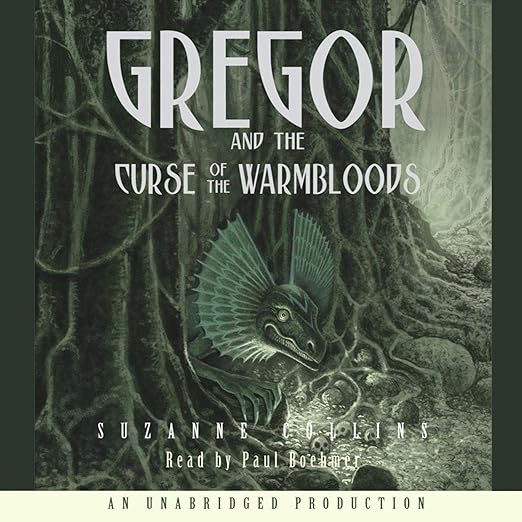
Gregor and the Curse of the Warmbloods is the third installment, and it follows Book Two's momentum into territory that is genuinely grim for a middle-grade series. A plague is spreading through the Underland, the vast subterranean world beneath New York City where Gregor has been traveling since Book One. When someone close to Gregor is infected, his involvement stops being about prophecy and becomes about survival and love. Collins uses that shift well.
What Suzanne Collins Delivers
Mid-series books in long fantasy sequences carry a specific burden: they must develop the world and move the characters forward while delivering their own emotional arc rather than merely serving as a bridge to the finale. Collins largely succeeds here. The Prophecy of Blood, which Gregor is slowly being drawn into, gains real weight in this installment because Collins makes the cost personal before she makes it cosmic.
One reviewer who read the series as a child and returned as an adult noted that the writing is simple enough to be believable from a child's perspective while the plot itself is unpredictable and full of genuine twists. That observation captures what Collins does throughout the Underland Chronicles: she writes at the level of her protagonist's voice without dumbing down the story her protagonist is living inside. That is technically harder than it looks.
What Suzanne Collins Gets Right
Paul Boehmer has narrated the series from the beginning, and continuity matters in a five-book sequence with an established ensemble of characters including giant rats, bats, cockroaches, and humans navigating fraught political alliances. Boehmer maintains that world's texture across the installments, and by Book Three, a listener who has followed the series will find his voices for recurring characters immediately recognizable.
At 7 hours and 47 minutes, this is the shortest entry in the series so far, which reflects Collins's increasing economy of storytelling. There is no filler here. A parent-and-child pair who reviewed it described staying up past bedtime to finish it, unable to put it down. That is the book's most useful endorsement.
Where Suzanne Collins Loses Some Ground
As a third book in a five-part sequence, this installment does carry some setup weight for Book Four. One reviewer found the middle sections slightly thinner in terms of plot resolution and suspected the author was laying groundwork for what comes next. That is not wrong. Collins is building toward a finale, and parts of this book are architecture rather than event. The payoff chapters are excellent, but the path to them takes some patience.
The series also has a minimal synopsis available compared to many audiobooks, which makes it harder for new listeners to assess fit from the listing alone. The series is best entered at Book One; starting here will strand the listener in the middle of a world that requires investment to make sense.
Who Should Pick Up The Underland Chronicles Book Three
This is exclusively for listeners already in the series. If you have arrived here having finished Books One and Two, you will want to continue immediately; Collins has constructed the series to feel genuinely consequential, and this installment earns its place in that arc. Adults reading alongside children will find it holds up; adults reading alone for the first time should go back to Book One rather than starting here. Do not recommend this as a first Suzanne Collins audiobook to someone who has not read The Underland Chronicles from the beginning.
Can I listen to Gregor and the Curse of the Warmbloods without having heard the first two Underland Chronicles books?
Not recommended. This is Book Three in a five-book series with ongoing character arcs, political alliances, and prophecy threads established in earlier installments. New listeners should start with Gregor the Overlander.
Is Paul Boehmer's narration consistent with the previous books in the series?
Yes. Boehmer narrated earlier Underland Chronicles entries and maintains the same vocal landscape across the series. Listeners who have established an audio relationship with his voice for these characters will find the continuity reassuring.
Is the Underland Chronicles series comparable to other Collins works in terms of quality?
Several adult readers who revisited the series found the Underland Chronicles to be Collins at her most inventive in terms of world-building. The Hunger Games has more cultural presence, but the Underland series is considered by many devoted readers to be equally accomplished and somewhat darker in its moral vision.