Quick Take
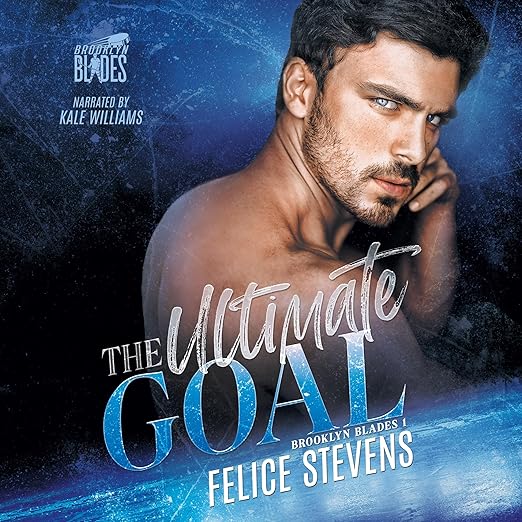
- Narration: Kale Williams handles both the confident hockey star and the nervous, self-doubting Adrian with distinct energy, the chemistry between the two voices reads as genuine.
- Themes: Fake dating, childhood crushes, sports identity and late-career anxiety
- Mood: Warm, funny, and emotionally earnest
- Verdict: A satisfying opener to the Brooklyn Blades series with two genuinely sweet protagonists who earn their happy ending through real emotional work.
I was in the middle of a reading slump when I picked this one up, the kind where nothing seems to stick and you are suspicious of anything that sounds too cheerful. The Ultimate Goal sounded, on paper, like exactly the kind of book a slump would reject: hockey romance, fake dating, childhood crush, best friend’s brother. Every box checked. But Felice Stevens has a way of making familiar tropes feel inhabited rather than assembled, and by the time Rip Tremaine was fumbling through his first attempt at helping Adrian on camera, I was fully invested.
The setup is genuinely charming. Rip is thirty-six, has played fifteen seasons for the Brooklyn Blades, and is watching the Stanley Cup remain just out of reach. His ex-boyfriend is now the team goalie, a situation the paparazzi love and Rip does not. Then his best friend Neil’s younger brother Adrian turns up to cover a game for the local evening news, visibly terrified of cameras and completely unequipped to discuss hockey. Rip saves the interview, one thing leads to another, and they agree to fake-date so Adrian can anchor his own sports show while Rip gets a distraction from his complicated personal life.
Our Take on The Ultimate Goal
What Stevens does well here is give both characters genuine insecurities that feel specific rather than generic. Rip’s anxiety is not just about his career ending, it is about what his identity will be when hockey is gone, and it is tangled up with an absent father who has reappeared at the worst possible time. Adrian’s fear of the camera is not simple shyness; it is connected to how he has always seen himself as the overlooked younger brother, the person who fades into the background. Watching these two specific wounds find each other and slowly heal is the actual story. The hockey plot and the fake-dating mechanics are the container.
Kale Williams is well-cast. He differentiates Rip’s easy confidence from Adrian’s nervous energy without overstating either, and the scenes where they genuinely begin to connect feel natural rather than obligatory. At just under eight hours the pacing is comfortable, neither rushed to the romance nor padding out the complications.
Why Listen to The Ultimate Goal
The Brooklyn Blades series kicks off with a strong foundation. Stevens establishes an ensemble around the team that promises future entries will have room to breathe, the ex-boyfriend goalie alone feels like a setup for a book I would read immediately. Readers who came in as Felice Stevens fans noted that she reliably delivers, and The Ultimate Goal lands as expected. Readers who arrived via the hockey romance subgenre found it accessible even without prior genre experience.
The LGBTQ+ framing is handled without the story making a drama out of identity. Both Rip and Adrian are simply gay men living their lives in a professional sports context. The tension the series generates around that, how public the relationship can be, how it plays in the locker room, how the media covers it, is present but treated as circumstance rather than crisis. That feels like the right choice for a romance that wants to be warm rather than issue-driven.
What to Watch For in The Ultimate Goal
One reviewer flagged that the story mislabels the team as the Atlanta Coyotes in a moment of apparent editorial error, the team in the book is the Brooklyn Blades. That kind of continuity slip is minor but worth noting for the detail-oriented reader. More substantively, the fake-dating arc resolves fairly cleanly, which is the nature of the subgenre but may feel too tidy for readers who prefer their romance complications to carry real weight into the ending.
The absent-father subplot involving Rip is given meaningful page time and does not feel like filler. It adds a dimension to Rip that prevents him from being simply a charming athlete coasting through the story. Stevens is careful with it, which I appreciated, these emotional threads are often introduced and then resolved in a single scene; here it actually builds.
Who Should Listen to The Ultimate Goal
This is for listeners who enjoy MM hockey romance, fake-dating dynamics, or the childhood-crush premise handled with care. It works as an entry point to Stevens’s writing. Listeners who want high-stakes sports drama or substantial hockey detail on the ice itself should know the focus is clearly on the relationship, the games are backdrop, not centerpiece. Fans of the genre who have read widely will recognize the tropes immediately, but Stevens’s character work gives them enough texture to feel fresh.
Frequently Asked Questions
Does The Ultimate Goal work as a standalone or do I need to read previous Brooklyn Blades books?
It is the first book in the Brooklyn Blades series, so there is no required reading. You can start here.
How explicit is the romance content in The Ultimate Goal?
The book falls in the steamy romance category. There are explicit scenes, but they are not the dominant focus of the story, the emotional development between Rip and Adrian takes up at least as much space.
Is there significant hockey detail or is it mostly background?
Hockey is very much background. The sport provides atmosphere and drives the plot mechanics, but Stevens does not go deep into gameplay, statistics, or technical detail. Non-hockey readers will have no trouble following along.
Does Kale Williams narrate both Rip and Adrian’s perspectives or is there a dual narrator setup?
Williams handles both dual perspectives as a single narrator rather than dual casting, differentiating the characters through vocal tone and energy rather than switching between two performers.