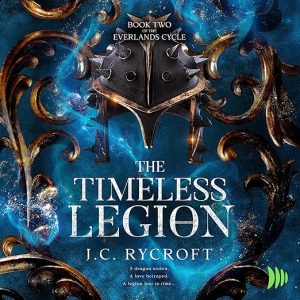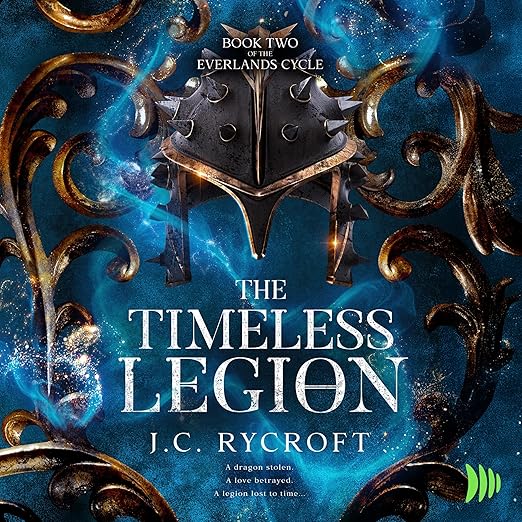
Des has lost her dragon, her last sanctuary and most of her self-respect before this audiobook has finished introducing her. The sellsword at the center of The Everlands Cycle opens volume two betrayed again by an ex-lover, separated from her bonded dragon Squid, and finding her only comfort at the bottom of a glass of ale, or nine. She cannot simply drink herself out of the problem, because her death is exactly what the Emperor wants: it would free him to bond with Squid himself and use the dragons' mastery of time to stop dying. Sixteen hours and forty-six minutes later, the question of whether she gets the dragon back has turned into a much larger question about who owns history.
Our Take on The Timeless Legion
DK F. reached for Game of Thrones to describe the worldbuilding, which is the kind of comparison that usually means very little and here means something specific. The scale is imperial rather than local, the political stakes involve conquest rather than a single villain's grudge, and the detail work is dense enough that DK F. singled it out ahead of plot and character both. That density is real. Ascelin, the militarized border Des has to cross, the machinery of permission and paperwork that governs who travels where, and the theology of a ruler who wants to become immortal all get worked out rather than gestured at.
Voice is what keeps all of that from turning into homework. The same response praises the banter as sassy and witty, and it is doing structural work, not decorating. Des is a self-sabotaging drunk with a broken heart and a stolen dragon, and the comedy is how the book survives its own bleakness. Rycroft also builds the plot around a genuinely unusual central device: a rescue that requires the protagonist to pass as the man she could not marry, which turns an infiltration into a much more uncomfortable examination of the life she declined.
The Strengths
An August 2024 notice from TrpnTggr names the effect that made me keep going: the story pulls you in several directions at once, and the characters visibly change under the strain. Growth is the right word for what happens to Des across this volume. She starts at her lowest, and the recovery is neither quick nor linear, and the book is patient enough to let a bad decision stand for several chapters before its cost arrives. That patience is what the long running time buys. Recovery arcs in fantasy are usually compressed into a montage between set pieces. This one gets chapters, and a listener is asked to stay in the room for the stretches that are neither heroic nor entertaining.
Katherine Littrell is the only name attached to the reading, and the casting question this book raises is worth naming plainly. Des narrates her own disintegration, spends a substantial stretch presenting as a man she is impersonating, and holds a wordless bond with a dragon that has to register as a relationship rather than a plot token. That is three distinct registers for one performer to hold across a very long recording. The page names no second voice and no director, so how many of those registers a listener actually gets is something the product page cannot answer.
Bonding is the emotional engine here, and it is handled better than the genre average. Squid is not a mount, a weapon or a mascot. The separation reads as grief, and every practical decision Des makes about the border, the Emperor and her old friend runs through that grief first. Listeners who came to fantasy for animal companion stories and left disappointed by how disposable those companions usually are will find this one takes the premise seriously.
Before You Commit to The Timeless Legion
One content warning in the record deserves passing along verbatim in substance. TayTay, who otherwise enjoyed the book enough to buy the sequel immediately, cautions anyone squeamish about stomach trouble to think twice, having never encountered a character who is nauseous or vomits this often. Everything sets Des off, and the response notes that the pattern extends into scenes where it is least expected. Read on a page, that texture is skippable. Delivered aloud over sixteen hours, it is not, and it is the single most useful piece of buying advice on the page.
Two structural cautions follow. The page files this under an identity category while carrying no tags at all, so a buyer gets a classification and no description of what kind of romance sits inside a story the copy sells purely on magic, mystery, dragons and betrayal. And the entire written record was filed before the December 2024 recording existed, in a vocabulary of pages, reading and typing, so an average of 4.6 built from a hundred and ninety-seven ratings is a verdict on the text rather than on this performance.
Recommended For
Issy W describes the experience as enjoyable, stressful and interesting in equal measure, notes that the darkness of the opening gives way to something better, and rates this volume stronger than the first. That is the profile of the ideal listener: somebody already invested, willing to sit with a protagonist at her worst, and untroubled by the fact that Issy W also confirms the ending is another cliff, as expected of a trilogy.
Hesitation makes sense for two kinds of buyer. Anyone shopping the identity category for representation will find the page unhelpful, since the tag list is empty and the description sells the book on dragons and betrayal without saying a word about who Des loves, which leaves the classification doing work no classification can do. And anyone who wants a fantasy that treats time travel as a puzzle box should know that the temporal material here is political before it is mechanical. The Emperor wants the dragons' relationship to time because it makes him unkillable and then makes him unstoppable, and the book is far more interested in that appetite than in the paradoxes it implies.
Newcomers should start at volume one. The page does not name it, does not give a volume count for The Everlands Cycle, and the opening chapters assume you know exactly what Des lost and who took it. Anyone who needs a self-contained arc, or who has run out of patience with series that end mid-fall, should wait until the run is complete. Volume three is where this one is heading, and the book makes no secret of it.
- Narration: Katherine Littrell is the only voice credited, carrying a first-person collapse, an impersonation and a wordless dragon bond across a very long recording
- Themes: a bonded dragon stolen, an emperor chasing immortality through mastery of time, self-destruction and slow recovery
- Mood: Bleak at the start, propulsive and often very funny after it
- Verdict: A dense, emotionally serious second volume that earns its length, provided you have read the first and can tolerate a cliffhanger.
A Few Questions About The Timeless Legion
Does the audiobook work as a standalone, or do I need book one?
Start with book one. This picks up after a betrayal, a theft and an exile that all happened previously, and the opening chapters treat that history as known. The page names neither the first volume nor a total for The Everlands Cycle, which makes assembling the series harder than it should be.
Who is Squid, and how central is the dragon to the plot?
Squid is Des's bonded dragon, taken before the story starts, and the whole plot is the attempt to get the dragon back. What the description does not say is how much of the book the two spend apart, which matters, since that separation is the source of both Des's grief and her drinking.
Is the romance central to this audiobook or a subplot?
A love betrayed opens the description, and an ex-lover sits at the root of Des's situation, and one March 2024 response frames the whole arc around learning to trust and letting love guide it. Expect romance woven through a rescue plot rather than a courtship with a dragon war attached.