Quick Take
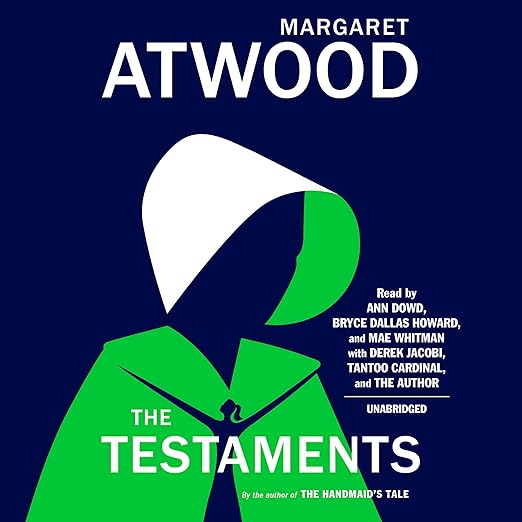
- Narration: Ann Dowd is a staggering choice – her embodiment of Aunt Lydia is among the most compelling narrator performances in recent literary audiobook history.
- Themes: Institutional rot and resistance from within, women’s testimony, complicity and conscience
- Mood: Tightly plotted and urgent, with a gathering sense of historical inevitability
- Verdict: A worthy sequel that answers The Handmaid’s Tale’s most haunting questions – and Ann Dowd’s narration transforms Aunt Lydia’s sections into something close to essential.
I came to The Testaments the way I suspect many people do: with a complicated relationship to The Handmaid’s Tale and a certain defensiveness about sequels to books that have become cultural monuments. Margaret Atwood does not need my protection, obviously – she is one of the most formally precise novelists working in English, and she received the Booker Prize for this book, which she shared with Bernardine Evaristo’s Girl, Woman, Other. But the question that every sequel to a perfect work must answer is whether it adds something that the original could not contain, or whether it merely extends a franchise. The Testaments, I am pleased to report, has a genuine reason to exist.
The book arrives more than fifteen years after the events of The Handmaid’s Tale and is organized around three testimonies. Two come from young women who grew up entirely within Gilead’s first generation, shaped by its structures without the lived memory of what came before. The third – the one that gives the audiobook its greatest charge – belongs to Aunt Lydia. I spent the first part of this listening experience on an overnight train, unable to stop, which is a significant feat for a book I was approaching with some skepticism.
Our Take on The Testaments
Atwood’s structural decision to give Aunt Lydia interiority is the most significant move in the book, and it is a brave one. In The Handmaid’s Tale, Lydia is the system’s most effective enforcer – the woman who trains other women into submission, whose voice becomes synonymous with the language of oppression. Giving her a first-person testimony, a complex past, and a moral life that runs alongside and beneath her institutional role transforms her from a symbol into a person. This is harder than it sounds; it requires Atwood to make the reader understand without requiring them to forgive, and she does it with characteristic precision.
The two younger narrators – one raised within the Wives’ system, one raised outside Gilead and recruited into resistance – provide the novel’s more conventional plot engine, and that engine is effective. The plotting in The Testaments is tighter and more explicitly suspenseful than The Handmaid’s Tale’s dreamlike structure, which will satisfy readers who found the original’s ambiguity frustrating while perhaps disappointing those who loved its uncanny, suspended quality. One reviewer describes it aptly: this book is different in the same way that filet mignon is different from popcorn. Both are excellent. They are not the same experience.
Why Listen to The Testaments
Ann Dowd is the reason to listen to this book rather than read it. Her narration of Aunt Lydia’s testimony is a masterwork of controlled performance – the same voice that gave Dowd an Emmy for her television portrayal, now working through Atwood’s prose with a precision and emotional depth that is genuinely startling. Dowd finds registers in Lydia’s voice that reveal the character’s suppressed conscience without ever softening the character’s genuine menace. The sections she narrates are the most intense listening experience in the audiobook, and the contrast with the younger narrators’ sections creates a structural rhythm that reinforces the book’s thematic argument about how systems are built by the complicity of those who believe they have no choice.
What to Watch For in The Testaments
Listeners who are particularly attached to the television series adaptation of The Handmaid’s Tale will find that Atwood incorporates elements of the show’s expanded canon into the novel – one reviewer notes specifically that this sequel incorporates the TV series as canon, which is an unusual authorial move. For those who know only the original novel, some references in The Testaments may require a moment of adjustment; the world has been extended beyond what Atwood’s first book established.
The novel’s ending is more resolved than The Handmaid’s Tale’s famously ambiguous conclusion, which may feel either satisfying or reductive depending on what you valued in the original. Atwood gives hope more room here – a Japanese reviewer notes the progression from The Handmaid’s Tale, where hope is barely visible, through to The Testaments, where it is clear – and that shift changes the emotional texture of the world.
Who Should Listen to The Testaments
Readers who have experienced The Handmaid’s Tale in some form – novel, TV series, or both – will find the most in this book. The Testaments can technically be read independently, but the emotional resonance of Aunt Lydia’s testimony, and the force of seeing Gilead from the inside of its own ideological structure, depends on the reader carrying some prior knowledge of the world. Ann Dowd’s narration makes this the preferred format for anyone who wants to spend time with Lydia’s sections specifically – it is not a neutral performance but an interpretive one, and it enriches the text considerably. Newcomers to Atwood would be better served starting with The Handmaid’s Tale and arriving here in sequence.
Frequently Asked Questions
Can The Testaments be listened to without having read The Handmaid’s Tale first?
Technically yes, but the experience is substantially diminished. The weight of Aunt Lydia’s character and the significance of Gilead’s structures depend on prior knowledge of the original novel or the television series. Atwood treats this as a companion work, not a fully standalone entry.
Is Ann Dowd the sole narrator, or does the book use multiple voices?
The audiobook uses multiple narrators to match the book’s three-testimony structure. Ann Dowd handles Aunt Lydia’s sections. The multi-narrator format mirrors the documentary structure of the novel and is part of what makes the listening experience work as well as it does.
Does The Testaments resolve the ambiguous ending of The Handmaid’s Tale?
It provides considerably more resolution, yes. Where The Handmaid’s Tale ends in suspension and uncertainty, The Testaments moves toward something more hopeful and explicitly plotted. Whether that feels satisfying or like a reduction of the original’s power depends on your relationship with ambiguity.
How does The Testaments handle the fact that it incorporates the Hulu TV series continuity?
Atwood writes the novel so that the TV series’ expanded world is treated as canonical. Readers who know only the original novel will notice some elements that were not in Atwood’s first book; fans of both the novel and the series will find the convergence deliberate and integrated rather than awkward.