Two hundred and nineteen pages is what this listing records for a three and a half hour audiobook, sitting next to a ten-character identifier that reads as an ISBN-10 and a full ISBN-13 one field below it, tucked behind an invisible formatting mark. None of that describes a recording. All of it describes a printed book that a catalog import stapled to this page, and the effect on a buyer is immediate: the metadata will not tell you what you are about to download, and the first line of the copy tells you something a skimming buyer will miss.
Despereaux Tilling gets one clause here: a brave mouse banished to the dungeon for speaking with a human. Kate DiCamillo's book won the Newbery Medal and has since appeared in twenty-three languages, with more than two million copies in print according to this page's own copy. That is the book most people mean when they say the title out loud, and it is the reason the title has the pull it has. It is not, however, the book this particular description is selling.
Roscuro is the rat who loves light and soup and is exiled into darkness anyway, and the pairing with Despereaux is the whole moral architecture: two creatures punished for wanting something outside their assigned nature. Pea is a princess held prisoner by her father's grief. Mig is a servant girl who longs to be a princess and is forced to serve the jailer instead. Four braided strands, one credited reader, and a version of the story built for the length of a family evening.
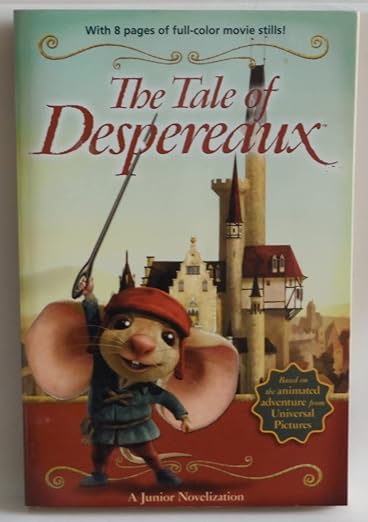
Universal Pictures is named twice in this description, and its opening clause says what the product actually is: a lively junior novelization of the film. Not the Newbery book. A tie-in written to match the movie, complete with an eight-page full-color insert of stills lifted from it. An entry headed 'Fun sneak peek at movie' puts the situation more generously and more accurately than the marketing manages: children should read the classic original first, and this is a fun, easy version of what the film shows them.
What Makes The Tale of Despereaux Worth Hearing
Children who have seen the film and want more of it are the honest audience for a novelization, and nothing about that is shameful. The story keeps its shape here: an unlikely hero, a rat who wants the wrong things, a grieving castle, and the proposition the copy states outright, that it takes only a little light to show the truth. The runtime works out to a manageable evening or two for a young listener, which at this age matters considerably more than fidelity to the original prose.
Soup and light are what Roscuro is said to love, and the description makes a point of both before it makes a point of anything else. That is a good sign for a young audience: the story's motives attach to objects rather than to abstractions, which is exactly what holds a child's attention across a short drive. DiCamillo's central claim survives into this version intact and is quoted in the copy almost as a slogan, that what you look like does not equal what you are.
Mig's thread carries the sharpest edge in the story, and it is also the one a novelization is most likely to sand smooth. A servant girl who longs to be a princess and is forced to serve the jailer instead is a genuinely cruel setup for a children's book, and how much of that cruelty survives here is the question the description declines to answer. Bravery, forgiveness and redemption are the three words the copy chooses, in that order, and they suggest a softer landing than the original arranges.
Things to Know Before Starting The Tale of Despereaux
Condition and edition are what this column mostly argues about, and one response gets to the heart of the confusion: a buyer who ordered it quickly for a child's school discovered that an entirely different adaptation had been created, with a story line matched to the movie. That is not a complaint about quality. It is a complaint about identity, and the description does answer it, in the very first clause, for anyone who reads that far before spending.
Delivery, packaging and price account for three of the five written responses on this page. None of those three concerns the story, the reading or the recording; they concern what arrived in the box and what it cost to get it there. When most of a column is about logistics, the star average stops being a measure of the work and turns into a measure of a supply chain, which is a different thing to buy on.
Graeme Malcolm takes the whole cast alone: mouse, rat, princess, servant, jailer. Four points of view inside a runtime this short is a lot of switching, and a young listener will follow it or lose it depending almost entirely on how distinct those voices turn out to be. That is the real technical demand of this recording, and a sample will tell you more about it in ninety seconds than any description can.
Who Kate DiCamillo Is Writing For
Families who watched the film and want the story again on a drive have exactly the right product here, and the compact runtime is a feature rather than a compromise. Buy it for a child sitting between the movie and the real book, as a bridge rather than a substitute for it. Reluctant listeners in particular do better with a version whose events they can already picture, because the pictures do the work that concentration would otherwise have to do.
Parents shopping for the Newbery winner should stop and read the first clause of the description before spending anything at all. This is not the buy for anyone who wants Kate DiCamillo's actual prose, and it is not the buy for a classroom assignment, where the difference between the novel and the tie-in is precisely the thing being assessed. The confusion is easy to fall into and expensive to discover on the far side of a deadline.
Buy the tie-in on purpose or not at all, and let the metadata serve as a warning rather than an obstacle: a page carrying a page count, an ISBN and a photo insert is a page describing a printed object first and a recording second. The story underneath all of it is still good, and the film it follows is still worth an afternoon. Order the Newbery book instead if what you wanted was the one that won the medal.
The Short Version
- Performance: Candlewick Press credits one reader for a text written to follow the film rather than the novel, a simpler job than DiCamillo's own prose would have set.
- What it covers: unlikely heroes, exile and forgiveness, light against darkness, a kingdom held together by grief
- Feel: Warm, brisk, storybook-simple
- Our call: Fine as a film companion for younger listeners, and the wrong purchase if you came for the Newbery novel.
Good to Know
Which version of the story is on this audiobook?
The junior novelization of the Universal Pictures film, stated in the opening clause of the description rather than buried inside it. It follows the movie's story line, which differs from Kate DiCamillo's Newbery Medal novel. Candlewick Press dates this edition to October 2008, and the copy names both the studio and the licensing arrangement behind the title.
How long does the audiobook run, and who reads it?
Graeme Malcolm is the voice, and the running time is three hours and thirty minutes, short enough for one long evening or a couple of school runs. One reader handles Despereaux, Roscuro, the princess Pea and the servant Mig, so listen in the sample for whether those four stay clearly apart from one another.
Why does the listing show a page count and an ISBN?
Because a print record has been welded onto this page. The identifier in the product slot runs ten characters and reads as an ISBN-10, a full ISBN-13 sits in the field below it, and a page count appears where no recording would have one. Read those fields as belonging to the paperback rather than to the file.
Is this suitable for a school reading assignment?
Only if the assignment names the tie-in specifically. The description advertises an eight-page insert of film stills and a plot that follows the movie instead of the novel, so a teacher expecting the Newbery text will not receive it. For classroom work, buy the original novel and keep this one for the family rewatch afterward.