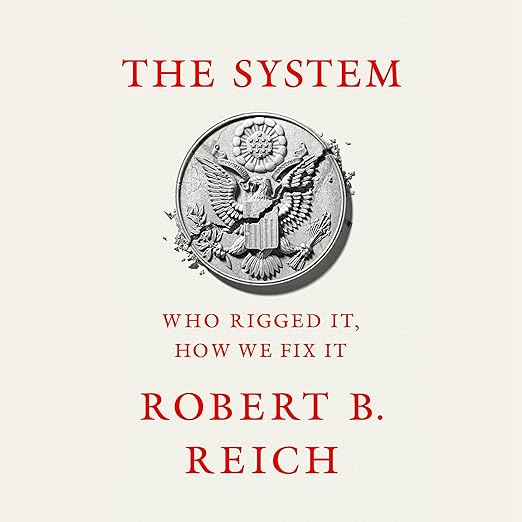
Authorship and narration belong to one person on this record, which is worth settling before you spend six hours and seven minutes inside an argument this pointed. The audiobook is listed under two words, The System, while the written column below it supplies the rest of the name: Who Rigged It, How We Fix It. Those five words change the pitch, since they promise a diagnosis and a repair rather than one more tour of American discontent. Robert B. Reich delivers both in his own voice, so every emphasis you hear belongs to the person making the case.
What Robert B. Reich Delivers
Reich builds the whole book on one substitution. Stop arguing about the free market against government, he says, and start asking who holds the power to write the rules that both of them run on. May 1, 2020 carries the earliest response on the page, and it states the premise more bluntly than the copy does: over the last forty years the system has been captured by the ultra-wealthy, with the top tenth turning government, finance and the economy to its own advantage while the bottom ninety percent gained almost nothing. Whether you agree is a separate matter. What decides a listening purchase is that this argues a single thesis end to end instead of surveying several.
Myths are the organizing device. The description names five that Reich wants retired, meritocracy, national competitiveness, corporate social responsibility, the free market and the political center, and each one gets the same interrogation, which is to ask who benefits from believing it. That structure suits listening. Five discrete objects, taken in order, each with its own examples, and no build toward a reveal, so a week between sessions costs you nothing. The cost is a shape that repeats by design, and if the second myth does not convince you, the third is unlikely to work differently.
What Makes The System Worth Hearing
Oligarchy is the word the copy commits to, without scare quotes or qualifiers, and the blunt declarative pitch of that sentence runs through everything after it. Wealth and power combined to install an oligarchy and undermine democracy: that is stated as fact, then supported, rather than floated as a provocation. For a listener the payoff is speed. Just over six hours is two evenings, and the case arrives without the throat-clearing that books of this kind often spend a full hour on before reaching a claim.
Power gets defined operationally instead of philosophically, which is exactly why the material travels in audio. Who writes the rules, who enforces them, who benefits: three questions applied to the same material again and again, so you can lose half a minute to a passing siren and still know where you are in the chain. Self-narration reinforces that. The stresses are authorial rather than interpretive, which matters more in polemic than in fiction, because a polemic depends on which half of each sentence gets the weight.
Ordinary citizens are the audience Reich says he wrote for, and the August 31, 2025 response takes him at his word, arguing that if enough ordinary people read the book they would see how the system is rigged against them and understand their own role in unrigging it. That is the register throughout: civic rather than academic. Listeners after footnoted economics have the wrong shelf. Listeners who want an argument they can carry into a conversation the same evening are being served precisely.
Things to Know Before Starting The System
Counting is the first problem the page hands you. The average shows 4.7 and the ratings counter shows two, and no pair of whole-star votes averages 4.7 by any arithmetic. Meanwhile five written responses sit under that counter, four at five stars and one at four, filed between May 2020 and January 2026. Whatever the badge is measuring, it is not the column you can read. Ignore the number, read the five entries, and note that they agree with the thesis more consistently than a two-vote average could ever express.
Pages turn up where you would not expect them. The January 19, 2023 four-star describes a 225-page book broken into three parts and places Reich at the Goldman School of Public Policy at Berkeley with seventeen books behind him. Do the division before it worries you: 225 pages across six hours and seven minutes is an ordinary unabridged pace, so the figure corroborates a complete reading rather than undermining it. That entry also hands you the only structural map on the page, since the description never mentions parts or sections at all.
Dating deserves more attention here than on most nonfiction. Release was March 24, 2020, so the illustrations stop before nearly everything that has happened since, while the newest responses were filed in January 2026. Almost six years separate the argument from its most recent readers, who are treating it as current. The structural claim may well hold. The examples are of their moment, and anyone expecting the last two election cycles inside the analysis will find the analysis older than the news it gets applied to.
Who Should Pick Up The System
Sympathizers get the most from it, and the January 15, 2026 five-star shows what that looks like: a listener who came away feeling the shape of the last forty years had been explained, insisting the story is not about right against left but about the one or two percent controlling the outcome. Anyone who wants the opposing case argued at equal strength should look elsewhere, because Reich states rival positions in order to dismantle them. That is what an argument book does, and pretending otherwise would only waste the listen.
Two cautions before you buy. The first is the ending, which arrives as an invitation to reclaim power and remake the system rather than as a program with steps, so a listener hunting policy mechanics will feel the last stretch thin out. The second is repetition of a different kind: the description points to Saving Capitalism and The Common Good as the author's earlier books, and if you have already worked through those, this compresses ground you have covered. Come to it new and it is one of the most efficient listens in the category.
Before You Press Play
- Voice: The author holds the narrator credit, so this is a case delivered in the voice of the person making it rather than an interpretation of it.
- Big ideas: Captured rulemaking and oligarchy, the meritocracy myth, civic power and how citizens might reclaim it
- Atmosphere: Direct, impatient, plainly civic
- Worth it?: Six efficient hours of one thesis argued hard, best if you want the case sharpened rather than tested.
Is this audiobook useful outside the United States?
The subject is American throughout: American rulemaking, American wealth concentration, the forty-year American story the responses keep returning to. As comparative material for a reader elsewhere it works well enough, but it will not map onto another country's institutions, and the copy makes no claim that it should.
Does the audiobook lose anything without charts or tables?
The description sells an argument rather than a data presentation, and the five myths it works through are conceptual, so nothing implies figures you would need to see on a page. Listeners who want documented series and tables should plan on a companion text; this is a spoken case, not a reference volume.
Is the audiobook angry in tone?
Impatient rather than angry. The copy calls it an urgent analysis and describes clarity and passion as the author's characteristic register. The January 16, 2026 response describes coming away feeling empowered and educated, which fits: the delivery is pressing rather than furious, and the closing move is an invitation.