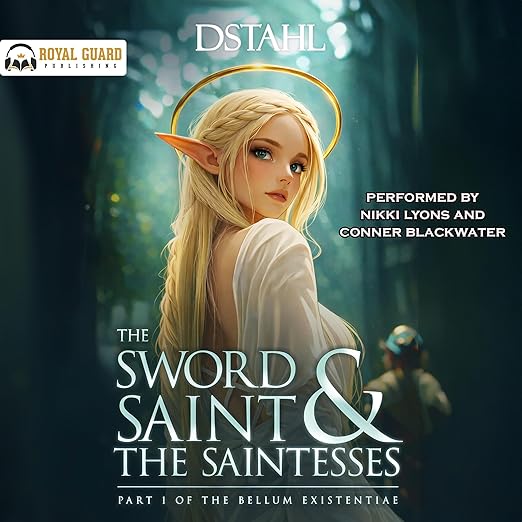
Quick Take
- Narration: Nikki Lyons handles the dense action choreography and multi-realm scope with steady authority, keeping 15-plus hours of intricate sword-combat sequences from blurring together.
- Themes: Second chances and the weight of memory, the slow build of trust between reluctant companions, sacrifice and the cost of foreknowledge
- Mood: Propulsive and densely detailed, with flashes of genuine emotional weight
- Verdict: A strong opening entry for readers who want their progression fantasy grounded in tactical swordplay and relationship-building rather than stat-screen theatrics.
I picked this one up on a Tuesday evening when I was deep in a streak of second-chance fantasy novels, testing where the genre’s current ceiling actually sits. The Sword Saint and the Saintesses arrived on my radar through a reader recommendation that specifically flagged it as unusual among LitRPG entries because its protagonist’s power is not combat strength or raw magic but time itself, wielded as a curse rather than an advantage. That framing caught my attention immediately, and fifteen hours later I understood why the recommendation came with that qualifier.
Aaron Hueber is not a power fantasy protagonist in any conventional sense. He has lived through the destruction of reality. He has watched the Saintesses of Space and Life fall. He has failed. The story begins with him restarting, memories intact, carrying the specific grief of someone who knows exactly what is coming and is not certain he can stop it again. D. Stahl’s choice to open on that psychological weight rather than on Aaron’s competence is what separates this from a significant portion of the field.
The Regression Premise Done With Unusual Care
Regression narratives are everywhere in LitRPG and isekai fiction right now, and the genre’s trap is always the same: the protagonist’s foreknowledge becomes a cheat code that drains tension from every scene. Stahl avoids this with considerable skill by making Aaron’s second chance less about exploiting what he knows and more about understanding what he missed. One reviewer described it as a story about spending a second life gathering strength not just in magic and swordplay but in the quiet arts: perception, persuasion, and understanding the world as he never had before. That description is accurate, and it is the source of the book’s best scenes.
The world-hopping architecture of the series, operating across what the synopsis describes as realms and realities, gives the story a scope that feels genuinely earned rather than gratuitously expansive. Stahl does not use the multi-realm premise to pad the narrative. Each location serves the emotional and tactical arc of Aaron learning to build the team he failed to build the first time.
What the Stats-Light System Gains and Loses
The publisher and author are upfront that this is a stats-light LitRPG, and that choice has real consequences for the listening experience. Readers who come to the genre specifically for the satisfaction of numbered progression, skill trees, and level-up notifications will find less of that here than they might expect. What the stats-light approach buys instead is a sword-combat system that feels physically grounded. Multiple reviewers flag how detailed and specific the fight choreography is, noting that the blow-by-blow commentary can occasionally tip into density that requires concentration to follow. As an audiobook, that means Nikki Lyons is doing real work keeping the spatial logic of each sequence legible.
One four-star reviewer noted a pacing tension between the fast combat sequences and the longer expository stretches, describing the transitions as occasionally jarring. That is a fair observation. The book moves between rapid-fire action and detailed world-explanation in a way that is not always smooth. It did not break my engagement, but listeners who prefer even pacing should know it is there.
Nikki Lyons and the Challenge of a Grief-Weighted Protagonist
Lyons performs Aaron with a measured gravity that suits the character’s accumulated weariness. This is not a protagonist who is brash or excitable. He has already lived through catastrophe, and Lyons communicates that emotional register without making Aaron sound flat or resigned. The supporting cast, including the Saintesses of Space and Life, get sufficiently distinct voices that the group dynamics read clearly even in extended ensemble scenes.
The romance elements, flagged by multiple reviewers as a slow-burn setup for something more developed in later entries, are handled with appropriate restraint. The explicit content warning mentioned in some reviews is, as one reader noted, not backed up by anything in this first volume. That may frustrate readers who came for it, but for the general fantasy listener it is essentially a non-issue. Lyons maintains the same tone throughout whether the scene is a blade-for-blade duel or a quieter moment of connection between characters who have every reason not to trust each other.
Best Suited for Patient Fans of Tactical Fantasy
This works well for listeners who love their progression fantasy heavy on relationship dynamics and tactical combat rather than stat optimization. If you have enjoyed series that blend cultivation elements with classic sword-and-sorcery stakes, this fits that appetite well. The free audiobook availability on Audible makes it a low-risk entry point into what is clearly planned as a substantial series.
Skip it if you find dense fight choreography tedious to follow in audio format, or if you need more consistent pacing between action and exposition. The first book covers less than a week of in-world time, which gives you a sense of how tightly packed the action is. But if the regression premise and the psychological weight of Aaron’s second chance sound like what you have been looking for in the genre, this is a confident debut that earns its enthusiastic reader base and leaves the larger war against unmaking still very much ahead.
Frequently Asked Questions
Is The Sword Saint and the Saintesses part of a series, and does it end on a cliffhanger?
It is the first book in The Bellum Existentiae series. It functions as a complete first act with its own arc, though it clearly sets up further volumes.
How stats-heavy is the LitRPG system, and will it feel like a traditional progression fantasy?
The author describes it as stats-light. There is a progression system, but it is woven into the story rather than foregrounded with constant level-up screens. Readers who want heavy number-crunching may find it lighter than expected.
Is there romantic or sexual content in this audiobook?
There is a slow-burn romance setup involving the MC and multiple companions, but multiple reviewers confirm there is no explicit sexual content in this first volume despite a content warning on the listing.
Does Nikki Lyons’s narration hold up through 15 hours of complex sword-combat sequences?
Yes. Lyons maintains consistent character voices and keeps the spatial logic of the fight scenes followable, which is particularly challenging given how technically detailed the combat writing is.