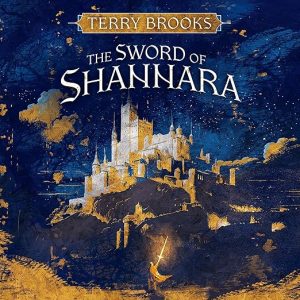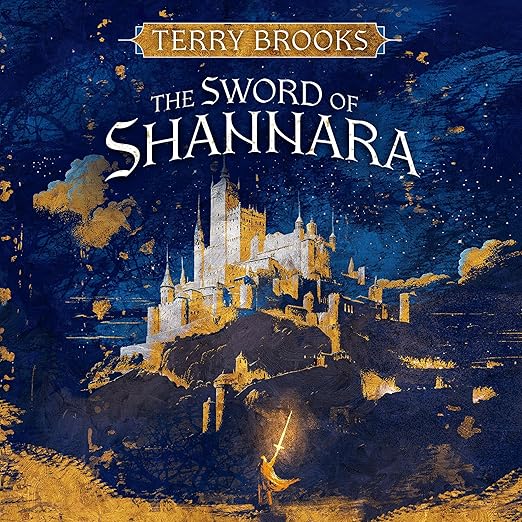
Terry Brooks published The Sword of Shannara in 1977, and it arrived as the first fantasy novel to appear on the New York Times trade paperback bestseller list. The question of whether that distinction was earned on pure literary grounds or on the strength of an audience hungry for more high fantasy after Tolkien has been argued since the first reviews appeared. What the argument obscures is this: the book worked for millions of readers, and on audio, with Scott Brick's twenty-six-hour narration, it continues to work in ways that make the audiobook format feel like a natural home for it. Brick's voice gives the sprawling world of the four lands the weight its scale demands, and the prose that some readers find derivative on the page sounds more like tradition than imitation when spoken aloud.
Where This One Lands
The Tolkien comparison is unavoidable, and one reviewer captured its texture precisely by calling this version of The Lord of the Rings pretty good. The parallels are real: a young man in a peaceful village drawn out by a mysterious figure with knowledge of an ancient threat, a fellowship assembled to carry a crucial object against a dark power, races whose cooperation is required for any hope of success. Brooks does not pretend the architecture is original. What he does is inhabit that architecture with enough specificity, the Druid Allanon's particular relationship to the Ohmsford family, the history of the Warlock Lord's previous defeat, the function of the Sword as a weapon that operates on truth rather than force, to give the familiar shape a texture that is recognizably his own.
The post-apocalyptic dimension of Shannara's world is frequently undervalued in discussions of the series. The four lands are not a secondary world built from whole cloth: they are the far future of our own world, after civilizations fell and the land regenerated into something that looks like fantasy but contains the ruins of technology underneath. This layer gives the world a specificity that pure secondary world construction does not always achieve. When Shea Ohmsford and his brother Flick are drawn out of Shady Vale by the Druid Allanon, they are moving through a landscape that has its own geological and civilizational memory, and Brick's narration gives that landscape the time it needs to register.
What Makes The Sword of Shannara Worth Hearing
Scott Brick has the kind of voice that treats twenty-six hours as a natural scale. His baritone has the controlled authority that epic fantasy narration requires, and he maintains vocal distinction across the cast without resorting to caricature. Shea Ohmsford, the half-elfin young man on whose bloodline the fate of all races rests, needs a narrator who can hold both his ordinariness and his growing awareness of what his heritage means. Brick finds that balance across the full arc, with the Allanon sequences particularly well-served by his controlled gravitas. Allanon is a Druid who carries centuries of knowledge and the weight of decisions taken in the interest of the four lands rather than any individual within them, and Brick conveys that moral complexity without theatrical artifice.
One reader who first encountered the book years ago and returned to it described the experience of rediscovery as the joy and awe of an old friend, and noted feeling once again in the embrace of something deeply familiar. That response, characteristic of a book that has genuinely held up across time for its original readers, is the most reliable guide to what this audiobook offers. Twenty-six hours is a significant commitment. Brooks asks for it not because the story is inefficient but because the world it inhabits requires that scale to feel real and consequential rather than sketched.
What Gives Us Pause
Listeners who come to this title expecting the narrative innovation of later fantasy literature will encounter a book that reads more like an inheritance than a departure. Brooks is working within the high fantasy tradition rather than against it, and the pleasure of the novel is in how well he inhabits that tradition rather than in how he subverts it. The pacing is deliberate by contemporary standards: Brooks allows the world to unfold at the speed required for the reader to feel its weight, and the audiobook format is a natural fit for that approach. The Allanon-Shea dynamic is the emotional spine of the first book, and Brick's narration of their exchanges, particularly the passages where Allanon's tendency to withhold information generates friction with the party's need for clarity, is where the audio performance adds the most value over silent reading.
The racial politics of the four lands, with their distinct peoples and long histories of conflict and uneasy alliance, are drawn without nuance by contemporary standards but with more awareness than the era's fantasy typically managed. The Elves, Dwarves, and other races are not decorative: they are political actors with interests of their own, and the coalition-building required to face the Warlock Lord is itself a narrative thread that gives the epic scale a structural purpose beyond the hero's individual journey.
The Right Listener for The Sword of Shannara
Listeners new to epic fantasy who want to experience the tradition as it was established will find this audiobook a foundational entry. Readers who have encountered later Shannara novels through the television adaptation or other series entry points and want the original will find this twenty-six-hour listen the complete origin story of everything that follows. Those who require contemporary fantasy's self-awareness about genre tropes should approach this as a document of the tradition rather than a commentary on it. Tolkien readers who want to extend their engagement into the next generation of the tradition will find Brooks a respectful inheritor of the form who brings his own world-specific concerns to the work, even if the structural bones are recognizable.
Good to Know
How does Scott Brick's narration handle the large cast and epic scope of this audiobook?
Brick maintains vocal distinction across the main characters without resorting to exaggerated voice acting. His measured authority suits Brooks's deliberate pacing and the twenty-six-hour runtime without flagging. The Allanon sequences in particular benefit from Brick's controlled gravitas.
Is The Sword of Shannara audiobook too derivative of Tolkien to be worth listening to on its own terms?
The structural parallels to The Lord of the Rings are genuine and have been acknowledged by readers since publication. Brooks inhabits the high fantasy tradition with enough world-specific detail, including the post-apocalyptic four lands and the Sword's unusual mechanism, to produce an experience that is familiar in shape but specific in texture. Listeners willing to engage with tradition rather than demanding innovation will find it rewarding.
At 26 hours, is The Sword of Shannara audiobook paced in a way that sustains listener engagement throughout?
The pacing is deliberate rather than propulsive by contemporary standards. Brooks builds his world incrementally, and the audiobook format suits this because Brick's narration gives the accumulated detail the time it requires. Listeners expecting fast-moving action from the first hour will need to adjust to the epic's slower rhythm.