Quick Take
- Narration: Andrew Tell manages a demanding multi-POV narrative with consistency, though the emotionally quieter moments between Misaki and her son land with more power than the battle sequences.
- Themes: Family loyalty under political lies, the weight of a warrior tradition, suppressed identity
- Mood: Slow-burning and devastating, with bursts of kinetic fantasy combat
- Verdict: An emotionally ambitious standalone fantasy that earns its payoff in the middle third, even if the final act loses some of the focus the opening so carefully builds.
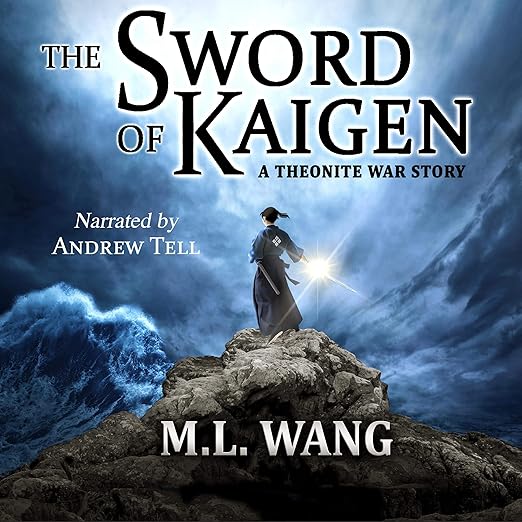
I started The Sword of Kaigen on a grey afternoon when I wanted something that felt serious, and I was roughly three hours in before I realized I had stopped noticing the household around me. M. L. Wang’s debut has the reputation of being the kind of book that sneaks up on you, and that reputation is accurate. The first portion requires patience: we are introduced to Misaki, a former fighter now living as a housewife in the frozen Kusanagi Peninsula, and her fourteen-year-old son Mamoru, who is being raised to fulfill the warrior destiny of the legendary Matsuda family. The setup feels domestic and slightly constrained, and then something shifts.
What shifts is the arrival of an outsider who begins asking questions about the empire’s history. The empire of Kaigen has sold its citizens a particular story about peace and superiority, and that story, it turns out, is a lie. The moment when Mamoru begins to understand what has been hidden from him is the hinge on which the entire novel turns, and Wang handles it with a precision that made me put down what I was doing to just listen.
Our Take on The Sword of Kaigen
This is fundamentally a book about two people: Misaki, who buried her former self when she married into the Matsuda family, and Mamoru, who is about to discover that the world he was bred to defend is not what he was told. The dual-POV structure is well-managed for most of the runtime. Misaki’s chapters carry the emotional weight; Mamoru’s carry the mythological scale. When Wang brings them into collision, the result is exactly as devastating as several reviewers describe.
One reviewer who read Stephen King’s Wizard and Glass as a benchmark for emotional impact in fantasy writing places The Sword of Kaigen in that company, which is high praise and not entirely unearned. The battle sequences are genuinely cinematic, but what distinguishes this book from most military fantasy is that Wang is more interested in what the fighting costs than in the spectacle of the fighting itself. A single quiet line of grief, as one reader puts it, often carries more weight than pages of description. That is exactly the calibration that separates literary fantasy from the kind that is only exciting in the moment.
Why Listen to The Sword of Kaigen
Andrew Tell’s narration suits the material. He handles the Japanese-inflected naming and cultural detail without over-stylizing it, and his voice for Misaki has a restrained quality that works well for a character who has spent years suppressing everything she once was. The audiobook runs to just over twenty-four hours, which is long, but the pacing across that runtime is generally well-managed. The slow first act plays better on audio than in print for some listeners, because Tell’s reading does not let you skim.
The worldbuilding is detailed but unobtrusive. Wang does not pause to explain her elemental magic system; it emerges through action and cultural practice in a way that feels natural rather than instructional. The Kusanagi Peninsula, with its frozen landscape and rigid social codes, is rendered with enough specificity to feel fully inhabited.
What to Watch For in The Sword of Kaigen
Two readers separately note that the final act does not quite sustain the power of the middle section. One calls out the Robin subplot as a distraction that feels underdeveloped relative to how much time it occupies in the closing chapters. I think this is a fair observation: the book spends most of its energy building toward a particular emotional crescendo, and the aftermath is handled less confidently than the buildup. It is not a ruinous flaw, but it leaves the ending feeling slightly less inevitable than everything that precedes it.
The slow opening is worth acknowledging honestly. If you go in expecting immediate momentum, you will be disappointed for the first three or four hours. The investment is real and it pays off, but the patience requirement is genuine rather than negligible.
Who Should Listen to The Sword of Kaigen
Listen if you want fantasy that prioritizes family psychology and the emotional cost of violence over spectacle, and if you can give the opening section the time it needs to build its foundation. Skip if slow-burn family drama is not your mode regardless of the fantasy setting, or if you need the final act to deliver with the same precision as the middle. This is a book that is almost great, and almost great is still well worth twenty-four hours of your time.
Frequently Asked Questions
Is The Sword of Kaigen a standalone or part of a series?
It is a standalone war story set in M. L. Wang’s Theonite universe, though other books in that universe exist. You do not need to have read anything else to follow this story, and it resolves fully on its own terms. Several readers express disappointment that there is not more content in this particular corner of the world.
How explicit is the violence in this audiobook?
The battle sequences are intense and the emotional consequences of violence are depicted with unflinching honesty. It is not gratuitous in a horror sense, but the book does not soften the cost of combat. Listeners sensitive to scenes involving family tragedy should be aware that the middle section is genuinely harrowing.
Does Andrew Tell’s narration handle the Japanese-influenced cultural elements respectfully?
Tell navigates the naming conventions and cultural references without over-stylizing or reaching for stereotypical Japanese voice affectations. The performance is grounded and treats the culture as a fictional construct worthy of straight delivery rather than as a signifier to be performed.
Does the dual POV between Misaki and Mamoru work equally well, or does one character’s storyline carry more weight?
Most readers find Misaki’s chapters more emotionally resonant, partly because her arc involves recovering a suppressed identity. Mamoru’s chapters carry the political and mythological discovery plot. They complement each other, but if you are drawn to the book for its emotional depth, Misaki is the center of gravity.