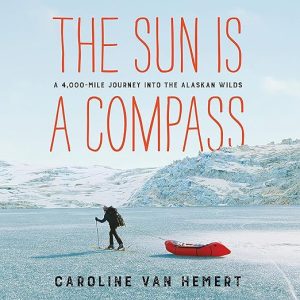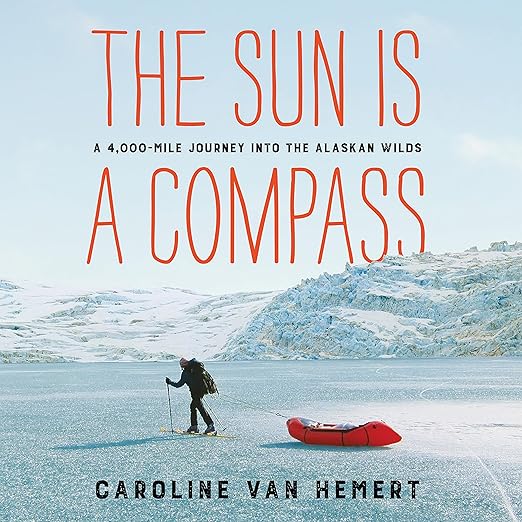
When an ornithologist decides that studying chickadees under controlled laboratory conditions has stopped being enough, the response is rarely to plan a 4,000-mile wilderness journey from the Pacific rainforest to the Alaskan Arctic using only human-powered transport. For Caroline Van Hemert, it was the only response that made sense. The audiobook edition of The Sun Is a Compass poses a question that takes a full nine hours to answer properly: what does it cost to remember why you cared about something in the first place, and is it worth paying?
The opening conceit of the book, that Van Hemert felt stifled and hollowed by graduate school in a way that threatened her relationship with the very subject she had devoted her life to, is familiar enough as a setup. The execution is not familiar at all. She and her husband Pat set off in March 2012 with a route that would demand rowboat, ski, foot, raft, and canoe travel across some of the most unforgiving terrain on the continent. The result is a piece of adventure writing that earns the genre by delivering on its physical and emotional promises simultaneously.
Our Take on The Sun Is a Compass
Van Hemert has both a PhD in biology and an MA in creative writing, and the audiobook reflects both credentials without leaning too hard on either. The science surfaces in the precision of her observation, the way she notes not just that birds are present but what their presence means within the particular ecosystem they are moving through at that moment. The writing surfaces in the quality of the prose and in the structural choices she makes about when to slow down and when to accelerate through sections of the journey.
One reviewer made the combination of credentials explicit, noting that the dual background shows in 'how fun and rewarding this book was to read.' That observation is accurate. Van Hemert is not primarily performing expertise at the reader, and she is not primarily performing emotion either. She is doing something harder, which is being genuinely present in the account in a way that her scientific training might easily have suppressed.
Xe Sands is the narrator of the audiobook edition, and the casting is well-matched to the material. Sands has a voice that understands landscape prose, and she does not rush through the descriptive passages that give the book its particular texture. The midnight silhouette of migrating birds against the moon, the steamy breath of caribou at close range, the physical and psychological toll of traveling by ski in conditions that want to kill you: these require a narrator who can sustain pacing across long stretches without losing the listener's attention, and Sands delivers that. The nine-hour runtime feels earned rather than padded.
The book won the 2019 Banff Mountain Book Competition in the Adventure Travel category, which tells you something about how it was received within the community best positioned to judge its accuracy and its ambition. The award is not decoration. It reflects genuine achievement in a form with rigorous standards.
What to Watch For in The Sun Is a Compass
The book includes her husband Pat as a significant presence throughout, and one reviewer noted a wish that Van Hemert had written more about the relationship and its dynamics under extreme duress. That is a fair observation. The relational dimension is present but treated with restraint, and readers expecting a book about what wilderness travel does to a partnership will find that thread thinner than the landscape and natural history writing. This is primarily Van Hemert's story, told from her perspective, and the book makes no apology for that focus.
Comparisons to Cheryl Strayed's Wild are inevitable given the Appalachian adjacent female solo and partnered wilderness memoir space, but they are not entirely fair to either book. Van Hemert is working in a different register. The science is real, not atmospheric, and the physical demands of the journey she undertook dwarf Pacific Crest Trail hiking in technical difficulty. Listeners who enjoyed Wild but want something with deeper natural history content and more demanding outdoor subject matter will find The Sun Is a Compass a natural next read.
The book also quietly addresses the question of what sustained partnership looks like under physical extremity. Van Hemert and her husband Pat undertook this journey together, and while the book is primarily told from her perspective, the relationship registers throughout. The experience of making a decision as ambitious as a 4,000-mile human-powered journey and then actually executing it together, through injury, equipment failure, and the grinding physical accumulation of months in wilderness, produces a kind of intimacy that is different from ordinary shared experience. Van Hemert is not writing a relationship memoir, but readers who pay attention to that thread will find something genuine there even if it receives less explicit attention than the ornithology and landscape writing.
Who Should Listen to The Sun Is a Compass
This audiobook rewards listeners drawn to expedition narrative written from the inside by someone with genuine expertise in the natural world she is moving through. Birders will find specific pleasures here that general readers may partially miss, but the book does not require specialist knowledge to appreciate. It works as adventure writing, as memoir, and as a meditation on what it means to pursue scientific curiosity beyond the controlled environment where that curiosity is usually confined.
Listeners who prefer high-pace adventure narratives over sustained descriptive prose may find the middle sections slower than they want. But for listeners who settle into the rhythm of the journey rather than waiting for the next crisis, this audiobook delivers something rare: the feeling of actually moving through a landscape rather than being told about it from a comfortable distance.
Before You Listen
How does the audiobook narration by Xe Sands handle the descriptive nature writing?
Well. Sands has experience with landscape-driven nonfiction and she does not rush the descriptive passages that give the book its texture. The pacing suits material that rewards attention rather than acceleration.
Is this audiobook appropriate for younger listeners or family listening?
The content is appropriate for mature young adults and up. The physical dangers described are real and sometimes graphic, and the book assumes a reader with some background in wilderness thinking. It is not a children's adventure story.