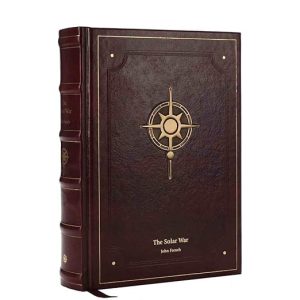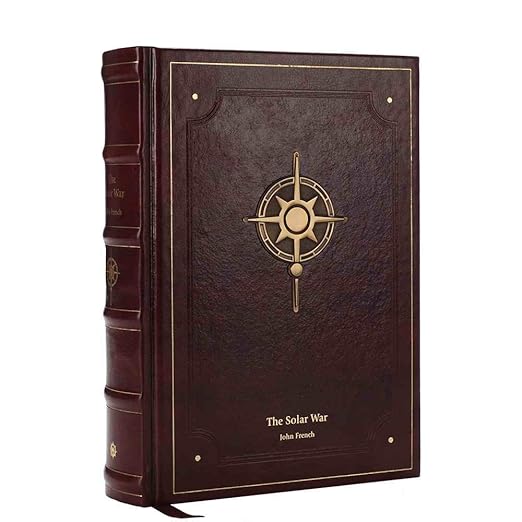
- Read by: Jonathan Keeble brings ceremonial gravity and precise cast differentiation to French's operationally complex opening of the Siege of Terra, making twelve hours of multi-perspective warfare legible and compelling.
- At its heart: Betrayal at civilizational scale, tactical command under collapse, the cost of loyalty
- Vibe: Monumental and relentless, dense with military and political consequence
- Short version: John French opens the Siege of Terra with tactical clarity and narrative severity, and Keeble's narration makes the operational complexity fully audible.
Rogal Dorn stands at the defenses of Sol, and the war that has been building across years of Horus Heresy fiction finally arrives at the solar system itself. The Solar War by John French, narrated by Jonathan Keeble, is the first volume of the Siege of Terra sub-series, the finale of Black Library's long-running Horus Heresy sequence, and it begins exactly where the scale of that finale demands: not on Terra's surface, but in space, where Horus must break through the most fortified star system in the Imperium before his forces can set foot on the Throneworld. This audiobook runs twelve hours and fourteen minutes, and from the first scene it carries the weight of everything the preceding novels have been building toward.
The Review
John French is among the most technically minded writers in the Black Library stable, and The Solar War reflects that orientation. Where some Horus Heresy authors are strongest in philosophical exposition or character study, French thinks spatially and operationally. This volume is structured around the military problem of how an armada breaches a fortified star system, and French renders that problem through the perspectives of specific commanders on both sides, with specific fleet deployments, specific tactical decisions, and specific moments of failure and adaptation under impossible pressure. The result is one of the most technically focused entries in the series, and the audiobook format is where it reaches its fullest potential.
Keeble's narration is not incidental to this claim. The novel moves between multiple command perspectives simultaneously, cutting from the Loyalist defense to the Traitor assault in ways that require the listener to track several simultaneous threads of tactical logic. In print, this demands active effort. With Keeble guiding the reader, the intercutting becomes cinematic rather than disorienting. His differentiation between the Loyalist and Traitor voices is among the most consistent and reliable performance work in the series' audio catalog. Rogal Dorn's methodical, deliberate authority sounds nothing like the fractured, Chaos-touched commanders arrayed against him, and the characters within each faction are distinguishable from each other without requiring theatrical exaggeration. This is difficult work across a twelve-hour production, and Keeble's consistency is what makes the novel's complex structure audible rather than merely readable.
The character of Sigismund receives particular attention in this volume and represents French's strongest contribution to the series' character work in this entry. The Emperor's Champion's absolute orientation around duty and combat gives the Loyalist perspective an emotional anchor that the larger strategic picture cannot provide on its own. Keeble's performance of Sigismund is precise and unhurried, a man who is not afraid and is not performing fearlessness, but who exists in a different relationship to the combat than the characters around him. It is one of the more quietly compelling performances in the entire Heresy audio catalog.
What Makes The Solar War Worth Hearing
The audiobook format is the optimal way to experience French's structural approach. The intercutting between multiple simultaneous perspectives, each providing a fragment of the operational whole, creates a picture that assembles itself in the listener's mind across the full runtime rather than being delivered as a single constructed panorama. Keeble's consistent performance makes the assembly feel natural rather than effortful. Listeners who have followed the Heresy across dozens of volumes in audio will find that this production maintains the standard those volumes established, and in the Sigismund sections specifically, exceeds it.
French also handles the disintegration within the Traitor armada with more psychological acuity than many Chaos-aligned perspectives in the series. The enemy is not a monolithic force. The tensions within Horus' coalition, the specific ways different Traitor factions pursue incompatible objectives even within a shared campaign, add texture to what could have been a purely oppositional force. These internal tensions are not merely political decoration. They have tactical consequences that French traces carefully, and they give the Traitor perspective a coherence that makes the Loyalist resistance more difficult and therefore more meaningful.
Things to Know Before Starting The Solar War
The opening chapters establish the tactical situation with deliberate patience, laying out the full scope of the solar system's defenses and the challenges Horus faces before the campaign begins in earnest. Listeners who prefer action-first Warhammer fiction may find this setup extended, but it is load-bearing. The specificity of the tactical picture French builds in these early sections is what gives the climactic space engagement its full weight when it arrives. Keeble's pacing in the setup sections reflects French's intention: he does not rush through strategic exposition to get back to combat, because the combat depends on the listener understanding what is actually at stake at each tactical decision point.
Who It's For
This audiobook is for listeners who have followed the Horus Heresy and are ready for its conclusion to begin. The Siege of Terra sub-series assumes substantial prior knowledge of the series' characters, factions, and accumulated history. New listeners to Warhammer fiction should not start here. Long-term fans who have followed across dozens of Heresy volumes will find The Solar War a satisfying and appropriately scaled opening to the siege they have been reading toward. Military science fiction listeners who enjoy large-scale operational fiction with strong character work will find French's approach more accessible than some Heresy entries. The twelve-hour runtime is a reasonable investment for a novel that opens one of the most anticipated conclusions in contemporary genre fiction.
Questions Listeners Ask
Do I need to read the full Horus Heresy series before this audiobook?
Yes. The Solar War opens the Siege of Terra sub-series, which is designed as the culmination of the full Horus Heresy sequence. The political, military, and character context built across preceding novels is load-bearing for the events of this volume. New readers to the setting should start at the beginning of the Heresy.
Does The Solar War audiobook resolve its story completely or end requiring the next Siege of Terra volume?
The Solar War resolves the first stage of the siege, the battle for the Sol System, as a narrative unit. However, it is explicitly the opening movement of a multi-volume conclusion, and the larger conflict continues. Listeners should expect to continue with subsequent Siege of Terra titles for the full story.