Quick Take
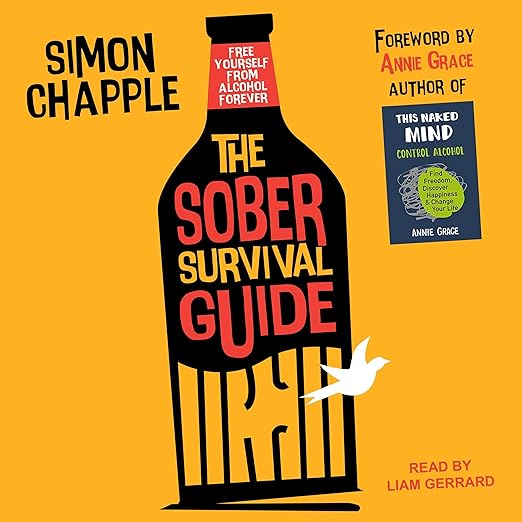
- Narration: Liam Gerrard brings an easy British warmth to Chapple’s conversational prose, the delivery suits a book that reads like a knowledgeable friend talking you through the hard parts.
- Themes: Practical sobriety tools, social navigation without alcohol, the transition from drinker to non-drinker identity
- Mood: Warm, honest, and pragmatically optimistic
- Verdict: Simon Chapple’s two-part guide is exactly what it claims to be, equal parts memoir and practical manual, and unusually good at the social situations that other quit-lit books gloss over.
I finished this one on a Tuesday afternoon that had started out rough, and by the end I’d made a list. Not a to-do list, a mental inventory of the situations Chapple covers that I’d either witnessed or been adjacent to: the work Christmas party without a drink in hand, the sober holiday, the relationship where one partner quits and the other doesn’t. Chapple handles all of these in the second half of the book, and he does it with the specificity that separates actually useful guidance from inspirational vagueness.
The Sober Survival Guide is structured in two parts, which Chapple announces clearly and which give the book a genuine two-act logic. Part one is setup: the early stages of controlling your drinking, the cognitive and emotional preparation, the case for why this matters and how to make it through the first phase. Part two is the maintenance manual, the situations, relationships, and social territories you’ll need to navigate after the decision is made. The split is smart because the needs at those two stages are genuinely different, and most quit-lit books treat them as the same thing.
The Social Landscape Nobody Maps
Chapple is at his most useful in the second half, and the reason is that he’s specifically charted territory other recovery books tend to treat as self-evident. The work Christmas party chapter is not a throwaway. He actually thinks through the logistics: what to say when people notice, how to handle the “just one” pressure, how to make the evening enjoyable rather than merely survivable. The chapter on what to do when you stop drinking but your partner won’t is even more carefully done, it acknowledges real relational complexity without resolving it falsely.
Reviewers consistently use the word “practical,” and they mean it. One notes being turned on to the 30-day alcohol experiment as a specific tool, Chapple functions as a curator as well as a narrator, pointing readers toward resources and frameworks beyond his own. That generosity of reference feels genuine rather than performative.
Liam Gerrard and the Tone of a Trusted Guide
Liam Gerrard narrates with a gentle authority that matches Chapple’s first-person voice without impersonating it. The conversational quality of the prose, informal, occasionally self-deprecating, always direct, translates cleanly to audio, which is what you want from a book people will return to during difficult moments rather than listening to once and setting aside. The four-and-a-half-hour runtime is deliberately compact. Chapple doesn’t pad. Each chapter earns its place.
The part-memoir structure means there are passages where Chapple recounts his own path through drinking and early sobriety with a candor that creates genuine identification. This isn’t the relentlessly triumphant memoir of someone who quit everything gracefully and transformed overnight. The stumbles are in there, and they’re the most useful parts.
Who Should Listen, Who Should Skip
This is for someone who has either made the decision to quit drinking or is seriously close to it, not necessarily someone in formal addiction treatment, but someone in the broader “quit lit” reader community who wants guidance that’s secular, warm, and grounded in actual social reality. Listeners who need clinical addiction support or who are managing severe physical dependence should start with medical supervision rather than this book. But for the broader population of people who have decided that alcohol isn’t serving them and want help navigating the world that comes next, Chapple’s guide is exactly as useful as its reputation suggests.
Frequently Asked Questions
Is this book suitable for someone who still drinks but is considering quitting, or is it aimed at people who’ve already decided?
Chapple writes for both audiences, though the first part is particularly useful for someone in the consideration phase. He describes the early stages of controlling drinking alongside the decision to quit, so the entry point is flexible.
Does the book follow a 12-step or spiritually oriented framework?
No. Chapple explicitly positions the book as non-12-step oriented. Multiple reviewers specifically praise this, describing it as part of the growing library of quit-lit that isn’t organized around AA or higher power frameworks.
How does Liam Gerrard’s narration compare to Chapple self-narrating?
Gerrard’s narration is warm and well-suited to the material, though with a book this personal there’s always some distance from the author’s specific voice. Chapple’s conversational style translates well to Gerrard’s delivery without feeling significantly filtered.
Does the book deal with situations where alcohol is culturally central, like weddings or work events?
Yes, and this is one of its genuine strengths. Chapple spends considerable time on the social navigation of sober attendance at alcohol-centric events, the work Christmas party, holidays, and relationship dynamics when sobriety is asymmetric are all covered with practical specificity.