One Platypus's Night, From Hunt to Burrow
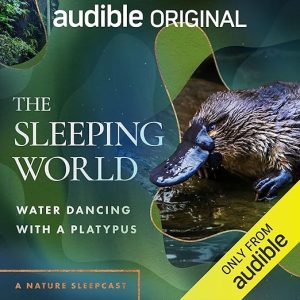
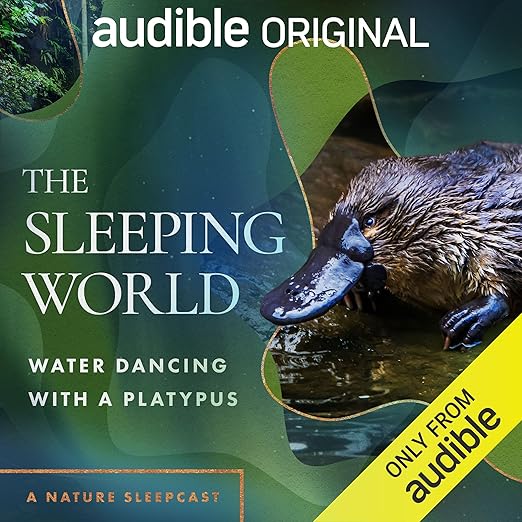
Platypuses have always struck me as nature's strangest joke, a creature assembled from leftover parts: a duck bill, a beaver tail, venom spurs, and the habit of laying eggs while technically being a mammal. So when I queued up this audiobook on a tense weeknight, needing something to quiet my brain without putting words in it, I was genuinely curious whether fifty minutes with one of them could do what the series promises. The Sleeping World is a sleep-aid audiobook in the plainest sense, produced by Mumble Media and Audible to carry you out of your day and into unconsciousness by way of Tasmania's rivers. It works, and not through dullness but through the specific, precise language of natural history rendered in the right voice at the right pace.
Writer Fil Corbitt has done something careful here. The platypus episode does not merely describe an animal; it follows one individual through his nightly routine, from the moment he enters the water using his electroreceptors to hunt prey he cannot see, through the synchronized swimming courtship ritual with his mate, to her extraordinary act of digging forty feet into a riverbank to build a nesting burrow. Each detail is specific enough to hold your attention but unhurried enough not to demand it. By the time the burrowing is complete, the weight of the night has settled over the production in a way that feels earned rather than manufactured. You have been somewhere real, even if that somewhere was Tasmania and your couch never changed.
Kimola's Voice Layered Inside a Real Soundscape
The Dolby Atmos production, available through Audible, is what transforms this from a pleasant narration into a genuinely immersive audiobook experience. The sound design places you beside the river, with water movement spatially distributed rather than simply ambient. Kimola's voice becomes one layer in a carefully mixed whole, the words rising and receding against the backdrop rather than competing with it. For listeners who find music too stimulating or silence too loud at the end of the day, this format occupies a productive middle space.
The production credits are unusually transparent: platypus consultant Geoff Williams vetted the science, and fact-checker Andrea Lopez-Cruzado worked through the natural history claims. That rigor matters. The detail about platypuses sensing electric fields generated by the muscular contractions of their prey, which is how they hunt while their eyes and ears close underwater, is not decorative. It is real, and knowing it is real makes the listening more satisfying. This is sleep content that respects your intelligence while giving you permission to surrender to it. The executive producers at Mumble Media and Audible, the sound design team, and the specialized consultants represent a level of production investment that most sleep audio never approaches.
Fifty Minutes Leaves No Room for Digression
The series structure, with each episode tracking a single species through a single night in a specific ecosystem, is a format choice that disciplines the storytelling productively. A fifty-minute runtime cannot accommodate digressions or encyclopedic coverage, so every fact that appears has been selected for its ability to ground you in the scene and carry you further toward sleep. The courtship sequence, where platypuses perform their synchronized swimming ritual before the female begins her burrowing excavation, carries a quiet strangeness that might be the last thing your conscious mind registers before the night takes over.
Paced for Drowsiness, With the Science Kept Light
One honest note: if you are hoping for an educational deep-dive into platypus biology, this audiobook is not that. The science serves the sleep experience rather than the other way around. The episode is paced for drowsiness, not study, and the production team made that priority clear in how they constructed the rhythm of Corbitt's narration. Listeners who want to go deeper into monotreme biology can treat this as an appetizer and look elsewhere for the full meal. But for its stated purpose, the pacing is an asset, not a limitation. The gentleness of the information delivery is exactly what makes it appropriate for this format.
The series production team, including Jaymeson Catsouphes, Cara Ehlenfeldt, Chester Gwazda, Liz Mak, Lee Mengistu, Renee Vargas, and Jake Young, brings a collaborative approach to every episode that shows in the seamless integration of narration and sound. Writer Fil Corbitt's decision to focus on a single night in a single creature's life rather than attempting a survey of the species gives the episode its intimacy. You follow one platypus, not a documentary subject, and that specificity is what makes the sleep transition so effective.
From the Day's Noise Into Monotreme Curiosity
This audiobook is for anyone who needs help transitioning from the noise of a working day into rest, particularly listeners who find music or white noise insufficient but cannot settle into a full narrative before sleep. It suits nature enthusiasts, science readers who want something lighter at the end of the day, and anyone who has ever been genuinely fascinated by the alien biology of monotremes. Skip it if you are looking for a lecture-style natural history course, a longer immersive experience, or a podcast you can actually follow while conscious. The fifty-minute runtime is exactly what it is. Listeners who own Dolby Atmos-compatible hardware will get the most from this production, but it remains fully satisfying on standard headphones as well, and the series has other episodes exploring different species if this one earns a place in your sleep routine.