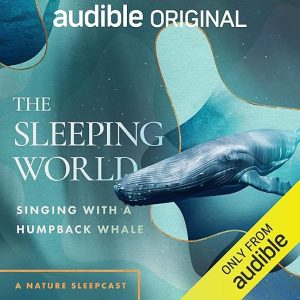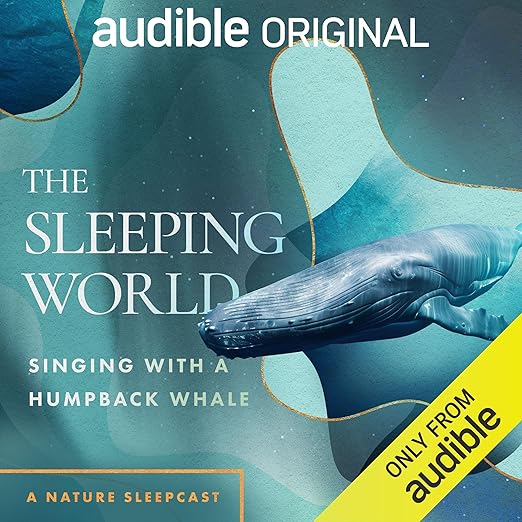
Humpback whales rank among the most studied animals on Earth, but Mumble Media's audiobook production The Sleeping World: Singing with a Humpback Whale approaches them from an angle scientists rarely get to inhabit: the whale's own temporal rhythm. This is not a documentary lecture. Narrated by Cynthia Kimola and written by Bonnie Swift, the audiobook sits somewhere between a nature soundscape and an intimate bedtime story, produced in Dolby Atmos with real field recordings gathered under a NOAA research permit. At 54 minutes, it is precisely long enough to carry you out of your day and into someone else's entirely.
The premise is deceptively simple. We follow a single humpback whale through a series of behaviors: bubble-net feeding with other humpbacks, rescuing a sea lion, improvising on melodies circulating among whales across the Pacific. By the end, the whale closes one eye, the way cetaceans sleep, and Swift's text makes gently clear that you should be doing the same. The arc is not a plot in any conventional sense. It is a cycle, shaped by ecology rather than narrative tension, and that deliberate structure is exactly why it works.
Sound Design That Doesn't Just Accompany the Whale
This is one of those productions where the category labels almost get in the way. It is filed under health and wellness, science, and sports outdoors, and there is justification for all three, but the experience is closer to what a skilled radio producer might call audio furniture: something designed to inhabit a room, or a mind, rather than demand active attention. The Dolby Atmos sound design by Mumble Media is not incidental to the experience. It is the experience. The whale sounds collected by researchers Lisa Walker and Fred Sharpe are woven through Kimola's narration rather than layered beneath it, so the voice and the ocean feel like they are occupying the same space.
Swift's writing takes the science seriously without making it dense. The detail that humpbacks might surpass humans in certain dimensions of self-awareness is introduced and then allowed to settle rather than argued. The information serves the mood rather than disrupting it. This is harder to do than it looks, and it is one of the underrated strengths of this production. Whale consultant expertise is credited in full, fact-checking is listed in the credits, and the result is a piece you can trust as well as enjoy.
Kimola Avoids Turning the Whale Into a Cartoon
The most obvious answer is that it works. A 4.9 rating across 328 reviews is not the kind of number you see for productions people merely respect. It is the number you see when something does exactly what it promises. The promise here is simple: you will wind down. The whale will sleep. So will you.
But there is more to recommend it than its function as a sleep aid. Kimola's narration gives the humpback a kind of personhood without anthropomorphizing him into a cartoon character. She keeps the register low and observational, never crossing into the cloying sentimentality that can make nature storytelling feel forced. The rescue of the sea lion is described with genuine attention to the animal's behavior, and the improvised singing across the Pacific feels genuinely strange and moving in the way good nature writing always does: it expands your sense of what is happening on Earth right now, entirely without you.
The Dolby Atmos production also rewards good headphones. The spatial quality of the underwater recordings creates a physical sensation of depth that a flat stereo mix cannot replicate. At 54 minutes, you can listen in a single session with time to spare, and the production has been built so that you can safely fall asleep before it finishes without missing anything narratively essential.
Sensory Immersion Chosen Over Scientific Breadth
If you approach this expecting a conventional audiobook with chapters, arguments, and conclusions, the format will feel unfamiliar. There is no information hierarchy here, no key takeaways. The knowledge is embedded in observation rather than presented as instruction. Some listeners who prefer structured non-fiction will find the experience more passive than they want. That is a genuine limitation of the form, not a flaw in the execution.
The short runtime also means this is not a comprehensive exploration of humpback whale biology. Swift and the Mumble Media team have made deliberate choices about what to include, and those choices prioritize sensory immersion over scientific breadth. If you are coming to this for deep cetacean research, you will want to supplement it with longer-form material. But as a production designed to do one specific thing exceptionally well, it holds together with unusual integrity from the first minute to the last.
Beauty at Bedtime for Ocean Lovers of Any Age
This audiobook was made for anyone who finds it difficult to disengage from the day at bedtime, and for anyone who wants their sleep routine to contain something genuinely beautiful rather than merely functional. It suits curious adults who appreciate when science and storytelling occupy the same space without crowding each other out. Ocean lovers, nature documentary enthusiasts, and anyone who has ever found comfort in marine footage will find it particularly satisfying. It also works for younger listeners, given its gentle pace and the inherent appeal of whale behavior, though the production credits it for general audiences. If you use sleep meditations regularly but find spoken-word guidance too directive, this is a worthy alternative.
Questions Listeners Ask
Is this audiobook just ambient sound, or does it have narration throughout?
It combines both throughout. Cynthia Kimola's narration runs alongside Dolby Atmos field recordings of actual humpback whales gathered under a NOAA research permit. The voice and the ocean soundscape are designed to feel simultaneous rather than layered.
At 54 minutes, is this audiobook long enough to be worth it?
For what it does, yes. The runtime is calibrated to the experience: long enough to carry you through the whale's complete behavioral cycle, short enough to fit into a single pre-sleep session. The production is not trying to be comprehensive; it is trying to be immersive, and 54 minutes is the right length for that.
Does the Dolby Atmos production require special equipment to appreciate?
Good headphones make a noticeable difference, but the experience works on standard speakers too. The spatial depth of the underwater recordings is most apparent with headphones, where you can hear directional sound. On flat speakers the narration and soundscape are still rich and well-mixed.
Is the science in this production accurate, or is it dramatized for entertainment?
The scientific content has been verified by whale consultants Lisa Walker and Fred Sharpe, and a fact-checker is credited in the production. The claim about humpback self-awareness is presented as scientific hypothesis rather than settled fact, which is the honest framing of current research.