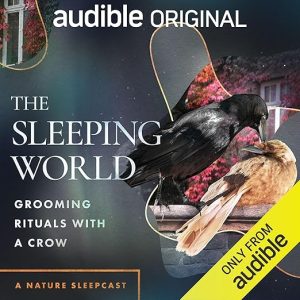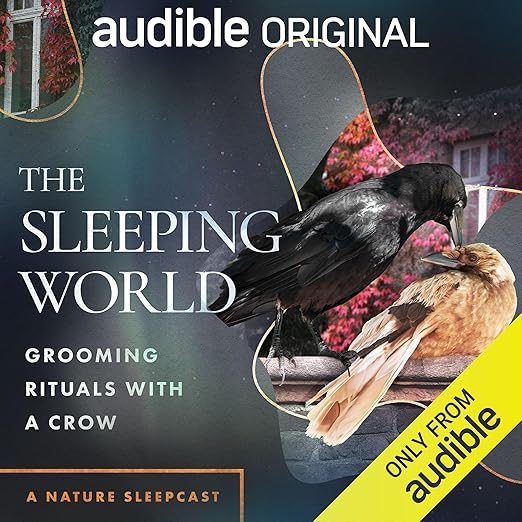
The Sleeping World: Grooming Rituals with a Crow, produced by Mumble Media and Audible and narrated by Cynthia Kimola, opens by following a crow through the streets of Seattle as she grooms her mate. That is the scene. And the question the audiobook is really asking is whether you will slow down enough to stay with it. Written by Dr. Kaeli Swift, a crow researcher whose expertise makes every behavioral detail in this audiobook accurate and purposeful, the 50-minute production is part soundscape, part bedtime story, and fully committed to the premise that nature's actual rhythms are more restorative than anything engineered to replace them.
Crows are, as Dr. Swift notes, strikingly similar to humans. They form lasting pair bonds. They maintain complex social relationships. They commute. This particular crow grooms her mate, delivers what appears to be a gift, and then travels miles from her home territory to join thousands of other crows at a communal roost before settling in for the night. That narrative arc, from the intimacy of grooming to the spectacle of the roost and finally to sleep, mirrors the arc the listener is meant to follow.
Gift-Giving as Genuine Social Currency Among Crows
What distinguishes this production from generic sleep audio is the level of specific knowledge embedded in the storytelling. Dr. Swift writes crows from the inside out. The behavioral details, the pair-bond dynamics, the gift-giving behavior (which in crows can be a genuine social currency), the communal roosting that serves both warmth and information-exchange functions, are all grounded in actual crow ecology. That specificity gives the Kimola narration something to do beyond being soothing. It gives the listener something to imagine with genuine precision rather than vague naturalist gesture.
The sound design is essential to the experience. Mumble Media has built the Sleeping World series on the idea that soundscape and story are not separate tracks but a single immersive environment, and this episode demonstrates that philosophy effectively. The ambient audio of Seattle streets, the wing sounds, the calls of the roost, these are mixed into the narration at a level that fills the room without overwhelming the voice. Available in Dolby Atmos on the listening platform where the original is hosted, the production rewards good headphones or speakers in a way that compressed audio does not.
Kimola Finds the Register Between Warm and Remote
Cynthia Kimola's narration is the right human presence for this kind of production. She is neither remote nor overly warm, but inhabits the space between, the tone of someone describing something beautiful that they do not want to disturb. For a sleep audio format, that calibration is harder to achieve than it sounds. Too polished and the narration becomes a performance you stay awake for. Too flat and it becomes a drone that signals nothing. Kimola finds the register that invites you to follow the crow downward, toward the branch, toward the roost, toward sleep, without you quite noticing you are being guided.
The 50-minute runtime is the structural decision the whole production turns on. Long enough to feel like a complete journey, short enough that it ends before you have had time to resist it. If you fall asleep before the crow reaches her roost, the production has succeeded entirely. If you stay awake through the ending, you have still spent 50 minutes in an immersive natural soundscape that most urban listeners have no other way to access.
Relaxation First, Crow Science Second
This audiobook is a sleep aid and nature experience, not a lecture or a documentary in the conventional sense. Listeners expecting detailed scientific explanation of crow behavior will find the production more impressionistic than academic. Dr. Swift's expertise underlies every detail, but the experience is designed to relax rather than educate in any direct sense. If you want to learn about crows systematically, there are better starting points. If you want to inhabit the experience of following one crow through a single extraordinary day until night falls, this is the production for it.
The single-episode format means there is no narrative continuity with other Sleeping World episodes. Each installment centers on a different species and ecology, and they function as independent experiences. This crow episode stands alone. Whether the series' approach to different ecologies holds consistent quality across episodes is outside the scope of this review, but as a standalone 50-minute production, this one is coherent and complete.
Right Between White Noise and a Real Story
This audiobook is for listeners who struggle to wind down at night and find standard music or white noise too abstract to hold their attention but find conventional audiobooks too engaging to fall asleep to. The nature narrative occupies exactly the middle ground, specific enough to follow without effort but unhurried enough to let the mind drift. People who have always felt a particular affinity for crows, or who have observed them in urban environments and wondered what their days actually look like, will find Dr. Swift's account a satisfying answer delivered in the gentlest possible format.
Listeners looking for plot, character development, or information they can act on in waking life should look elsewhere. This production is doing one thing, and it does it with enough care and craft to be worth the runtime many times over for the right listener. If your nights regularly involve staring at the ceiling, a crow's daily commute through Seattle might be exactly the right companion.
Common Questions
Is The Sleeping World: Grooming Rituals with a Crow audiobook suitable for children as a bedtime listen?
Yes, with some parental judgment about age. The content is entirely family-friendly and the pace is calm and slow. Younger children who can stay with a narrator's voice without pictures may find it soothing. Older children and adults are the more natural audience, but there is nothing in the content that would be inappropriate for younger listeners.
How does this audiobook differ from standard white noise or sleep music?
The production combines an actual narrative, following a specific crow through a day in Seattle, with ambient sound design. It gives the listener something specific to follow and imagine, which many people find more effective than undifferentiated sound for calming an active mind. The scientific accuracy of Dr. Kaeli Swift's writing adds a layer of credibility that generic nature sounds lack.
Does the audiobook require Dolby Atmos to experience properly?
No. The production is designed to work on standard audio equipment. The Dolby Atmos version enhances the spatial quality of the soundscape for listeners with compatible systems, but the experience is complete and effective on ordinary headphones or speakers.
Is this episode part of a series, and do I need to listen to others first?
The Sleeping World is a series from Mumble Media, with different episodes focusing on different species and ecologies. Each episode is fully independent. This crow episode requires no prior listening and functions as a complete standalone experience.