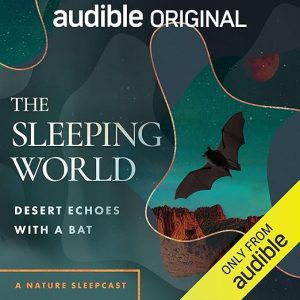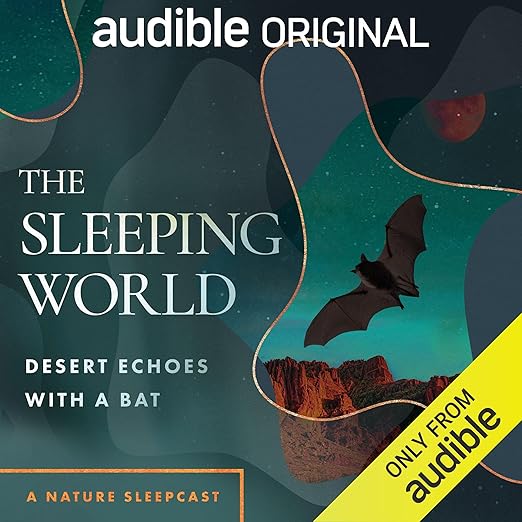
Somewhere in the Jornada Cave near the Rio Grande, as the sun goes down and the mountains glow orange, thousands of Mexican free-tailed bats are stretching, murmuring, and preparing to do what they do every night: pour out into the warm air and hunt bugs by echolocation for hours before returning to nurse their young and rest. The Sleeping World: Desert Echoes with a Bat, produced by Audible and Mumble Media, narrated by Cynthia Kimola, is a fifty-two-minute audiobook experience built around following one of those mothers through her night, from the nursery inside the cave where thousands of bat pups sleep together through the full arc of a night's hunting and back to sleep. It is part nature documentary, part bedtime story, and part spatial audio experience, and it accomplishes all three functions without compromising any of them.
The production context is worth naming clearly. Written by Fil Corbitt and produced by the Mumble Media team with executive oversight from both Audible and Mumble Media, this is not a solo author audiobook but a full production with credited sound design, fact-checking by Andrea Lopez-Cruzado, and spatial audio mixing available in Dolby Atmos on Audible. The Sleeping World is a series of nature-immersion sleep audio experiences, each focused on a different ecosystem and creature, and the desert bat episode extends a format that the 4.9 rating from 123 listeners suggests has found a genuinely enthusiastic audience.
Kimola Moves at the Pace of the Desert Evening
The premise of a guided nature sleep audiobook is not new. Nature soundscapes, white noise recordings, and narrated relaxation audio have existed in various forms for decades. What separates this production from the ambient sound genre is the writing. Fil Corbitt is not just describing sounds or reciting bat facts over audio atmosphere. The narration has a genuine story arc: a new mother bat's specific journey from the nursery to the sky and back. The choice of a nursing mother whose night of hunting ends in returning to her young to sleep is not arbitrary but calibrated. When the bat comes back and rests, the listener, by design, is already drifting. The structure of the story and the structure of falling asleep are designed to coincide.
Kimola's narration carries the writing with the kind of quiet authority that sleep audio needs. The most common failure of narrated relaxation content is over-deliberate pacing that becomes its own source of irritation, a voice so obviously trying to relax you that you become more aware of the attempt than the content. Kimola does not fall into that trap. Her delivery is unhurried because the subject is unhurried: the desert evening slows everything, and she moves at the speed of the environment she is describing rather than at the speed of forced calm.
Echolocation Rendered With Real Spatial Depth
The Dolby Atmos spatial audio component is the production element most worth discussing for listeners who have access to headphones or audio equipment that supports it. Spatial audio in sleep content creates a dimensional quality in the sound environment that standard stereo cannot achieve. The cave with its murmuring bats, the open desert air, the specific sonic texture of an echolocation-based hunt: these environments are rendered with a presence that positions the listener inside the scene rather than outside it observing. For sleep audio specifically, that dimensionality is significant because it removes the residual sense of listening to a recording and replaces it with something closer to being in a place.
The educational dimension of the writing, the bat ecology content, the Mexican free-tailed bat population specifics, the mechanics of how echolocation works, is present but lightly worn. You absorb information about bat behavior and desert ecosystem function without feeling instructed. This is harder to achieve than it looks, and Corbitt's writing distributes the factual content through narrative in a way that feels organic rather than appended. The fact-checker credit in the production notes signals that the accuracy is taken seriously, which matters for an audience that includes listeners who will know when bat biology is misrepresented.
Closer to a Film Score Than a Story
At fifty-two minutes, this is purpose-built content rather than a long listen. The runtime is a deliberate production choice: enough time to follow the bat through her full night arc, not so much that the listener is still awake at the end waiting for a conclusion. Listeners who approach audiobooks expecting either extensive narrative development or long immersion sessions will find this format unfamiliar. The experience is closer to a film score or an ambient music album than to a conventional audiobook, and those who have engaged with similar Sleeping World episodes or comparable nature-immersion sleep audio will have the most accurate expectations.
The desert setting is specific rather than generic, and that specificity is part of the value. The Rio Grande region at dusk, the particular colors of the mountains at sunset, the temperature drop that activates the bat colony, these are rendered with enough environmental detail to feel like a real place rather than a conceptual nature sound. Listeners who have spent time in desert Southwest environments may find the geographic specificity adds a personal resonance that generic nature audio cannot replicate.
Interesting Enough to Beat Plain White Noise
This audiobook is for listeners who want a sleep aid that is also genuinely interesting: people who find standard white noise or ambient soundscapes too featureless to hold their attention during the transition into sleep but who also do not want narrative complexity that keeps them awake. Wildlife enthusiasts who are curious about bat ecology and desert ecosystems will find the educational content an additional draw. Listeners with access to Dolby Atmos-compatible audio equipment will get the fullest version of the production. Anyone who wants a conventional story arc, extended character development, or a listening experience that rewards staying awake through it should choose a different format. This is a production designed to accomplish a specific thing, and it does that thing with care and craft.