At a Glance
- Performance: Vivienne LaRue handles an invented vocabulary of names and a book swinging between court politics and intimacy; no review here evaluates the recording.
- What it covers: Sapphic fantasy romance, warring cultures, academy setting, mentor and student
- Feel: Warm, sensual and unexpectedly moving
- Our call: A strong second volume for series readers, and the wrong place to meet Arianthem for the first time.
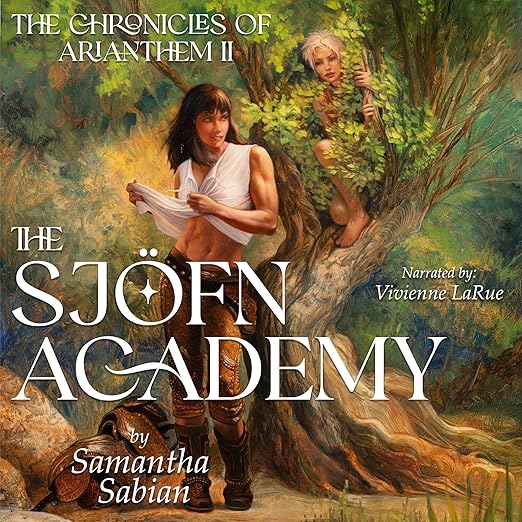
An academy story with a war behind it is a sturdier structure than either half would be alone, and this audiobook uses both at once. Samantha Sabian's second Chronicles of Arianthem novel sends Skye, daughter of the Tavinter Chieftain, into "the most prestigious school in all of Arianthem" as part of a peace offer from Queen Halla, whose own daughter Dallan will serve as her mentor there. Vivienne LaRue narrates the nine-hour, fifty-two-minute recording. Two hundred and eighty-three ratings average 4.6, and the written reviews come from people who have read the book several times over and followed the series for a decade.
A Closer Look at The Sjöfn Academy
The worldbuilding does something smarter than it first appears. The Ha'kan are an all-female race who, in the copy's framing, revere sexuality and regard monogamy as unnatural, and they have been at war with the nomadic Tavinter for centuries. Queen Halla's peace offer is not a treaty; it is an invitation to educate the Chieftain's daughter. That is a real political instrument, and it is simultaneously the oldest setup in romance: put two people from opposed cultures in a confined space with a status gap between them and let the gap do the work. Sabian gets a war, a school and a slow courtship out of a single decision, which is efficient plotting by any standard.
Skye arrives, in the copy's phrasing, with determination and trepidation, and needs only one look at "the laughing dark eyes of the princess" to understand what kind of education she has signed up for. That sentence does double duty as plot summary and as content signal, and the book keeps its promise. What surprised me is how much emotional weight the reviewers report getting out of it. RobsonFire, at five stars, calls this the "First book to bring tears in a very long time" and describes being caught up in the love and companionship of all the characters rather than only the central pair. That is a fair description of what Sabian is building: an ensemble with a romance at the center, not a romance with scenery around it.
What Makes The Sjöfn Academy Worth Hearing
The reread testimony is the strongest evidence on this listing, and rereads are a better quality signal than stars. Kailen writes: "I've reread this book at least 5 times already", having followed the series for ten years, and names it as the book that led to reading the whole chronicle from the start. That is not enthusiasm, it is durability. The third reviewer, ltpsp, offers a more moderate four-star version of the same thing, moving on to the third book while describing these as "a good easy read". Between them you get a clear picture: comfort reading with genuine emotional pull, in a setting substantial enough to sustain a long series.
Vivienne LaRue reads it, and the text places an unusual naming load on whoever does. Sjöfn, Ha'kan, Tavinter, Arianthem, Skye, Dallan, Halla: a listener has to hold an invented vocabulary of proper nouns straight from the first chapter, and pronunciation drift across ten hours is the classic failure mode in secondary-world fantasy. The second demand is tonal, since a book moving between court politics, a centuries-old war and frankly intimate scenes needs a reader who can change register without announcing the change. None of the three reviews here mentions the audio at all, so I cannot report how this recording handles either problem, which makes a sample the sensible next step rather than an optional one.
Things to Know Before Starting The Sjöfn Academy
Series position first. This is the second Chronicles of Arianthem book, and the reviewers treat it as part of a sequence rather than a standalone: one says this was the book that led to reading the first volume at all, another is already into the third. The copy offers no recap of the war's history and no explanation of who the Ha'kan are beyond a single sentence, so a listener starting here assembles the world from context. It is more forgiving than most middle entries, because the academy setting resets the frame and Skye is new to that world herself, but you will still be meeting a cast that an earlier book introduced.
The content deserves to be stated plainly. The copy tells you the Ha'kan revere sexuality and reject monogamy as unnatural, and it closes on Skye realizing she will get far more of an education than she dreamed possible. This is a sensual book by design, so if explicit material is not what you want in your ears on a shared commute, plan accordingly. The power dynamic is worth naming too: Dallan is the queen's daughter and Skye's assigned mentor at the academy, inside an arrangement that began as diplomacy between formerly warring peoples, and readers who find that structure uncomfortable will find it central here rather than incidental.
Who Samantha Sabian Is Writing For
The audience is clear enough: readers of sapphic fantasy who want worldbuilding underneath the romance rather than a contemporary setup with dragons bolted on. The Ha'kan premise is unusual enough to carry a series, the academy structure gives the book a shape, and the reviews suggest the emotional payoff is real rather than merely promised. If you have read the first Arianthem book and liked it, this appears to be the entry that converts readers into series completists, which is what a decade of rereading looks like from the outside.
Look elsewhere if you want a closed-ended standalone, if a mentor-and-student romance is a hard limit for you, or if you prefer your fantasy chaste. Look elsewhere too if invented names are something you struggle to track by ear, because ten hours of Ha'kan, Tavinter and Sjöfn is a great deal of unfamiliar vocabulary with no page to glance at. If the premise appeals and none of that disqualifies it, begin with the first volume and come here second, which is the order the reviewers themselves describe taking.