Quick Take
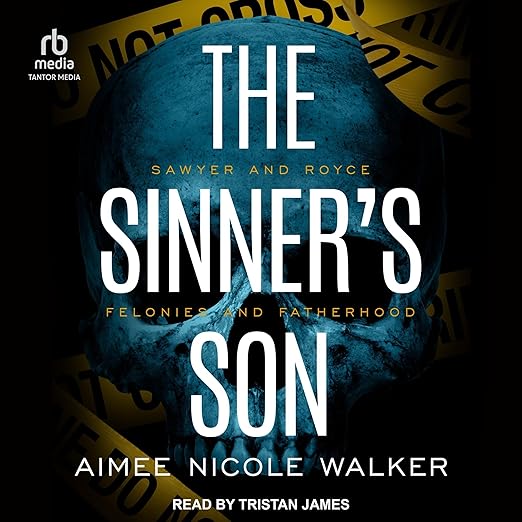
- Narration: Tristan James returns for the Sawyer and Royce universe and handles the blend of investigative tension and domestic warmth with practiced ease.
- Themes: nature versus nurture, chosen family and fatherhood, the long shadow of a parent’s crimes
- Mood: Warm and tense in equal measure, a family drama with a real investigation at its center
- Verdict: The Sinner’s Son deepens an already beloved couple’s story with a genuinely interesting mystery and a thematic question that earns its place in the narrative.
I came into The Sinner’s Son having spent the previous evening with The Paternity Puzzle, which is exactly what several series fans recommend before starting this second installment. It is good advice. Aimee Nicole Walker’s Sawyer and Royce universe has built up an emotional infrastructure over the Curl Up and Die series that feeds into this spinoff, and arriving with that foundation makes the moments of warmth and tension in this book hit considerably harder than they would for a newcomer.
Sawyer and Royce are two of the more fully realized characters in contemporary LGBTQ+ romantic suspense. Sawyer is a detective with a personal code and a carefully maintained emotional equilibrium. Royce is his partner in every sense. The Felonies and Fatherhood spinoff finds them at a new threshold: the countdown to Baby Locke has begun, and the anticipation of parenthood runs parallel to the investigation that occupies the book’s main plot throughout.
Our Take on The Sinner’s Son
The mystery element centers on cold cases, evidence boxes gathering dust, justice sought for the forgotten, and the arrival of Alec Bishop complicates things considerably. Alec is the son of a serial killer, which triggers the book’s central thematic preoccupation: nature versus nurture. The question is not rhetorical. Walker is asking Sawyer and Royce to confront their own relationships with their fathers and to think seriously about the kind of parents they want to become, all while managing an investigative partnership with someone whose inheritance is genuinely dark.
Walker handles this tension with considerable skill. Alec is described as having an audacious ego, an unwillingness to accept boundaries, and an overzealous fan club, which is a specific kind of energy to introduce into the established Sawyer and Royce dynamic. He is the kind of character who arrives in a series like this and clearly has more story ahead of him. Reviewers were already asking for the Alec and Dane book before they had finished reading this one, which is a meaningful measure of how successfully Walker developed him across relatively limited page time.
Why Listen to The Sinner’s Son
Tristan James narrates with the familiarity of someone who has inhabited these characters for multiple books. The Sawyer and Royce dynamic has a particular rhythm, moments of dry wit cutting through genuine tension, warmth surfacing unexpectedly in the middle of procedural sequences, and James handles that rhythm with enough subtlety that it feels natural rather than performed. The family warmth that reviewers describe as making them simultaneously laugh, cry, and feel scared is largely a product of that narration landing the emotional transitions correctly.
At six hours and nine minutes, the book is compact for what it contains. Walker does not waste time establishing the world for new readers, which means this is very much a continuation rather than an entry point. The plot moves efficiently between the mystery and the domestic arc, and the final reveal delivers the kind of twist that rewards the reader’s attention without feeling engineered. Several reviewers noted they were genuinely scared at specific moments, not just emotionally invested but actually tense in the way a well-constructed procedural achieves when the stakes are properly established.
What to Watch For in The Sinner’s Son
The nature versus nurture question is handled with more nuance than the premise might suggest. Walker is not making a simple argument in either direction. She is using the Alec Bishop situation to force Sawyer and Royce to articulate what they believe about inherited versus chosen character, which has direct implications for the family they are building. That philosophical dimension gives the book more substance than a straightforward mystery-plus-romance would carry on its own.
Readers who have followed Sawyer and Royce from the Curl Up and Die series will notice the emotional continuity Walker maintains across a large cast and many books. The series is one of the more impressive examples of long-form character development in the LGBTQ+ romantic suspense genre. The relationships feel earned because they have been earned, over many thousands of pages of prior reading and many years of Walker building this world with genuine care.
Who Should Listen to The Sinner’s Son
This book is for readers already invested in the Sawyer and Royce universe. Starting here without prior context would be technically possible but the emotional impact depends significantly on the relationship history built across earlier books. For those who are invested, this is a rich, emotionally satisfying continuation that deepens both the characters and the series mythology. Newcomers to Walker’s work should start at the beginning of the Sawyer and Royce arc and work forward. The investment of time in the earlier books is returned with interest in moments like this one.
Frequently Asked Questions
Is The Sinner’s Son accessible to new readers, or is prior series reading essential?
Walker provides enough context to follow the plot, but the emotional depth depends on the history built across the Curl Up and Die series and The Paternity Puzzle. New readers will lose a significant portion of the book’s impact.
Does Alec Bishop get his own story, or is he purely a secondary character in this book?
Alec is positioned clearly as a character with a future. He is fully developed and generates his own story energy, multiple reviewers finished the book asking for the Alec and Dane book before the series continues.
How does The Sinner’s Son handle the nature versus nurture theme without becoming preachy?
Walker grounds the theme in specific character decisions rather than abstract argument. The question of whether Alec can outrun his father’s shadow forces Sawyer and Royce to examine their own paternal relationships, which is a personal rather than philosophical framing.
Does Tristan James’s narration maintain the warmth and wit that define Sawyer and Royce’s dynamic?
Yes, James has narrated this universe long enough to handle the tonal blend naturally. The moments of humor and genuine tension land at the right register, and transitions between investigation scenes and domestic warmth feel organic rather than jarring.