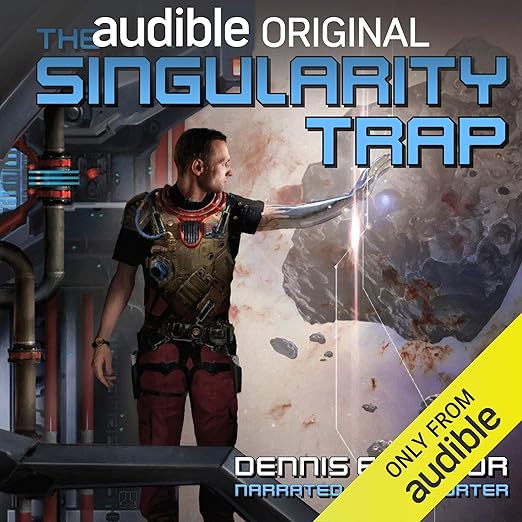
- Performance: Ray Porter is in his element here, his command of Ivan Pritchard's interior monologue particularly as the character loses certainty about what he is becoming is the kind of performance that turns a solid novel into something memorable.
- What it covers: first contact, body horror and transformation, game theory and extinction-level diplomacy
- Feel: Tense and escalating, with flashes of cosmic dread
- Our call: Dennis E. Taylor's darkest novel rewards patient listeners with a premise that starts human and ends at the edge of comprehension.
Dennis E. Taylor built his reputation on a particular flavor of science fiction: smart, conversational, laced with humor, and deeply interested in what happens to consciousness when it outlives its original container. The Bobiverse trilogy made him essential reading for anyone who cares about identity, loneliness, and the sheer scale of deep time. This audiobook, The Singularity Trap, is something different. It trades Bob Johansson's sardonic first-person charm for a tighter, more frightening premise, and the result is one of Taylor's most unsettling works.
Ray Porter narrates, and the pairing is well-earned. Porter has become synonymous with Taylor's voice precisely because he understands how to modulate the tension between technical exposition and emotional urgency. He reads Ivan Pritchard's growing horror with a calibrated restraint that makes the transformation sequences land harder than any amount of breathless narration could. When Pritchard begins to suspect that whatever has taken up residence in his mind is not hostile in any simple sense, that the threat may be more complex and more philosophical than he initially feared, Porter's delivery carries the weight of that ambiguity without telegraphing where the story is heading.
What We Made of It
Taylor opens The Singularity Trap in recognizable territory: near-future space, unglamorous asteroid mining, the economics of working men and women at the fringes of known space. Ivan Pritchard signs on with the Mad Astra because he needs money. His motivation is domestic, not heroic, a better life for his wife and children. That ordinariness is deliberate. Taylor is setting up a collision between the deeply human and the incomprehensibly alien, and the contrast only works if we believe in Pritchard's smallness before we watch him expand into something else entirely.
The alien contact sequence is handled with real craft. Taylor resists the temptation to explain too quickly. The mysterious substance Pritchard encounters does not announce itself. It begins as wrongness, a physical unease, a sense of doubling, and only gradually resolves into something that can be named, examined, and negotiated with. One reviewer described the novel as starting "small and slow but quickly building to something at first horrifying, and then incredible," and that arc is accurate. The first third demands patience. The payoff requires it.
Why Listen to The Singularity Trap
What separates this novel from standard first-contact fare is Taylor's decision to embed a genuine game theory problem at its center. Pritchard, and by extension humanity, must find a way to demonstrate non-aggression to an entity whose conception of threat and safety is radically unlike anything biological evolution produced. The reviewers are divided on whether the solution Taylor arrives at feels earned or slightly convenient. One describes it as having "more of a deus ex machina vibe than a real game theory solution," and that critique is not without merit. But the intellectual framework itself, the attempt to think rigorously about how two incompatible intelligences could establish trust, is worth the price of admission.
The novel also engages seriously with questions about the Fermi paradox, the nature of consciousness, and what it means for a civilization to be truly extinct versus merely transformed. These are not decoration. They are the machinery the plot runs on. Porter's narration handles the more philosophical passages with genuine interest rather than mechanical recitation. You can hear him thinking through the ideas as he reads them, which keeps the denser sections from feeling like homework. A second reviewer praises the "use of game theory and immortal existence compared to the fleeting experience of a human life," identifying the philosophical layering that distinguishes this from a straightforward thriller. The military backdrop of the Mad Astra crew provides a grounding in human stakes that makes the philosophical superstructure feel earned rather than imposed, and Taylor is careful never to let the ideas outrun the characters who are experiencing them.
What Might Not Land
Listeners who arrive expecting Bobiverse energy will need to recalibrate. The humor is present but quieter. The tone runs cooler and darker. Taylor is not interested in making Pritchard a wise-cracking hero; he is interested in what happens to a person's sense of self when something else starts sharing the cognitive space. There is real body horror here, carefully calibrated rather than gratuitous, and the military thriller elements in the final act serve the philosophical argument rather than displacing it.
Watch also for the way Taylor handles time and scale. The novel keeps pivoting between the intensely personal, Pritchard's marriage, his fear, his loyalty to his crewmates, and the civilizational. The jump cuts between those registers can feel abrupt on first encounter, but they are doing structural work. The contrast between one man's domestic stakes and an extinction-level negotiation is the point. When the book finally pulls those two threads into the same room, the effect is quietly devastating. The eleven-hour-and-twenty-three-minute runtime gives Taylor space to build that contrast patiently, and the pacing rewards a listener willing to stay with the slower early sections.
The Right Listener for The Singularity Trap
Listeners who respond to hard science fiction with genuine philosophical stakes will find this one of Taylor's most ambitious projects. Fans of Ted Chiang's first-contact stories, or of Peter Watts's willingness to make the alien genuinely alien, will feel at home here. If you have already worked through the Bobiverse trilogy and want to see what Taylor sounds like when he leans into darkness rather than wit, this audiobook is the natural next step. Those looking for lighter fare or the Bobiverse's particular brand of geeky warmth may find The Singularity Trap less immediately welcoming, but more persistently interesting after the fact. Ray Porter's performance alone makes the runtime feel entirely justified.