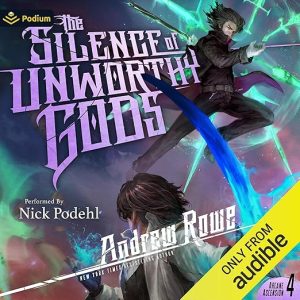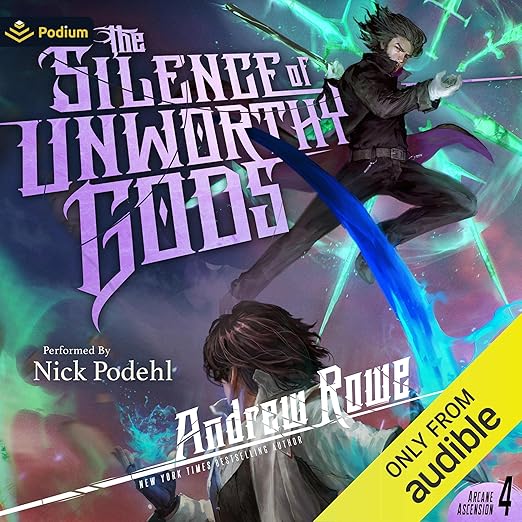
Returning to Andrew Rowe's Arcane Ascension series after three books is like settling back into an elaborate system of nested puzzles that has, in the intervening period, added several more layers. This audiobook is book four in the Arcane Ascension series, and it is emphatically not an entry point. Rowe's own synopsis notes that events from the Weapons and Wielders series, up to book three of that connected series, are also referenced here, meaning this is a listen designed for readers who have been tracking both narrative threads. Nick Podehl narrates over twenty hours of material that brings Corin Cadence back from Caelford and the Unclaimed Lands and drops him directly into the most dangerous confrontation yet: his own father.
For listeners who are already embedded in the Arcane Ascension world, the setup is immediately legible. For anyone else, a brief orientation: this is progression fantasy built around magical attunements, a system where individuals receive abilities tied to specific affinities or god-like entities, and the series has been running this system with exceptional consistency and growing complexity since the first volume.
Reviewer Jeremy M. offered the most structurally honest assessment of this installment: "the series is starting to juggle a lot." That observation is not a criticism so much as an observation about the stage of development a long-running progression fantasy reaches when its ambitions have expanded beyond what a single book can comfortably contain. By book four, the Arcane Ascension world has a main cast with individually complex arcs, a school setting at Lorian Heights with its own politics and dangers, a geopolitical crisis threatening Valia as a mysterious faction targets attuned commoners and foreigners, and a deeply personal family conflict for Corin that has been building since the series began. Rowe is managing all of this simultaneously, and the result is a book that occasionally feels more like several storylines running in parallel than a single unified narrative.
Reviewer Harris, who admitted he had initially judged the series as a four-book run and been pleasantly surprised, found that knowing more volumes were coming made his reservations about pacing feel "less important." This is an insight worth sitting with. Arcane Ascension is a series that benefits from being understood as an ongoing epic rather than a collection of self-contained arcs. The Silence of Unworthy Gods expands the world significantly, introduces threats that cannot be resolved within this volume, and deepens characterization in ways that pay off across the larger narrative. Reviewer Liz, who called the series "truly special" and described the writing as creating "a world that grabs the reader at page 1 book 1 and never lets go," captures the cumulative investment that makes book four rewarding despite its sprawl.
Why It Works in Audio
Nick Podehl is one of the better fantasy narrators working in the genre, and his work on the Arcane Ascension series has been one of the production's strongest assets throughout. He handles Rowe's large cast with distinct vocal characterizations that remain consistent across books, which matters considerably for a series where a reader returning to characters after months away needs to be immediately oriented by voice alone. His performance during the combat sequences, and this book has significant action including Corin's anticipated duel with his father, maintains the energy of the moment without sacrificing the clarity of what is actually happening tactically.
The magical system work in this installment is particularly inventive. Rowe has always been systematic about his attunement mechanics, and The Silence of Unworthy Gods builds on that foundation with new tricks and theoretical expansions that feel earned by the established rules rather than arbitrary. Listeners who came to the series partly for the magic system's intellectual rigor will find book four continues to reward that interest, even as the narrative complexity multiplies.
What to Watch For in The Silence of Unworthy Gods
The dual-series requirement is the most significant caveat for this audiobook. Listeners who have not read the Weapons and Wielders series to at least book three will encounter character arrivals and plot developments whose weight depends on context that this book does not fully supply. Rowe is writing for his established readership here, and he does not slow down to re-explain connections that returning listeners will recognize immediately. If you are behind on the connected series, catching up before this installment will substantially enrich the experience.
The pacing of the campus-based storyline, the second year at Lorian Heights with its new classes and new enemies, is deliberately slower than the Corin-and-his-father thread, and listeners who prefer constant forward momentum may find the school sequences feel like a gear shift. This is partly structural: the Lorian Heights material is where Rowe is doing long-term character and world building that will pay off in later volumes. Patience with that slower register is part of the contract of reading ongoing epic fantasy, and readers who have been with the series since book one are likely to understand that implicitly.
Who Will Get the Most From It
This audiobook is for listeners who have completed at least the first three books of Arcane Ascension and, ideally, the first three books of the connected Weapons and Wielders series. If you are already invested in Corin Cadence, Lorian Heights, and the attunement system, this installment is exactly the kind of ambitious, complex continuation the series has been building toward. New listeners should not begin here; start with the first Arcane Ascension volume and let the world accumulate its proper weight before reaching book four. Nick Podehl's narration is reward enough to make the long path to this installment worthwhile.
A Few Questions About The Silence of Unworthy Gods
Can I listen to this audiobook without having read the previous Arcane Ascension books?
No. The Silence of Unworthy Gods is book four in the Arcane Ascension series and also references events from the Weapons and Wielders series up to its third installment. Rowe does not re-explain established lore, characters, or magic system mechanics from prior books. Start with the first Arcane Ascension volume and build from there.
Does this audiobook resolve the main conflict it introduces, or does it end on an open note?
The Corin-versus-his-father duel is a structured set piece rather than an unresolved cliffhanger, but the larger threats facing Valia, including the faction targeting attuned commoners and foreigners, are not resolved within this volume. The book is designed as a continuation within an ongoing epic rather than a self-contained arc with full resolution.