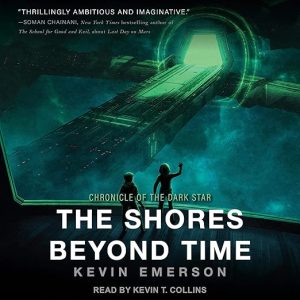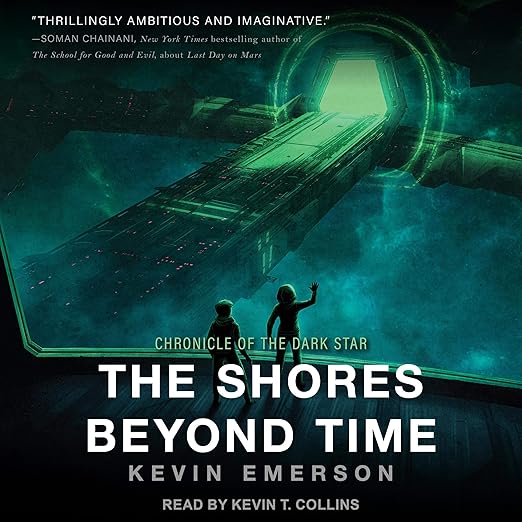
Earth year 2256 arrives in this audiobook with the home planet already reduced to a memory that only a handful of people still carry. Mina Saunders-Chang is stranded in the Centauri system alongside surviving humans and the Telphon refugees they barely finished fighting, and all of them sit inside the blast zone of a supernova. Liam and Phoebe wake somewhere stranger still, aboard a starliner that disappeared decades earlier, facing an abandoned alien machine that has begun speaking to Liam in a voice nobody else can hear.
Kevin Emerson wrote this as the closing volume of the Chronicle of the Dark Star, and the story behaves accordingly. Very little gets established here; nearly everything gets settled. O_Livia, posting in March 2021, compares the writing to a more contemporary Isaac Asimov and describes an engaging story from book one to book three, which is praise for the arc rather than for this installment standing on its own. Treat the trilogy as the unit of purchase, because the book plainly does.
What the premise buys is an unusually stark setting for science fiction pitched at younger listeners: a dead universe with no stars in it, a derelict human vessel that should not exist, and a machine that has singled out exactly one person. That last detail does most of the work. A voice only Liam can hear is the kind of device that lands squarely in this format, since everything in the story reaches a listener through the same channel it reaches him.
Kevin T. Collins carries the reading credit across eleven hours and fifty-three minutes for Tantor Audio, on a recording dated the end of September 2019. The page files all of it under children's audiobooks, tagged for action and adventure and for growing up, which sits oddly against a plot in which the surviving human population waits inside the blast radius of an exploding star. The shelf label undersells the age this actually plays to.
What Works
Trilogy structure works as the selling point here rather than as the obstacle. Emerson has two previous books of setup to spend and spends them: the confrontation with the Telphon refugees, the scattering of the survivors, and Mina's separation from Liam and Phoebe are all live by the time this volume opens. The result splits into two halves that sit in genuinely different places, one inside a supernova blast zone and one in starless space, with a single question, where Liam and Phoebe have gone, holding the near half together.
Kevann Fanniel, writing in January 2021, sums the appeal up as a mix of action, science and love that keeps you guessing what will happen next. That reading matches the shape of the material. The science is not decorative here, since the supernova, the starliner and the machine are all load-bearing, and the emotional line runs through characters who have been separated by two books rather than by two chapters.
A finale this long is a serious commitment for a young audience, and the running time deserves weighing against how the trilogy usually gets consumed. Families who worked through the first two books have a rhythm already, and a finale is the easiest volume to sustain that rhythm through, because the questions are all open and none of them are new. A household coming to it fresh should know that this is the longest possible way into the story, that the payoff structure assumes the earlier volumes sit somewhere in memory, and that Tantor released it as the third of three rather than as an entry point.
What to Watch For in The Shores Beyond Time
The single most detailed entry here is not about this recording at all. Michael Lynn McGuire, in August 2022, describes a well printed and well bound trade paperback published by Walden Pond Press in 2020, bought used, carrying a sharpie mark on the bottom edge, and adds surprise at having to buy a secondhand copy at all. That entry is careful and specific, and every word of it grades a physical object rather than an audio edition.
That matters for how you read a 4.7 built on 242 ratings. Written entries number five, with four maximum scores and a single four, spanning 2019 to 2022 and covering hardcover, paperback and audio interchangeably. The number is a verdict on a trilogy that people liked, not a reading of what this particular recording delivers.
Starting cold is the second thing to weigh. The description opens on a battle that already happened, a refugee population whose grievance is already established, and a separation that only stings if you watched it occur. Nothing in the copy pretends otherwise. A listener who begins here gets the mechanics of the plot and almost none of the accumulated weight.
Tone is the third consideration. A supernova with the entire remaining human species inside its blast radius, a universe emptied of stars, and a machine that talks to one child are not gentle materials, whatever the children's filing suggests. The book is aimed at the older end of that shelf, and the science fiction gets its logic taken seriously rather than softened.
Who It's For
Anyone hoping for a self-contained adventure should look at book one instead, where the setup is actually built rather than cashed in. The same goes for listeners who want their middle-grade science fiction light on physics, because the supernova and the dead universe get treated as real problems with real consequences rather than as backdrop. Impatient listeners are the third group to think twice, since a finale of this length spends its opening hours reassembling a cast the previous volumes scattered, and that reassembly is slow by design.
The audience that fits is the household already two books deep, or a young listener who has aged into Asimov-adjacent territory and wants a full trilogy to finish. Rob, in March 2020, called the ending fantastic and unexpected after the two previous books, added that it could not have been anticipated, and noted that the kids would enjoy it with nothing unclean in it, which is the specific reassurance a parent shopping this shelf is usually looking for.
Judge it as the last third of one story rather than as a book, and the eleven-hour runtime stops looking like a risk and starts looking like the size of the ending Emerson decided this arc had earned.
- Voice: Kevin T. Collins is the sole credit on the Tantor Audio recording, which is the only production fact this page supplies about a trilogy finale.
- Big ideas: trilogy finale, first contact with an abandoned machine, separated siblings and friends, survival inside a supernova blast zone
- Atmosphere: Bleak-edged adventure with a real countdown under it
- Worth it?: Worth the twelve hours if you have the first two books behind you, and close to pointless if you do not.
Questions Listeners Ask
Can I begin the series with this audiobook, or do the first two books come first?
Begin with book one. The Chronicle of the Dark Star runs as one continuous story, and this volume opens on the aftermath of a confrontation with the Telphon refugees that happened earlier. The copy takes for granted that you know who Mina, Liam and Phoebe are to each other, and the emotional stakes depend entirely on that history.
Does the audiobook really belong on the children's shelf?
It sits at the top edge of it. The catalog files the recording under children's audiobooks with growing-up tags, but the plot involves a supernova about to consume the survivors of humanity and a universe with no stars left in it. Confident middle-grade readers and young teenagers are the realistic fit.