Quick Take
- Narration: Ali Stroker narrating her own novel is the defining creative choice here, her first-person authenticity brings an authority no hired narrator could replicate.
- Themes: Disability and self-determination, the theater as equalizer, finding community after relocation
- Mood: Warm and propulsive, a show-tune energy that earns its uplift through honest struggle
- Verdict: Ali Stroker’s self-narration elevates what is already a thoughtfully constructed middle-grade novel about belonging, and the Wicked production sequences are genuinely joyful.
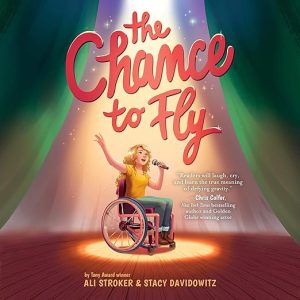
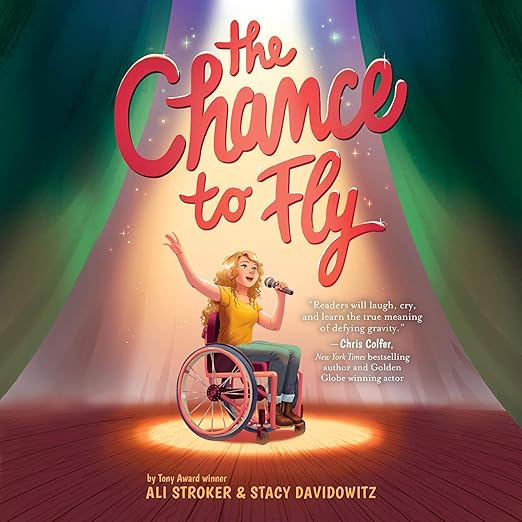
I listened to the opening chapters of The Chance to Fly on a Saturday morning while stretching after a run, which seems wrong in retrospect. This book asks for full attention, not because it is difficult, but because Ali Stroker’s narration has a quality of directness that rewards being fully present for it. By the time Nat Beacon was listing her obsessions (Warbucks the dog, wheelchair racing, musicals memorized note for note), I had stopped stretching entirely.
Ali Stroker, co-authoring with Stacy Davidowitz, is writing from a position of specific authority: Stroker is the first actress who uses a wheelchair to win a Tony Award, which she received for her performance in Hadestown. That biography is not incidental to this novel. Thirteen-year-old Nat has never seen an actor who uses a wheelchair for mobility on stage, and the book makes that absence land with quiet precision, not as tragedy, but as a gap in the world that Nat is learning to notice.
What the Audition Sequence Actually Reveals
Nat stumbling upon auditions for a kids’ production of Wicked after her family’s cross-country move to New Jersey is the novel’s structural pivot, and Stroker handles it with more complexity than the premise suggests. Nat gets into the ensemble, which is not the same as being cast in the lead, and the book is careful about that distinction. The other cast members are mostly inclusive, the synopsis tells us, with a qualifier: well, most of them. That qualifier does a lot of work across the middle section of the novel, as Nat discovers which forms of acceptance are conditional.
Stroker’s narration in the rehearsal sequences has a particular energy, she knows exactly what it sounds like when a cast is finding its chemistry, and she knows exactly what it sounds like when one person in the room is not quite safe. Both textures come through in her voice before the prose makes them explicit.
The Hamilton Problem and Why This Avoids It
A children’s novel built around theater kids auditioning for a famous musical runs the risk of becoming a catalogue of references rather than a story. The Chance to Fly skirts that trap by keeping the emotional focus on Nat’s relationship to belonging rather than on showbiz aspirations. Yes, the climactic sequence involves Wicked’s Defying Gravity being deployed as emotional metaphor, but Stroker earns it, because the setup is about Nat’s specific physical and psychological fears rather than generic stage-fright narrative.
Malik, the male lead described as the cutest boy Nat has ever seen, functions as a secondary strand of the story, one that the book handles with age-appropriate warmth without becoming a distraction from its more substantive concerns. Stroker’s narration of the Malik passages carries exactly the right degree of thirteen-year-old self-consciousness.
Disability Representation That Stays Specific
The most valuable thing The Chance to Fly does is refuse to make Nat’s wheelchair a symbol or a lesson. She uses it for mobility. The wheelchair racing team, the Zoomers, is part of her identity before the theater plot begins. There is no backstory of overcoming, just a life being lived, with the particular logistics and occasional friction that life involves.
Reader reviews note that the book opens your mind and heart into what it is like to grow up with wheels while also being funny and relatable. That balance is genuinely difficult to sustain, and Stroker and Davidowitz sustain it consistently. The audiobook version is where this pays off most visibly: Stroker’s self-narration means that the physical descriptions carry natural authority, and the comedic timing, the book is frequently funny, lands without effort.
Who Should Listen and Who Should Skip
The Chance to Fly is suited to listeners between ten and fourteen, though families listening together will find it holds adult attention comfortably. Children who use wheelchairs will find a protagonist who reflects their experience with genuine specificity. Theater kids will respond to the production sequences. Anyone navigating a recent move or a new school will recognize Nat’s combination of anxiety and determination.
Skip it if you need pure action, this is a character novel, and its pleasures are relational rather than plot-driven. The pacing is confident but not rapid.
Frequently Asked Questions
Is Ali Stroker’s self-narration noticeably different from a professional audiobook narrator’s performance?
Yes, in the best way. Stroker does not have the polish of a career narrator, but she has something more valuable for this particular book: the authority of direct experience. Her pacing in the rehearsal and performance sequences is instinctive rather than performed, and the emotional authenticity she brings to Nat’s uncertainty about casting and belonging could not be replicated by anyone reading from the outside.
Does the book handle sensory and disability content in a way that works as an audiobook specifically?
Yes. Nat’s wheelchair use is described through action and logistics rather than through lengthy interior monologue, which translates particularly well to audio. The physical environment of the theater, the practicalities of the racing team, the way crowds function, all of this comes through vividly in Stroker’s narration.
Is this a good audiobook to listen to with a child who has recently been diagnosed with a disability?
It can be, with the caveat that the novel is primarily a story about belonging and theater rather than a guide to disability experience. Nat’s character is not defined by her wheelchair, and the book’s refusal to center her disability as a problem to overcome makes it useful precisely for children who are tired of narratives that do that. That said, it is fiction, not nonfiction support material.
Does the first book in The Chance to Fly series need to be read before the second?
This first volume is self-contained, and the Wicked production arc has a full resolution by the end. A second book in the series would presumably follow Nat into new circumstances, so starting here is the right move regardless.