Quick Take
- Narration: Allyson Johnson brings a quiet emotional intelligence to ‘Lois’s first-person narration, her reading of the Mississippi sequences carries a weight that the brief runtime makes even more concentrated.
- Themes: Institutional racism and the Jim Crow South, the cost of visibility while Black, childhood’s first confrontation with injustice
- Mood: Proud, then frightened, then quietly devastating, this is a 31-minute listen that lands like something much longer
- Verdict: An essential short-form civil rights story for middle-grade listeners, best experienced with space for conversation afterward.
I heard The Gold Cadillac for the first time on a school visit years ago, when a teacher read it aloud to a class of fourth graders. The room was quiet in a way that classrooms rarely are. Mildred D. Taylor’s prose has that effect, it does not announce itself, it simply arrives with the full weight of lived experience. Allyson Johnson’s narration on the audiobook finds the same quality: nothing is performed, nothing is over-explained, and that restraint is exactly right for a story this precise.
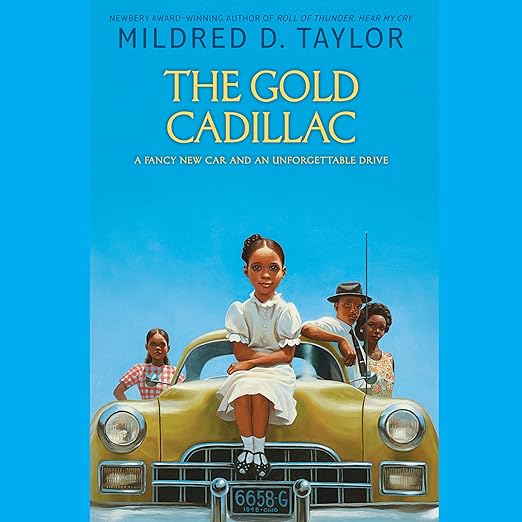
At 31 minutes, The Gold Cadillac occupies its own literary territory: not quite a picture book, not quite a chapter book, something between them that functions as a bridge. ‘Lois and her sister Wilma live in Toledo, Ohio in the 1950s. Their father buys a gold Cadillac, the first car he has owned, and decides the family will drive it south to Mississippi to show it off to their relatives. What begins as an occasion for celebration becomes, as the family travels deeper into the Jim Crow South, something entirely different. The beautiful car that meant success and pride in Ohio makes their father a target in Mississippi, and the girls encounter institutional racism for the first time in their lives.
What Taylor Accomplishes in 31 Minutes
Taylor is best known for Roll of Thunder, Hear My Cry, the Newbery Award winner that covers the Logan family in Depression-era Mississippi across a full novel’s length. The Gold Cadillac is a companion piece to that world, shorter, sharper, and in some ways more concentrated in its emotional impact precisely because it has so little room to breathe. The 31-minute runtime forces every scene to carry maximum weight. The moment when their father is stopped by police on a Mississippi road, the specific quality of that fear in a child who has never experienced it before, the difference between how Black men are treated in Ohio and how they are treated in Mississippi, Taylor communicates all of this in fragments, in glimpses, in what ‘Lois notices without fully understanding yet.
A reviewer who read it with their nine-year-old daughter described having deep conversations about discrimination, segregation, and race relations afterward, and noting that it opened her daughter’s eyes to history in a way she could easily understand. That accessibility without simplification is Taylor’s essential achievement here, and Johnson’s narration honors it by trusting the text.
Allyson Johnson’s Reading and the Weight of a Child’s Voice
Johnson performs the narration in ‘Lois’s voice, a child’s perspective, but not a childish one. The distinction matters enormously for a story like this. ‘Lois is observant and frightened and honest in the way that children are when they are witnessing something they do not yet have the language for. Johnson maintains a vocal quality that sounds young without sounding small, which allows the moments of fear and confusion to land without melodrama. Her reading of the scene where ‘Lois and Wilma are left with relatives while their father continues the drive in the Cadillac, because it is safer that way, is particularly strong. The girls do not fully understand why they have been separated from their parents, and Johnson does not explain it for them. She lets the not-knowing sit.
The Logan Family Context and Where This Fits
This book stands alone. Readers do not need to have read Roll of Thunder, Hear My Cry to understand it, and the audiobook makes no assumptions about prior familiarity with the Logan family world. What knowledge of the larger Taylor catalog does provide is additional resonance, the reader knows that the South these characters are entering has a specific and brutal history, one that Taylor documented extensively in her longer novels. For younger listeners encountering Taylor for the first time, The Gold Cadillac is an ideal entry point: brief enough to be approachable, honest enough to be meaningful, and good enough to send them toward the longer work when they are ready. The New York Times called it a personal, poignant look at a Black child’s first experience with institutional racism, the narration earns that assessment.
Who Should Listen / Who Should Skip
For children ages eight and up, ideally with a parent or teacher present for conversation afterward. This is not a difficult listen in terms of language or plot complexity, but it is a difficult listen in terms of emotional honesty, and that honesty deserves a response. Listeners who want a comfortable or gentle experience with historical racism should look elsewhere. Listeners who want Taylor’s clear-eyed, unsentimental truth-telling will find it here in its most concentrated form.
Frequently Asked Questions
Do I need to have read Roll of Thunder, Hear My Cry before listening to The Gold Cadillac?
No. The Gold Cadillac is a standalone story and does not require knowledge of the wider Logan Family Saga. It functions entirely on its own terms, though familiarity with Taylor’s longer work will add additional resonance for those who have it.
Is 31 minutes really enough time for a meaningful story about institutional racism?
Taylor is one of the few writers who can make it work. The Gold Cadillac is precisely structured, every scene is load-bearing. The brevity is part of the point: the experience of encountering racism for the first time is immediate and specific, and Taylor does not dilute it with setup. Reviewers consistently note that it prompts rich conversation despite its short length.
How does Allyson Johnson handle the narration from a child’s first-person perspective?
Johnson voices ‘Lois with a quality that sounds genuinely young without being infantilizing. She does not over-explain or emotionally signal the scenes, she trusts the text and the listener. The scenes of confusion and fear come across as experienced rather than performed, which is the right approach for this material.
What age is the right entry point for The Gold Cadillac, and how might a parent handle the harder scenes?
Most reviewers suggest ages eight to ten as an appropriate starting point. The police stop scene is the most intense moment. Having a framework in place, either a basic conversation about Jim Crow laws before listening, or a readiness to pause and discuss, will make the experience more valuable rather than confusing or upsetting.