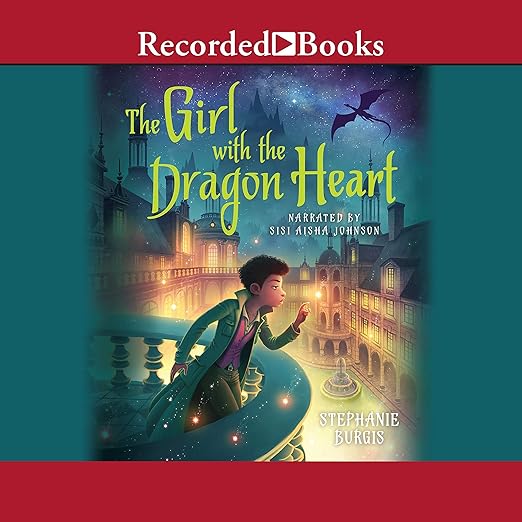
Silke arrived in Drachensburg with nothing and talked her way into the finest chocolate house in the city, which is worth knowing before this audiobook starts, because Stephanie Burgis never pauses to explain it. The second Dragon Heart book hands the story to the sidekick: the orphan promoter who can make a crowd want anything, and who has never managed to talk herself into the one thing she wants most. Somewhere safe. Sisi Aisha Johnson reads all six hours and forty-nine minutes of that attempt.
What Stephanie Burgis Delivers
R. Silva, five stars in February 2020, frames the handover precisely. The sequel to The Dragon with the Chocolate Heart puts its spotlight on the orphan refugee who has learned every street and alley in Drachensburg, and whose skill with stories brings customers through the door of the Chocolate Heart, where she works part time beside her best friend, the dragon Aventurine. What that response catches is Silke's determination to be the hero of her own story rather than the useful voice in somebody else's.
Her assignment is a spy job. The Crown Princess asks Silke to watch the Elfenwald royal family during their first visit to the kingdom, and the payment is the thing she has wanted since she arrived with empty pockets: a guaranteed place inside the palace walls. What complicates the arrangement is that Silke has her own dark reasons for distrusting fairies, reasons the book holds back for a long stretch, and the mission is nowhere near as simple as a clever girl assumed.
Burgis builds everything on one good idea: a heroine whose superpower is persuasion is also a heroine who lies, and the novel keeps testing where that line falls. Spoken aloud, the idea has an obvious hook, since every one of Silke's performances is itself a piece of speech and has to be delivered as one. The run is compact for a middle-grade fantasy, and almost none of it goes on scenery. Burgis spends it on rooms, bargains, and the exact moment a story stops being convincing to the person hearing it.
What Stephanie Burgis Gets Right
Lois Fisher, five stars in February 2021, delivers the strongest recommendation and the most useful warning in a single breath: the second entry is darker and scarier than the first. Silke lands in situations she cannot talk her way out of, and has to think and feel more than she ever wanted to. For a series that opened with a dragon who wanted to make chocolate, that is a genuine escalation rather than a marketing adjective.
Elsewhere in that same response, the scenes with the grumpy Princess Sophia get singled out as some of the best in the book, which is a good tell for what kind of sequel this is. Burgis has not rebuilt the first novel's shape with fresh decorations. She has put her most charming character in rooms with people who are immune to charm, then let the friction generate the comedy and most of the tension along with it.
For a household listening together, the pleasure is that nothing here condescends. The Elfenwald court arrives with real menace instead of pantomime villainy, the city has an economy, and the chocolate house is a workplace with customers and shifts rather than a whimsical set piece. Silke's promotional stunts are plausible pieces of business, which matters, because the whole book asks you to believe a teenager can move a kingdom by telling it what it wants to hear.
Where Stephanie Burgis Loses Some Ground
Sonya Maree, four stars, is blunt about the ceiling: a great story, but not quite as good as the original. That deserves to be taken seriously. The first book ran on a simpler engine and a more immediately lovable heroine, while Silke is prickly by design, her secrets stay buried longer, and the emotional payoff arrives late enough that a younger listener may need encouragement to stay with it through the middle stretch.
Dates complicate this response pool. Recorded Books issued this reading on January 22, 2020, and two of the five signed entries, Sonya Maree's among them, are dated December 13, 2018, more than a year before the recording existed. The five span December 2018 to February 2022 in total, and not one of them mentions Sisi Aisha Johnson or the experience of listening. For two of them, that silence is simply chronology doing its work.
One mismatch is worth flagging before you buy. The listing shelves this under children's audiobooks with a single tag, Growing Up and Facts of Life, an odd fit for a book about fairy diplomacy, dragon politics and a spy whose main skill is spinning the truth. The series line reads Dragon Heart, a truncation of the first book's title rather than a name a bookseller would recognize, so finding volume one from this page takes more work than it should.
Who Should Pick Up The Girl with the Dragon Heart
Linda Cusumano, five stars in February 2022, describes the household this series actually belongs in: a nine-year-old grandson who loved both books, a family working through them together, and a third volume, The Princess Who Flew with Dragons, already underway. That is the right frame for it. The Dragon Heart books reward being taken in order, out loud, and with somebody in the room to ask what Silke is going to do next.
Come to it after the first book rather than before. Silke's friendship with Aventurine, her position at the Chocolate Heart and her standing in the city are all established elsewhere, and this volume treats them as settled facts a listener already owns. Anyone who found the opening novel gentle should also know the fairies here are genuinely unsettling and that Silke's history involves loss the text refuses to soften on the way past. Burgis trusts a young audience with grief, diplomacy and the possibility that a friendly face is running a longer game, and she does it without a single reassuring aside.
Under seven hours, one credited reader, and a city worth spending them in. What Burgis has managed is the rare middle book that improves the first one in retrospect, because watching Silke work from the inside changes how her cheerful competence looked from the outside. Anyone who assumed the promoter was a comic sidekick will finish this one with a different picture entirely, and probably reach straight for the third.
A Few Questions About The Girl with the Dragon Heart
Do I need the first Dragon Heart audiobook before this one?
Yes. One December 2018 entry, five stars, admits to real wariness about the sequel, having loved The Dragon with the Chocolate Heart, then concludes that Silke can carry a story of her own and that hers is the more heartbreaking of the two. That comparison only works if you have heard the first.
Is this audiobook too frightening for younger listeners?
It is a step up from the opening book. The Elfenwald visitors are written as a real threat rather than decoration, the city itself ends up in danger, and Silke's distrust of fairies is rooted in loss. Nothing is graphic, but the menace is sustained and the resolution comes late in the run.
How long is the recording, and who narrates it?
A six-hour, forty-nine-minute run, narrated by Sisi Aisha Johnson for Recorded Books and released in January 2020. That makes it a compact middle-grade listen, roughly two long evenings, and a single-reader format suits a novel that is largely one character talking her way into and out of rooms.
How does Silke differ from Aventurine as a lead?
Aventurine's arc ran on appetite and transformation. Silke's runs on safety. She is a refugee who built her position out of nothing but talk, so her victories are social rather than physical, and the fear of losing the ground she has gained drives every choice she makes inside the spying plot.