Quick Take
- Narration: Arthur Morey brings the Cold War-era American atmosphere alive with a steady, warm authority that suits both the historical setting and the emotional weight of Snowman’s story.
- Themes: Second chances, immigrant perseverance, the bond between horse and rider
- Mood: Hopeful and quietly triumphant, the audiobook equivalent of a long slow-motion victory lap
- Verdict: A rare children’s adaptation that honors the source material without dumbing it down, and a genuinely moving listen for equestrian fans of any age.
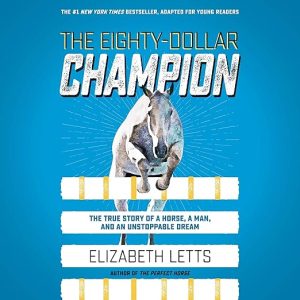
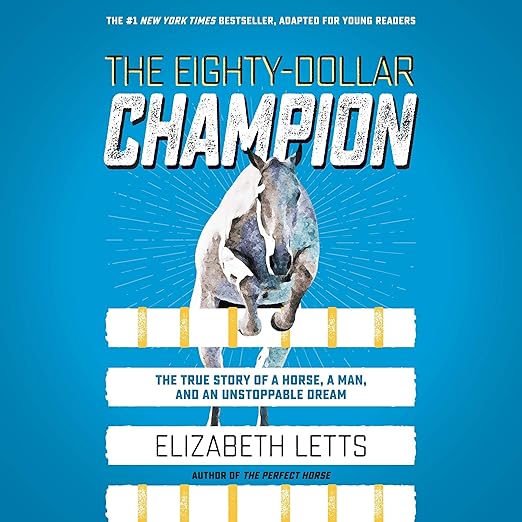
I was halfway through the first chapter when I realized I had completely forgotten I was supposed to be evaluating this. That doesn’t happen often. The story of Harry de Leyer and Snowman, the horse bought for eighty dollars from a slaughterhouse truck and trained to the summit of competitive show jumping, is one of those true stories that would feel implausible as fiction. Elizabeth Letts’s adult version was a number-one New York Times bestseller for good reason. The question for this young readers adaptation is whether the compression loses what made the original essential, and the answer, pleasingly, is mostly no.
The core of the story arrives intact: Harry, a Dutch immigrant with a modest farm in Long Island, buys a broken-down horse on impulse, takes him home, sells him to a neighbor out of financial necessity, and then watches the horse escape and return. That return is the pivot on which the entire book turns. When Snowman showed up back at Harry’s barn dragging an old tire and a broken fence board, Harry understood something he had missed before. The horse had chosen him. From that point, the story of training Snowman for competitive show jumping, an absurdly ambitious project with a horse that had no pedigree for it, becomes an allegory for the immigrant dream that Harry himself embodied.
Arthur Morey and the Sound of Cold War America
Arthur Morey is one of those narrators who becomes inseparable from the material after a certain number of pages. His voice has a quality that suits period nonfiction particularly well, a warmth and cadence that places you in the historical setting without becoming stagey. The Cold War-era Long Island atmosphere that Letts invoked in the adult edition translates through Morey’s delivery: a sense of a time when ordinary people could still become heroes in ordinary sports, before professionalization made elite competition inaccessible. He handles the show jumping sequences with appropriate urgency without losing the reflective quality that makes the biographical sections work.
What the Young Readers Adaptation Changes
Young readers editions of adult bestsellers always involve trade-offs. The adult version of The Eighty-Dollar Champion was condensed to a roughly 170-page young readers edition. At 6 hours and 31 minutes of audio, it’s a substantial listen, nearly comparable to the adult version in runtime, which suggests the adaptation was conservative about trimming. What typically gets condensed in young readers editions is the historical and contextual scaffolding: the Cold War references, the class dynamics of competitive equestrian sport, the technical details of show jumping training. Based on how the audiobook sounds and what reviewers describe, Letts preserved the emotional architecture while lightening the social history.
That’s the right call for this specific story. Snowman’s journey doesn’t need extensive historical explanation to resonate, the emotional logic of a rescued animal refusing to leave is universal. The immigrant story requires slightly more context, but Letts trusts young readers to follow Harry’s determination without needing a sociology lecture around it. One reviewer specifically noted the history and atmosphere as strengths even in this edition, which suggests the social dimension wasn’t entirely sacrificed.
For Animal Lovers and History Buffs Alike
The synopsis uses this phrase, and for once it’s accurate rather than promotional. This is genuinely a book with two entry points. The horse story works completely independently: an animal with nothing going for it, redeemed by a connection with the right person, trained against all expectation to compete at the highest level. The human story, a Dutch immigrant building something extraordinary in postwar America, works independently too. That dual accessibility is why the adult book crossed over so broadly, and it’s why the young readers edition can find readers who care about animals, history, immigration, or any combination of the three.
The Seabiscuit comparison in the original reviews is apt as a tonal reference, though Snowman’s story is more intimate and less epic in scope. The praise from Gwen Cooper, author of Homer’s Odyssey, points to the right emotional register: this is a book about what can grow from unexpected bonds, and it earns its conclusion without manipulation.
Who Should Listen and Who Should Skip
Essential listening for young equestrian fans and horse-loving children from about age 9 upward. Adults who haven’t read the adult version will find this a satisfying introduction to the story. Those who loved the original may find the young readers adaptation slightly thin on historical context, but Morey’s narration makes the listening experience worthwhile on its own terms. Not recommended for listeners who need plot complexity, the story is straightforward, and it’s the emotional resonance rather than narrative surprise that carries it.
Frequently Asked Questions
Is this adaptation significantly different from the adult version of The Eighty-Dollar Champion?
The core story, Harry de Leyer buying Snowman, selling him, the horse’s return, the training for show jumping, is fully intact. The young readers edition compresses the historical and social context around the story, particularly the Cold War atmosphere and class dynamics of elite equestrian sport, while preserving the emotional arc.
Do you need prior knowledge of show jumping to follow the competitive sequences?
No. Letts explains the relevant elements of show jumping as they become important to the story. The focus is on the stakes and the drama of each event rather than technical instruction. Young listeners with no equestrian background will follow the story without difficulty.
Is Arthur Morey’s narration appropriate for younger children, or does it skew toward older listeners?
Morey’s style is measured and somewhat literary, which suits children aged 9 and up who can follow a sustained narrative. Very young children under 8 may find the pace too contemplative. The content is appropriate from about 8 years old, but the listening experience is most rewarding from 10 upward.
Is this based on a true story, and what is the verified historical basis?
Yes, completely true. Snowman was a real horse, Harry de Leyer was a real Dutch immigrant farmer and equestrian trainer, and the show jumping victories depicted in the book happened as described. Letts developed the narrative from accounts including direct recollections of Harry de Leyer himself, referred to in the synopsis as the Flying Dutchman.