Quick Take
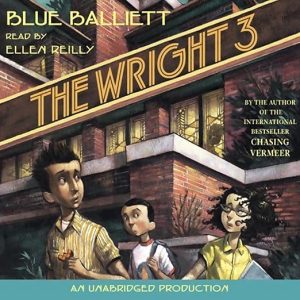
- Narration: Ellen Reilly handles the three-kid dynamic and the atmospheric strangeness of the Robie House sequences with steady craft, giving each young protagonist a distinct presence.
- Themes: Art and architecture as worth fighting for, the intersection of pattern and mystery, friendship tested by danger and differing loyalties
- Mood: Intricately atmospheric, like solving a puzzle in a building that may or may not be haunted
- Verdict: Blue Balliett’s sequel expands the Chasing Vermeer universe into architectural history with the same puzzle-dense ambition, and Reilly’s narration guides listeners through its layered mysteries with clarity and atmosphere.
I spent a year of my early career writing for a design magazine, and Frank Lloyd Wright was the name that appeared in practically every conversation about American architecture as both subject and specter. The Wright Three arrived at precisely the right moment in my listening rotation: a week when I had been thinking about buildings that matter and the question of who gets to decide their fate. Blue Balliett’s novel centers exactly that question, framed as a mystery for eleven-year-olds but built with enough structural complexity to hold up for considerably older readers.
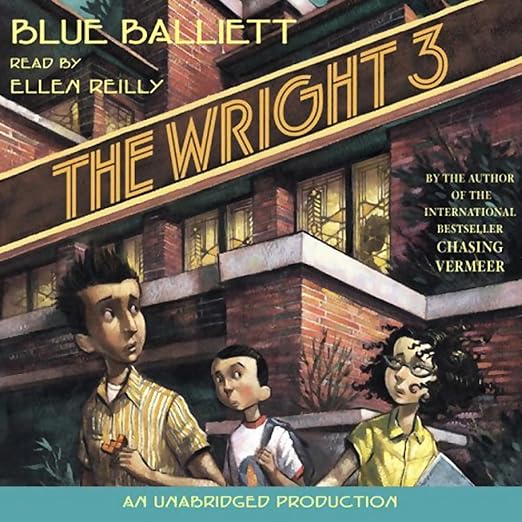
This is the second book in the Chasing Vermeer series, following Calder and Petra’s first collaboration on an art mystery. The Wright Three adds Tommy, Calder’s old friend who has a rare talent for finding things, and shifts the setting from Vermeer’s paintings to Frank Lloyd Wright’s Robie House in Chicago’s Hyde Park neighborhood. The book appeared in 2006 and has remained in print, finding new audiences with each generation of readers who encounter it in school settings. Ellen Reilly’s narration brings the atmospheric strangeness of the Robie House to life with the kind of measured mystery that suits Balliett’s densely layered prose style.
A Building Worth Fighting For
Balliett’s central gambit is to make her young readers care about a building, specifically about whether a particular Frank Lloyd Wright architectural masterpiece survives demolition pressure or gets torn down. This is a harder narrative task than it might appear. Buildings do not have faces or voices; their significance must be demonstrated rather than asserted. Balliett approaches the problem through the kids’ sixth-grade class, which gets drawn into the preservation effort before the eerie events begin, the floating voices, the shadows behind the art-glass windows, the roof that seems to move. By the time the supernatural dimension enters, readers already have a stake in the building’s survival that is not dependent on the mystery elements. Reilly gives the atmospheric passages their proper weight, resisting the temptation to play them as horror when they are really closer to wonder.
Pentominoes, Patterns, and Coded Messages
The Chasing Vermeer series is built on the conviction that art and mathematics share a deep structural relationship, and Balliett makes that conviction concrete through plot rather than instruction. Calder’s lifelong relationship with pentominoes, geometric shapes that can be combined and rearranged into patterns, becomes a key to unlocking the coded messages Wright left behind. One reviewer noted that the book works as a geometry study activity, which is both accurate and interesting evidence of how effectively Balliett integrates mathematical thinking into narrative structure. The puzzle elements are dense enough to reward close attention without being opaque to listeners who are not themselves mathematically inclined. Reilly handles the puzzle sequences with clarity, keeping the logic accessible without flattening the mystery.
Tommy, Calder, Petra, and the Dynamics of Three
The addition of Tommy to the duo of Calder and Petra creates the inevitable complications of a triangular friendship: old loyalty versus new, the adjustment of established dynamics to accommodate a third perspective, the particular pressure that comes from being the returning friend who no longer quite fits the relationship that formed in his absence. Balliett uses these dynamics with narrative intelligence rather than melodrama. Tommy’s talent for finding things is not simply a plot device; it is the quality that makes him valuable to the investigation and simultaneously the quality that keeps being tested by what the investigation asks of him. Reilly gives Tommy a distinct voice that holds its own against the well-established presences of Calder and Petra.
Who Should Listen and Who Should Skip
The Wright Three is best experienced after Chasing Vermeer; the character relationships and the established world of art mystery carry more weight with prior context. Suited to ages nine through thirteen, with particular resonance for listeners drawn to architecture, pattern, and puzzle-dense mysteries. The atmosphere is more intense in places than typical middle-grade fare; the eerie events around the Robie House are genuinely unsettling rather than merely decorative. Reviewers have described finishing the book with a desire to visit the Robie House in Chicago, which is the best possible evidence that Balliett has done her job. Listeners interested in American architectural history as a subject will find the background material both accurate and made genuinely compelling by its narrative frame.
Frequently Asked Questions
Is The Wright Three accessible to listeners who have not read Chasing Vermeer?
Balliett provides enough context for new readers to follow the story, but the character dynamics and the established relationship between Calder and Petra carry significantly more resonance with the first book as background. Starting with Chasing Vermeer is the stronger choice.
How accurate is the historical and architectural information about Frank Lloyd Wright and the Robie House?
Balliett conducts thorough research, and the information about Wright’s life, his architectural philosophy, and the Robie House’s history is well-grounded. The book has been used in educational settings specifically because of the quality of its art and architecture content.
Does The Wright Three resolve the supernatural elements rationally, or does it leave the ghostly dimension open?
Balliett handles the ambiguous elements in her characteristic style, allowing for both rational and uncanny interpretations. The mystery has a solution, but the atmosphere of the Robie House retains its strangeness beyond the plot resolution.
How does Ellen Reilly’s narration handle the pentomino and mathematical puzzle sequences?
Reilly keeps the logic accessible without over-explaining, maintaining the mystery atmosphere through the mathematical passages. She treats the puzzle elements as integral to the story rather than as a detour, which is the right approach for Balliett’s structural intentions.