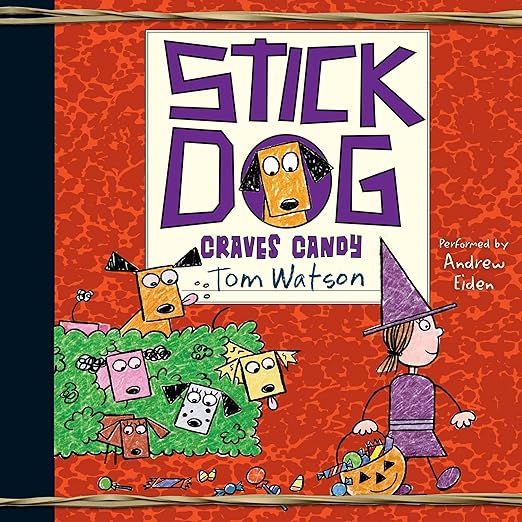
Quick Take
- Narration: Andrew Eiden is a reliable presence throughout the Stick Dog series, delivering Tom Watson’s dry observational humor with the deadpan timing it requires.
- Themes: Halloween adventure, canine loyalty and strategy, comic misadventure
- Mood: Gleefully chaotic and funny, with the same warm irreverence that defines the whole series
- Verdict: A fully reliable seventh entry in a series that continues to reward its audience with well-timed humor and a narrator who has found the exact frequency these books need.
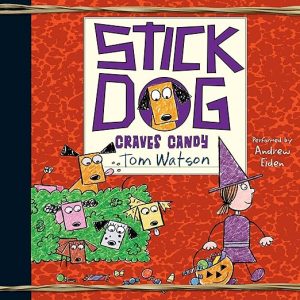
I played this one through during a long drive on the Saturday before Halloween, with two kids in the back seat who had already read several earlier Stick Dog books and were loud about wanting more. By the time the gang encountered the first witch, both children were laughing, and by the haunted house sequence one of them had started narrating along from memory with bits they were clearly making up on the spot. That is the Stick Dog effect. Tom Watson has built something genuinely replicable: a formula that never gets boring because the characters’ specific individual wrongheadedness is always surprising within its constraints.
Stick Dog Craves Candy is Book 7 in the series, and the Halloween setting gives Watson the best possible premise for his central joke, which is that Stick Dog is the only one in his gang with any situational awareness, and this makes his life very difficult. The gang discovers trick-or-treating, deduces that little humans in costumes are carrying orange buckets full of candy, and pursues that candy with the relentless single-mindedness that drives every book in the series. The witches are genuinely terrifying to the dogs. The haunted house is completely wrong in the ways that only Stick Dog books can make completely wrong.
The Voice of Andrew Eiden and Why It Works for Watson’s Humor
Tom Watson writes in a first-person narrative voice that is doing several things simultaneously: it is Stick Dog telling the story, it is Watson himself commenting on the narrative, and it is a direct address to a child reader that constantly acknowledges the child is sitting there listening. Andrew Eiden has been with this series long enough to have fully internalized that layered voice. He does not perform it as much as inhabit it, which is the crucial distinction.
Watson’s humor depends on timing in a way that not all children’s fiction does. The narrator’s observations about his friends’ logic, which is always impeccable within its own framework and completely disconnected from reality, need the slight pause before the deadpan commentary to land correctly. Eiden gives those pauses exactly the right weight. The comedy in this series would collapse without a narrator who understands that silence is part of the joke.
What Halloween Does for the Formula
One of the pleasures of the Stick Dog series is watching Watson introduce each new food source as if it is the most bewildering and magnificent thing the gang has ever encountered, and candy triggers this response magnificently. The dogs’ attempts to understand what Halloween is from first principles, working from the evidence of costumes and orange buckets and houses with lights on, has the quality of the best children’s comedy: it is logic applied rigorously to the wrong framework.
The haunted house sequence is the standout set piece of the book, and the witch subplot maintains momentum throughout. Watson is careful to give each member of the gang their specific role in the chaos, which is part of why this formula holds across seven books without repetition feeling stale. Each character is consistently themselves, which means each book is a new application of known variables rather than a reset.
A Word on Vocabulary and Reading Aloud
One parent reviewer specifically called out Watson’s use of vocabulary, noting that there were always a few words that prompted meaningful conversations about meaning through context clues. This is not accidental. Watson writes for emerging readers with genuine respect for their capacity, and the audiobook format benefits from this because Eiden’s reading makes context-building from oral comprehension natural. A word a child might skip over in print becomes a moment of curiosity when they hear it clearly articulated in a sentence they are following closely.
Another reviewer noted that her son had been reading about a book every two to three days in the series, which is the sign of a series doing everything right: it is satisfying enough to finish, compelling enough to start the next one immediately. Stick Dog Craves Candy holds that momentum.
Who Should Listen and Who Should Skip
This is Series 7 but it is entirely accessible as a first entry; the books do not depend on series continuity. The humor and reading level are aimed at roughly six to ten year olds, though one reviewer noted a kindergartener working through them with reading skills that outpaced their age. The Halloween setting makes this an obvious October listen, but the candy pursuit plot is funny in any month. Adults reading aloud will find themselves actually laughing, which is the highest compliment a children’s comedy book can receive.
Frequently Asked Questions
Do you need to have read the earlier Stick Dog books to enjoy Stick Dog Craves Candy?
No. Each Stick Dog book is designed to work as a standalone entry. The characters are consistent across the series and returning readers will appreciate the established dynamics, but a child picking this up as their first Stick Dog book will have no trouble following the story or enjoying the humor. The Halloween setting actually makes it a natural entry point.
Is there any content in the Halloween themes that might be too scary for younger children?
No. The scary elements, including witches, ghosts, and a haunted house, are filtered entirely through the dogs’ comic misunderstanding of them. The tone is consistently silly rather than frightening. Even children who are sensitive to Halloween themes should find this version of the holiday warm and funny rather than threatening.
How does Andrew Eiden’s narration handle the different dog characters?
Eiden gives each dog a consistent vocal identity that is differentiated enough to follow clearly without being cartoonishly exaggerated. His handling of the narrator-who-is-also-a-character dynamic is particularly strong, capturing Watson’s direct-address humor without losing the story’s momentum. By Book 7 he has fully settled into these characters and it shows.
My child loved this book. Where should we go next in the series?
The series runs in publication order and any of the earlier books work as next steps since each is thematically distinct. Stick Dog Wants a Hot Dog and Stick Dog Chases a Pizza are frequently mentioned as favorites in the series and make natural next listens. The food-pursuit formula holds consistent quality across all entries.