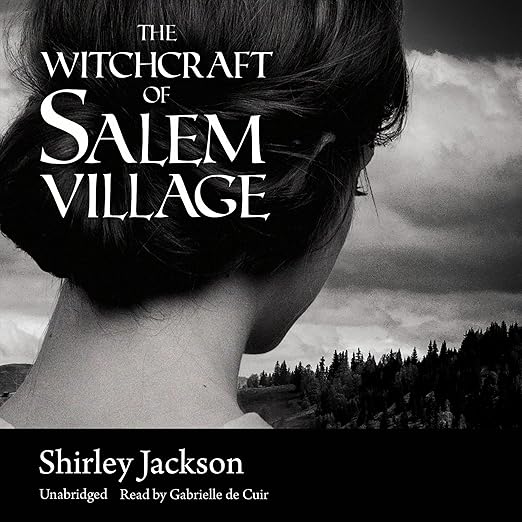
Shirley Jackson's range as a writer is one of the more striking facts in twentieth-century American literature, and The Witchcraft of Salem Village is evidence of it in a form that often surprises readers who know her only from The Lottery or The Haunting of Hill House. This audiobook, narrated by Gabrielle de Cuir, brings Jackson's account of the 1692 Salem trials to listeners at three hours and nine minutes, part of the beloved midcentury Landmark Books series of accessible history for young readers. The connection between this nonfiction work and Jackson's horror fiction is more direct than it might first appear, and following that connection rewards adult listeners as much as it serves younger ones.
Where This One Lands
Jackson is uniquely suited to write about Salem precisely because her literary preoccupations map directly onto the dynamics that produced the crisis. Her fiction returns obsessively to communities as vehicles for collective cruelty, to the fragility of social belonging, to the ease with which accusation becomes consensus before anyone pauses to demand evidence. The 1692 trials are a historical case study in exactly those dynamics, and Jackson brings to them the analytical clarity of a writer who has spent years understanding how fear becomes persecution before anyone fully intends it to.
She examines the progression from a group of young girls listening to Tituba's forbidden stories to the whirlwind of accusations, trials, and executions with careful documentary detail. The causal chain is rendered clearly enough for younger listeners to follow and precisely enough for adult readers to find it historically credible. What Jackson does that most children's histories avoid is refuse to simplify the moral structure. The girls are frightened, not simply malicious. The magistrates believe they are protecting their community. The accused are trapped in a system that offers no mechanism for proving innocence. By presenting these dynamics without reassigning them to cartoon villainy, Jackson produces an account of Salem that is more genuinely disturbing than most dramatizations of the same material, precisely because it requires no one to be a monster.
One reviewer who remembered reading the book in elementary school described the experience of returning to it as an adult as deeply rewarding. Another who bought it without realizing it was written for juvenile readers found Jackson's prose and the quality of historical engagement strong enough to satisfy adult standards. Both responses speak to the same quality in Jackson's writing: she does not condescend to young readers by removing complexity, and she does not perform literary sophistication at the expense of clarity. The result travels across audiences in both directions.
Why The Witchcraft of Salem Village Works as an Audiobook
Gabrielle de Cuir's narration is a significant asset to this audiobook. The material is short but covers events that are genuinely distressing: false testimony, wrongful imprisonment, and executions. De Cuir maintains a careful, dignified tone throughout that respects both the historical gravity of the events and the young audience the book was originally written for. She does not underplay the tragedy or permit the horror to recede into background detail, but she does not dwell in it gratuitously either. That balance is exactly what this material requires from a narrator, and de Cuir finds it consistently across the three-hour runtime.
The audio format serves Jackson's prose particularly well. One reviewer described the book as nonfiction that reads like fiction, and that quality is amplified in listening: Jackson's narrative control, her ability to build tension through sequencing and the deliberate withholding of information, means the three hours move with the pace of a well-constructed short novel rather than a textbook summary. The 1692 events become present-tense in de Cuir's reading rather than historical artifact, which is exactly how Jackson intended them to register.
The runtime of three hours and nine minutes makes this audiobook unusually flexible in terms of when and where it can be heard. A single long walk, an afternoon in the garden, a car trip with an older child: the length accommodates all of these listening contexts without demanding the sustained commitment of a longer work. For parents or educators looking for an audiobook to share with children in the ten-to-fourteen age range, that accessibility is a practical advantage as much as an aesthetic one.
What Gives Us Pause
The opening sections on Salem Village as a community, its social tensions, its religious climate, and its particular susceptibility to the kind of fear that produces mass accusation, are worth close and sustained attention. Jackson is not treating the witchcraft trials as an inexplicable outbreak of hysteria but as a comprehensible, if horrifying, response to specific social and theological conditions. The careful setup she provides in the early chapters makes the escalation feel logical rather than insane, which is more frightening than the alternative. If the crisis were simply irrational madness, it would be comforting in its distance from ordinary social life. Jackson's version is not comforting at all.
The treatment of Tituba is handled with more nuance than many popular accounts manage. Jackson's account of Tituba's storytelling as the catalyst for the crisis acknowledges her role without reducing her to a convenient scapegoat or to a straightforwardly culpable figure. Listeners who know the broader historiography of Salem will recognize that Jackson is writing before many of the twentieth-century revisions of the Tituba narrative, but her treatment is more careful than many popular accounts that came after her.
The figure of Samuel Parris, the minister whose household becomes the crisis point, is also worth watching throughout the audiobook. Jackson's portrait of him is not unsympathetic, which makes it more damning than a straightforward condemnation would be. He is a man responding to extraordinary pressure in ordinary human ways, and the result is catastrophic.
The Right Listener for The Witchcraft of Salem Village
Middle-grade and young adult listeners encountering the Salem trials for the first time will find this audiobook appropriately serious, clear, and written by one of American literature's genuine talents who trusted young readers with complexity. Parents and educators looking for an accessible, authoritative introduction to the 1692 events will find it age-appropriate without being sanitized. Adult listeners who want a short, literary, and well-crafted account of the trials will find Jackson's prose rewarding even if the material is already familiar. Those seeking a comprehensive academic treatment of Salem, covering current historiography, the social and economic dimensions of the accusations, or Tituba's full biography, should pair this audiobook with longer adult histories of the period. Fans of Jackson's fiction who want to trace the connection between her horror sensibility and historical reality will find this audiobook illuminating for reasons that extend far beyond its subject matter.
Frequently Asked Questions
Is this audiobook appropriate for children, and what age range does it suit best?
The Witchcraft of Salem Village was originally written as part of the Landmark Books series for young readers, typically aimed at readers aged ten and up. The content covers executions and wrongful imprisonment, but Jackson treats these events with appropriate gravity rather than graphic detail. Reviewers who encountered it in elementary school remember it as both suitable and memorable, and it holds up equally well for middle school listeners approaching it for the first time.
How does knowing Shirley Jackson from The Lottery change how this audiobook reads?
Significantly, and rewardingly. Jackson's preoccupations in her fiction, collective cruelty, the ease with which communities turn on individuals, the fragility of safety within social structures, are exactly the dynamics she traces in the Salem trials. Listeners who come to this audiobook from her horror work will find the connection immediate and illuminating. Reviewers have specifically described the experience of returning to the book as an adult after reading The Lottery as particularly resonant for this reason.