Quick Take
- Narration: Adam Verner brings the right energy to this finale, distinguishing the three main voices with clarity and matching the book’s escalating stakes without tipping into melodrama.
- Themes: Friendship under pressure, alternate-history mystery, the cost of knowing secrets
- Mood: Propulsive and emotionally charged, with a satisfying sense of closure
- Verdict: A strong series conclusion that rewards patient listeners who’ve followed Tess, Theo, and Jaime from the start.
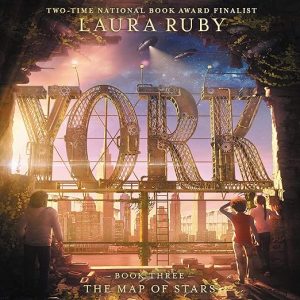
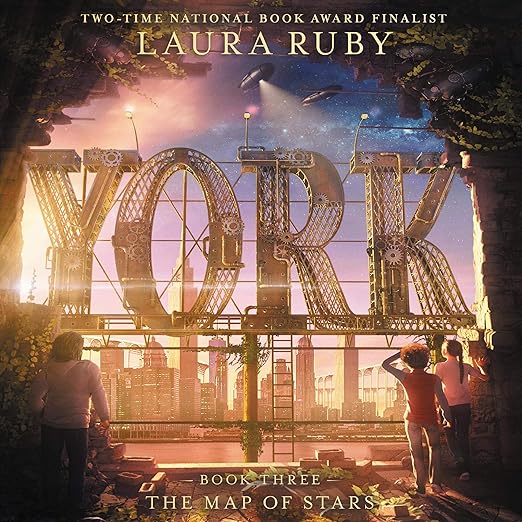
I came to the York trilogy late, finishing the first two books back to back over a weekend before immediately queuing up The Map of Stars. By the time the third volume opened, I was fully invested in what Laura Ruby had built: an alternate New York threaded through with impossible architecture, a cipher spanning a century and a half, and three middle schoolers who kept finding themselves in over their heads. The Map of Stars had a lot to deliver, and listening to Adam Verner navigate the final stretch was a genuinely satisfying experience.
There is a particular pressure that falls on concluding volumes. The Clockwork Ghost had raised stakes in ways that felt almost cruel, and plenty of readers I know were nervous about whether Ruby could stick the landing. Reviewer Neal D. put it well: it is rare for a final book to perfectly wrap up a trilogy, and this one comes remarkably close. That is, I think, the honest critical verdict here.
The Friendship Fracture at the Center of Everything
What separates The Map of Stars from a straightforward puzzle-adventure is that the central conflict is not Darnell Slant or the mysterious Morningstarr technology. It is the crack running through the friendship between Tess, Theo, and Jaime. Jaime believes they have been hiding things from him, and that suspicion sits in the middle of the story like a splinter. Ruby has always been interested in the emotional texture of these relationships, and here she makes the friendship itself the most pressing thing to save, more pressing even than the fate of multiple worlds.
Verner handles this material well. His Jaime carries a different quality of hurt than his Tess or his Theo, and the scenes where the trio is fractured have a genuine weight to them. He never overplays the resentment, which would have been easy to do, keeping it at a register that feels like real twelve-year-old grievance rather than theatrical estrangement.
What the Morningstarrs Were Actually Building
The revelation that Darnell Slant knows the Morningstarr buildings hold a power their creators never publicized is the engine that drives the plot forward. Ruby has been careful throughout this trilogy not to make the cipher feel arbitrary, and here the payoff arrives with some elegance. The way the book explains the Morningstarrs’ true project, and what it means for Tess and Theo specifically, lands with the kind of clarity that complex alternate-history fantasy often struggles to achieve. Neal D.’s observation that the author laid out explanations in a way that even a non-specialist reader could follow is accurate.
The alternate New York has always been the atmosphere here. The city’s strange architecture, its impossible transit systems, its layered history, all of it accumulates to give the resolution genuine emotional grounding. When the final pieces fall into place, it matters because Ruby has spent three books making you believe in this version of the world.
A Finale That Earns Its Scope
There is a moment late in The Map of Stars where the stakes expand to include not just Tess, Theo, and Jaime’s world, but possibly others. Ruby handles this with more restraint than you might expect from a middle-grade adventure, and the fact that she does not reach for easy cosmological spectacle at the expense of character is the book’s best quality. The resolution is satisfying precisely because it comes back to the human scale: three friends, one friendship, one city.
This is the third volume in a series, and I would strongly discourage starting here. York: The Shadow Cipher establishes everything that makes this finale resonate. Listeners who have been with the series will find the concluding chapters genuinely moving. One reviewer noted that nearly all their questions were answered, which is a generous assessment, though I would say a few threads remain intentionally frayed in ways that feel honest rather than incomplete.
Who Should Listen, Who Should Skip
If you have already listened to The Shadow Cipher and The Clockwork Ghost, this is a straightforward recommendation. If you have not started the series, begin at the beginning and listen to them close together. The plot connectivity is significant enough that a cold start here would lose most of what makes the ending work. Listeners who want a clean puzzle-box mystery with a tidy bow will find this slightly more emotionally complicated than that, which is a feature, not a flaw. Those who are sensitive to cliffhanger structures in the middle volumes should know that the finale does resolve its major threads.
Frequently Asked Questions
Do I need to listen to the first two York books before starting The Map of Stars?
Yes, absolutely. The Map of Stars is the direct conclusion to York: The Shadow Cipher and York: The Clockwork Ghost. The plot picks up immediately after the second book’s events, and the emotional weight of the finale depends on knowing these characters and their history.
Does Adam Verner’s narration distinguish between Tess, Theo, and Jaime effectively?
Yes. Verner gives each of the three protagonists a distinct vocal quality and manages the scenes of conflict between them without overplaying the drama. He has been the narrator throughout the trilogy, so his familiarity with these characters shows by the final volume.
Is the Morningstarr cipher actually resolved, or does the series end on another cliffhanger?
The cipher is resolved, along with the question of Darnell Slant and the mysterious power hidden in the Morningstarr buildings. Most reviewers note that the ending ties up the major threads, though Ruby leaves some emotional ambiguity in place, which feels appropriate for the story she has told.
What age range is The Map of Stars best suited for?
The series is generally aimed at readers around ages 10 to 14, and this finale handles some emotionally complex material around friendship, secrets, and the cost of knowledge. It is a strong fit for middle graders who enjoy history, action, and mystery, particularly those who like their fiction to take the characters seriously.