Quick Take
- Narration: The narrator is uncredited, a recurring limitation of the Graphic History series format. The delivery is functional and classroom-appropriate but lacks distinguishing character.
- Themes: Disaster and human response, class inequality aboard the Titanic, the limits of technology
- Mood: Clipped and factual, suited for short educational sessions
- Verdict: An 11-minute entry point into the Titanic story that works best as a classroom primer or a spark for children who will then want to go deeper.
The first time I encountered the Graphic History series was at a school book fair, buried in the nonfiction section between some struggling Magic Tree House spinoffs and a coffee-stained Bill Nye tie-in. A third grader was already holding three of them, working through them with the focused intensity children bring to short things they find genuinely interesting. That image has stayed with me. These are not audiobooks for the long commute or the sustained afternoon session. They are eleven minutes of focused history, and when they are good, they make that eleven minutes count.
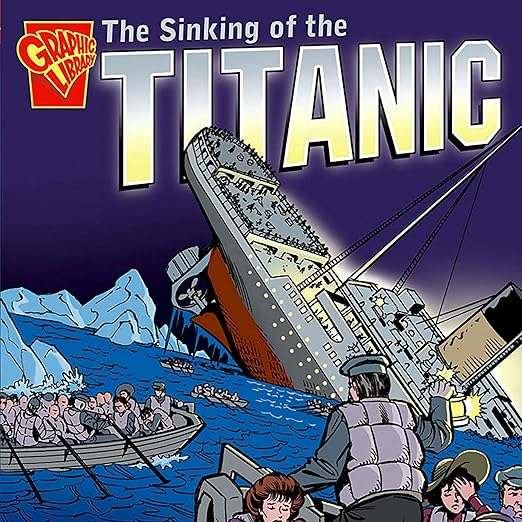
Matt Doeden’s entry on the Titanic is a solid representative of what the Graphic History format does well. The 1912 sinking is one of those historical events that children arrive at with strong preexisting interest: the iceberg, the inadequate lifeboats, the distress signals, the 1,500 deaths. The audiobook’s job is to organize that interest into accurate historical context without overwhelming a young listener.
What Eleven Minutes Can and Cannot Do
At eleven minutes, this is not a comprehensive account of the Titanic disaster. It is an introduction: the essential facts delivered in narrative form, sufficient to orient a child who has seen the film or heard the story referenced but wants the historical grounding. The Graphic History series originated as illustrated books designed for classroom use, and the audio conversion retains that educational directness. There are no digressions, no extended character portraits, no attempt to replicate the full dramatic weight of the event.
This is precisely its utility. A teacher working a third-grade unit on disasters or transportation history can use this audiobook as a brief primer before a broader discussion. A child who has become Titanic-obsessed and wants to know what really happened before graduating to longer treatments can start here. A parent who wants to explain the Titanic to a young child without committing to a feature film has a clean, factually grounded option.
The Classroom Endorsement Pattern
The reviews for this title are notably classroom-oriented. One reviewer used the series to teach leveled reading in a college education course. Another notes using them with third graders who seek out new entries and track which ones they have covered. A third purchased it for a student who was fascinated by the Titanic specifically. This is a title that functions as curriculum infrastructure rather than leisure listening, which is not a criticism but a description of what it is built for.
The uncredited narrator is worth noting for families and educators. The Graphic History audio series does not consistently credit its narrators, which is a production limitation that affects how you evaluate the listening experience. The performance here is competent and appropriately paced for young listeners, but there is no distinctive voice presence that would make a child seek out other titles narrated by the same person.
Where to Go After Eleven Minutes
The value of this audiobook is partly in what it points toward. A child who listens to this and wants more has obvious next steps: the I Survived the Sinking of the Titanic novel by Lauren Tarshis for fiction, or a longer nonfiction treatment for readers ready to go deeper. At a 4.2 average rating from 257 listeners, this is not the strongest entry in the Graphic History series by community consensus, but it holds its own as a brief, accurate account of one of history’s most discussed maritime disasters.
Who Should Listen, Who Should Skip
This audiobook is designed for elementary students in grades two through five and works best in that context. Independent young readers curious about the Titanic will find it useful but brief. Adults seeking any kind of depth or narrative richness will not find it here. This is a classroom tool rather than a listening experience, and it does not pretend to be otherwise. For what it is, it does its job well.
Frequently Asked Questions
Is eleven minutes really long enough to tell the Titanic story meaningfully for young students?
For an introduction aimed at elementary students, yes. The audiobook hits the essential facts, including the voyage, the iceberg strike, the lifeboat shortage, and the rescue, with enough context to orient a young listener. It functions as a starting point rather than a complete account, which is the appropriate scope for the Graphic History format at this age level.
Is the narrator credited, and does the narration quality affect the listening experience significantly?
The narrator is not credited in the available metadata, which is a recurring characteristic of the Graphic History audio series. The performance is clean and appropriate for the target age group but lacks a distinctive presence. For an eleven-minute educational title, this is a minor limitation rather than a significant one.
How does this fit into a classroom unit on the Titanic or on early 20th century history?
It works well as a brief audio introduction at the start of a unit, or as a comprehension check after students have encountered the topic through other materials. The concise format and factual delivery make it easy to integrate into lesson plans without requiring significant class time.
Is this the same as the Graphic History print book, or does the audio version add anything?
The audio version is a direct adaptation of the print text. The print version includes illustrated panels and visual elements that do not translate to audio, so listeners who have access to the print book will get the fuller experience. The audio works independently but loses the visual component that is central to the Graphic History series’ original design.