Quick Take
- Narration: Kevin R. Free handles Joseph Fink’s unlikely four-person ensemble with distinct vocal registers for each character, giving the seven-hour runtime the variety it needs to sustain momentum.
- Themes: Growing up and letting go, community in crisis, the line between imagination and reality
- Mood: Atmospheric and propulsive, with genuine warmth underneath the eerie surface
- Verdict: Fink’s first middle-grade novel translates remarkably well to audio, and Free’s narration earns every one of the book’s seven hours.
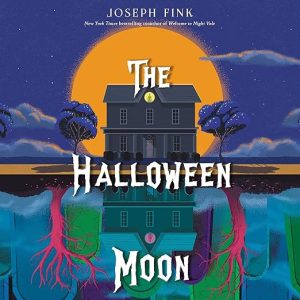
I finished the last two hours of The Halloween Moon on October 30th, sitting in my car in the driveway because I didn’t want to pause it to go inside. That specific experience, the driveway listen, where you sit in a dark car rather than interrupt a story, is a reliable indicator for me. It happens maybe four or five times a year. This was one of them.
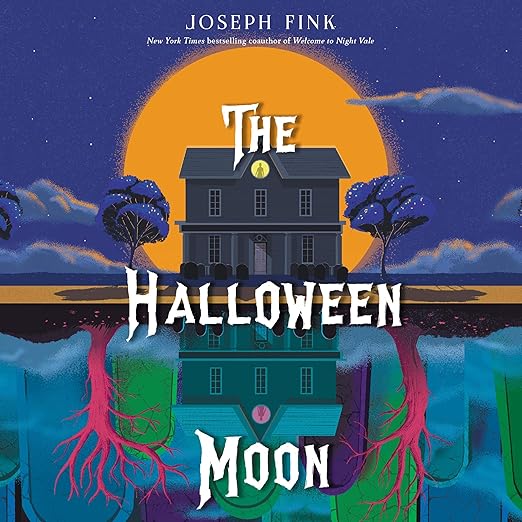
Joseph Fink is best known for Welcome to Night Vale, the long-running horror-comedy podcast that turned small-town supernatural unease into a genuine literary subgenre. The Halloween Moon is his first middle-grade novel, and it carries the Night Vale DNA without being a Night Vale product. Esther Gold loves Halloween more than any reasonable person should and is determined to go trick-or-treating one last year despite her parents’ objections. When the night arrives, nothing is right. No one answers their doors. The moon is an unnatural shade of orange. Strange children wander in costumes that may not be costumes. The only people awake alongside Esther are her best friend, her school bully, and her adult next-door neighbor, which is exactly the kind of unlikely ensemble that earns its dynamic through conflict rather than convenience.
Fink’s Particular Brand of Dread
What Fink does in The Halloween Moon, as he does in Night Vale, is treat the uncanny with the same matter-of-fact attention he gives to the ordinary. The orange moon isn’t accompanied by dramatic orchestration in prose form. It’s noted, considered, filed alongside the other wrong details, and then Esther moves forward because she is the kind of person who moves forward. That approach to horror, which never pauses to admire its own atmosphere, gives the book genuine momentum. The scares don’t announce themselves. Several reviewers noted finding sections unexpectedly frightening for a middle-grade novel, a credit to Fink’s structural restraint rather than to any gore content, of which there is none. One reviewer admitted being “quite scared” despite not being a Halloween person at all, which says something about how the book functions on readers not predisposed to enjoy the genre.
What the Halloween Night Is Actually About
The real engine of The Halloween Moon isn’t the curse or the strange children or the orange moon. It’s Esther’s refusal to let go of something she’s outgrowing. Her parents believe she’s too old to trick-or-treat. She’s not sure they’re wrong, and that uncertainty lives in her all night alongside the supernatural emergency. The trapped-in-Halloween premise is a brilliant literalization of that internal conflict: what happens when the thing you love most becomes a prison? One reviewer described having deep conversations with their ten-year-old daughter about change and growing up while reading this together, and the child wasn’t ready for it to end. That’s the mark of a book operating on multiple registers simultaneously. The plot delivers on its genre promises, and the emotional core is doing something genuinely worthwhile.
Kevin R. Free and the Four-Person Ensemble
Seven hours is a real commitment for a middle-grade audiobook, and Kevin R. Free is the reason it doesn’t feel long. He has a particular skill with ensemble casts, and The Halloween Moon requires him to differentiate between Esther (earnest and driven), her best friend (loyal and cautious), the bully (prickly and eventually more complicated), and the adult neighbor whose narrative function I won’t spoil. He finds distinct vocal registers for all four without resorting to caricature. The bully, in particular, is a character that could easily become a flat antagonist in lesser hands. Free gives the performance enough ambivalence to let the character’s eventual trajectory feel earned. That’s narration doing what it should: serving the material’s complexity rather than simplifying it.
Who Should Listen, Who Should Skip
This is ideal for ages 9-13 and for any adult who enjoys Fink’s Night Vale sensibility in a more emotionally grounded register. It’s well-suited to October listening, though the themes of change and growing up give it a longer seasonal shelf life than the premise suggests. If you dislike horror in any form, even mild and thoughtful horror, some sections may cause genuine discomfort. If you’re looking for a light holiday entertainment, this is slightly more serious than that. For everyone else, this is exactly what it promises and more.
Frequently Asked Questions
Is The Halloween Moon connected to Welcome to Night Vale? Do you need to know that universe first?
No connection or prior knowledge required. The Halloween Moon is a standalone middle-grade novel. It shares Fink’s sensibility for small-town supernatural dread but is a wholly independent story with its own characters and world.
How scary is this for a ten-year-old? Will it actually cause nightmares?
Multiple reviewers with children in the 9-12 range describe it as genuinely eerie without crossing into disturbing territory. One adult admitted finding it unexpectedly scary while the children they read with were less rattled. It’s calibrated for middle-grade readers, not adult horror fans.
Does Kevin R. Free handle the different character voices clearly enough to follow in audio?
Yes. He’s a skilled ensemble narrator and the four main characters are clearly differentiated. There is no confusion about who is speaking, even in scenes with multiple characters in conversation.
Is this suitable for Halloween listening with a mixed-age group of children?
It works well as a shared listen for families with children roughly 9 and up. Younger siblings may find some sections too unsettling. The seven-hour runtime makes it better suited to a chapter-a-night family listening schedule than a single group session.