Quick Take
- Narration: Michael Kramer is as reliable as the genre gets, his handling of Islington’s ensemble cast is clear and consistent across a 25-hour runtime, and his pacing suits the book’s deliberate worldbuilding.
- Themes: Forbidden power and its consequences, identity under occupation, the weight of a forgotten past
- Mood: Epic and patient, with an atmosphere of mystery that builds slowly and pays off
- Verdict: A confident debut that earns its comparisons to Sanderson and Jordan, best approached as an investment in a trilogy rather than a standalone experience.
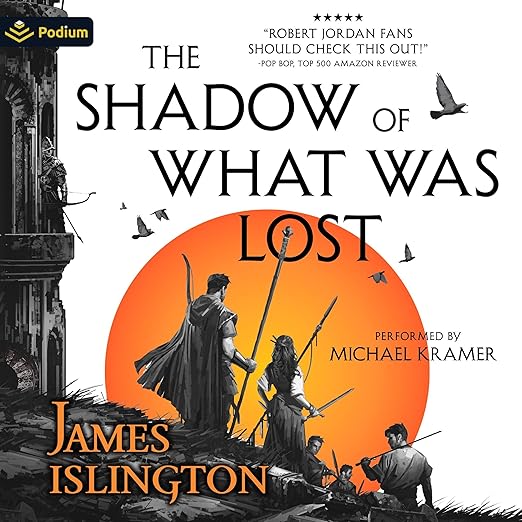
There is a particular kind of afternoon that is exactly right for a debut epic fantasy audiobook, overcast, unhurried, the kind where you can put in earbuds and lose several hours without guilt. I found my way into The Shadow of What Was Lost on exactly one of those afternoons, and I did not surface until I had burned through nearly four hours and the light had completely changed. That absorption rate, for a first novel, tells you most of what you need to know about James Islington’s craft.
The Licanius Trilogy has been a quiet favorite in the epic fantasy community since Islington self-published the first book in 2014, before Orbit acquired and reissued it. The version narrated by Michael Kramer, the same voice behind The Wheel of Time and the Stormlight Archive, carries real weight simply by virtue of that association. It is a signal that someone with industry standing believed the material worthy of that narrator, and that belief turns out to be correct.
Our Take on The Shadow of What Was Lost
The world Islington builds is one defined by the aftermath of a failed war. The Augurs, once near-divine figures with extraordinary power, were overthrown two decades before the story begins, and those who served under them, people with the lesser ability called the Gift, survived only by submitting to the Four Tenets: a set of binding laws written into their flesh. Davian, a student struggling to master his own ability, discovers he can wield the forbidden power of the Augurs, and that discovery sends the entire carefully maintained order into motion.
What is most impressive about the novel is how Islington handles the mystery embedded in its structure. There is a character who wakes in a forest with no memory and with blood on his hands, whose connection to Davian we understand is coming but cannot yet see. That structural patience, holding information back not as a tease but as a promise, requires a confidence in the reader that debut novelists do not always muster. Islington musters it. The first book ends having answered some questions and planted the seeds of larger ones, and the desire to continue immediately into An Echo of Things to Come is not a failure of resolution but a sign of successful setup.
Why Listen to The Shadow of What Was Lost
Michael Kramer is the correct choice for this material. His voice carries the weight of the worldbuilding without making it feel ponderous, and he maintains clean differentiation between the ensemble cast across 25 hours, which is genuinely difficult. One review noted that Brandon Sanderson personally recommended the book, and the Kramer narration underscores that connection: the same voice that has read The Way of Kings brings a recognizable epic-fantasy register to Islington’s debut, easing listeners into the world’s complexity.
Reviewer Gunta described the novel’s aura of mystery as “a delightful tale of characters learning who they are, what they are to become, and trusting the path will unfold,” and that is exactly the atmosphere Islington sustains. There is enough action to maintain forward momentum, but the book is fundamentally interested in identity, in what it means to carry an ability you have been told is wrong, and in what the past you cannot remember might be demanding of your future.
What to Watch For in The Shadow of What Was Lost
The Wheel of Time comparisons are not incidental. One reviewer described the book as “very derivative” of Jordan’s work, similar premise structure, similar magical language, similar character archetypes moving through a post-catastrophe world rebuilding itself around new power dynamics. Whether this reads as inspiration or imitation will depend on how generously you extend that latitude to debut novelists, and the honest answer is that it sits somewhere in between. The debt is real, but the world Islington builds is genuinely his own, and his plotting is tighter than early Jordan.
The 25-hour runtime is also worth factoring in. This is not a book that resolves quickly. The first act is slow and deliberate, and listeners who need narrative momentum from the first chapter may find the opening sections require patience. That patience is rewarded, but it is asked for.
Who Should Listen to The Shadow of What Was Lost
This is a book for readers who are already fluent in epic fantasy and are looking for something new enough to be fresh without being so idiosyncratic as to require constant orientation. If you have read The Wheel of Time or Sanderson’s Stormlight Archive and are looking for your next long commitment, this trilogy is a reliable answer. Listeners who prefer lean, fast fantasy will find the deliberate pacing frustrating. And anyone approaching this as a standalone should know upfront that it is the first of three, the full picture requires the complete trilogy.
Frequently Asked Questions
Does The Shadow of What Was Lost work as a standalone, or do you need to commit to the full Licanius Trilogy?
It is better approached as the beginning of a trilogy than a self-contained story. The first book resolves enough to feel complete, but major mysteries are left open and the character arcs continue into An Echo of Things to Come and The Light of All That Falls. Going in with trilogy commitment in mind will improve the experience.
How does Michael Kramer’s narration handle the large ensemble cast over 25 hours?
Kramer manages the cast with his characteristic consistency, character voices remain distinct and recognizable without becoming caricature. At 25 hours, the consistency matters considerably. His work here is not as technically virtuosic as some of his Stormlight performances, but it is entirely reliable and never a distraction.
Is this appropriate for readers who have never read The Wheel of Time?
Yes, though fans of Jordan will notice the similarities in premise and magical framework more acutely. The story stands on its own without requiring knowledge of any other series, the world has its own rules, its own history, and its own characters. The Wheel of Time comparison is about structural DNA, not about shared world or characters.
How does the magic system work in The Shadow of What Was Lost?
The magic divides into two tiers: the Gift, a lesser ability that surviving practitioners can use under the constraints of the Four Tenets binding laws, and the Augurs’ power, which is forbidden and far more dangerous. The rules of both systems are revealed gradually through the narrative rather than explained upfront, which suits the mystery-forward structure of the book.