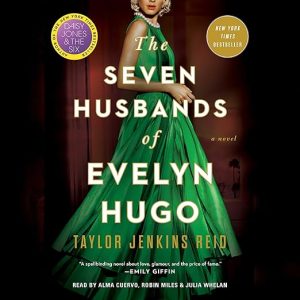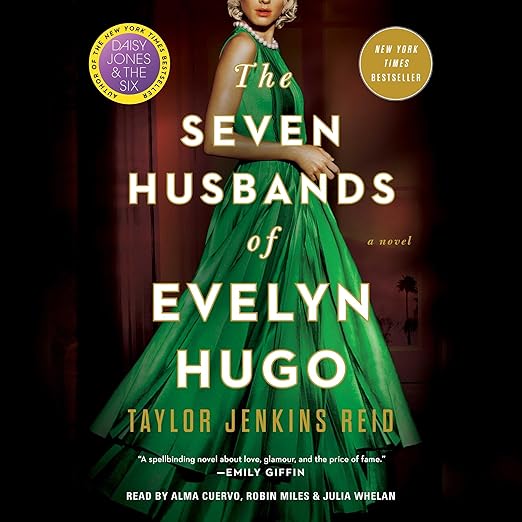
Evelyn Hugo does not apologize, and the audiobook makes that harder to look away from than the page does. Taylor Jenkins Reid built her novel as a confession delivered out loud: an aging film star summons an unknown magazine reporter to her apartment and starts talking, and does not stop for twelve hours and ten minutes. Alma Cuervo is the credited narrator on this listing. What arrives, structurally, is a recording of a woman dictating her own obituary while she still has the strength to control what goes into it.
Seven Husbands, Seven Public Costumes
The runtime here is roughly that of a long-haul flight, and the novel spends almost all of it inside one voice. Evelyn narrates her escape from Hell's Kitchen, which one reviewer here places at fourteen, through the Los Angeles studio years of the 1950s, to her exit from the business in the eighties. Monique Grant, the reporter, is the frame: her husband has left her, her career is stalled, and she has been handed the interview of a lifetime by a woman who will not say why she chose her. That withheld reason is the engine, and it is why the book survives its own soap-opera premise.
What Reid is actually writing about is image management as a full-time occupation. The copy promises a star reflecting on "her relentless rise to the top and the risks she took, the loves she lost, and the long-held secrets the public could never imagine", which reads like jacket boilerplate until you notice that the structure enforces it. Seven husbands means seven public narratives, seven assembled versions of a woman built for other people's consumption. The private version has to be smuggled through the gaps between them. Chelscey's review tracks the sequence bluntly, listing a progression from "bombshell, to sexpot, to Oscar winner, to civil rights supporter", which is a career and a costume rack at the same time.
The book is filed under LGBTQ+ here, and the review pool confirms where the emotional weight sits. The reader who calls it a masterpiece opens not with an argument but with a line lifted straight from the novel: "I spent half my time loving her and the other half hiding how much I loved her." That is the book in one sentence, and it is the reason all the Hollywood machinery matters. The glamour is not the subject. The concealment is.
Cuervo Spans Sixty-Five Years in One Voice
Reid wrote a novel that wants to be spoken. The conceit is an interview, so every chapter is somebody talking to somebody else with an audience of one sitting in the room. Audio does not have to argue for itself here the way it does with, say, a densely footnoted history. Form and format agree.
Alma Cuervo carries the credit, and the demand this material makes is unusual enough to name precisely. Evelyn is met at seventy-nine and narrates herself from fourteen, so one voice has to hold sixty-five years of a life without turning the young Evelyn into a child impression or the old one into a caricature. On top of that the recording needs two registers running at once: the practiced public Evelyn, who has been managing an audience since the 1950s, and the one who is finally telling the truth. Not one of the three reviews attached to this listing addresses the reading, and all three describe the experience as reading rather than listening, so the applause in the pool attaches to the prose. How the recording handles that double register is something to sample rather than take on trust.
The second argument for the audio edition is pacing. The seven-husband structure builds natural stopping points, roughly one marriage per stretch, which makes the book unusually easy to leave and rejoin without losing the thread. Long novels often punish interruption. This one absorbs it. The copy also stacks press blurbs high, from PopSugar's "wildly addictive journey of a reclusive Hollywood starlet" to Redbook's "Tinseltown drama at its finest". Blurb walls usually tell you nothing. This one is at least consistent about what it is selling, which is momentum rather than difficulty.
Monique's Collision with Evelyn, Announced Early
Monique is the thinner half of the book. Her stalled career and departed husband get sketched quickly and then set aside for long stretches while Evelyn talks, and the copy tells you upfront that the two lives will intersect "in tragic and irreversible ways." Knowing a collision is scheduled changes how you listen. You spend hours waiting for a shoe to drop rather than sitting inside the story. Some listeners find that unbearable in the good sense. Others find it a structural cheat.
The emotional register is the second thing to weigh. Us Weekly's Jamie Blynn is quoted calling the novel "Heartbreaking, yet beautiful", and every reviewer in the pool reaches for a similar pairing, with Eugenie opening flatly: "Moving and captivating. Heartbreaking and real." A book that arrives with that much advance warning about its ending works best when you are not looking for complication. This is melodrama executed with real skill, not a novel that resists you.
The review pool also skews unanimous in a way worth noticing. Every attached review awards five stars, and one reader places the book "in the top five for best books" of an entire lifetime of reading. That is genuine, and it is not calibration. A 4.6 average across 274 ratings implies dissent exists somewhere off this page, and nothing visible here tells you what the objections were.
Daisy Jones Fans Will Want More
If you have been avoiding this one because it looked like airport fiction with a good cover, the review pool deserves a hearing. Three separate readers reach for superlatives, and the most detailed of them argues from the text rather than from adjectives. Old Hollywood as a setting, queer love as the actual subject, and a confession structure that keeps tightening: those three together are rarer than the marketing suggests.
It suits anyone who finished the author's Daisy Jones novel wanting more of the same trick, since the retrospective oral-history instinct is shared. It suits people who read for character rather than for plot mechanics, since the entire novel is one person's account of herself. And it suits anyone looking for a queer love story that is neither a tragedy about persecution nor a contemporary romance, but a portrait of a woman who spends a lifetime deciding exactly what the public gets to have.
Skip it if melodrama makes you itch, if you want ambiguity where this novel delivers revelation, or if you would rather not know within the first hour that something devastating has been scheduled for the end. And if you need to hear how one voice manages a sixty-five-year age range before committing a full working day of listening, the sample is the only source on this page that can answer you.
- Narrator: Alma Cuervo is the credited voice on a novel built as one woman's spoken confession, and the material asks a single reader to hold a life from fourteen to seventy-nine.
- Subjects: Old Hollywood image-making, queer love kept private, ambition and its price, the ethics of telling somebody else's story.
- Tone: Confessional and propulsive, with a devastation you can watch approaching.
- Bottom line: Melodrama with genuine craft under it, and the interview frame makes the audio edition the natural way in.
Before You Listen
Does this audiobook use a full cast or a single narrator?
The listing credits Alma Cuervo alone, so plan for a single-voice reading. Because the novel is built as one woman dictating her life to a reporter, that is defensible, but it does mean the interviewer's questions and the star's answers come through the same throat, and the sample is where you learn whether that blurs them.
Does the audiobook work in short listening sessions?
Better than most books its size. The marriages function as movements, so the story supplies its own stopping points and rejoining costs nothing. Twelve hours and ten minutes looks daunting written down and behaves like a run of shorter listens in practice, which matters if you listen in bursts rather than long stretches.
Do I need to read the author's other Hollywood novels first?
No. The description names her other titles because they share an author rather than a world, and this one stands entirely on its own. What carries across is method instead of plot, namely the retrospective interview structure. If that shape worked on you once, the same instinct built this book.