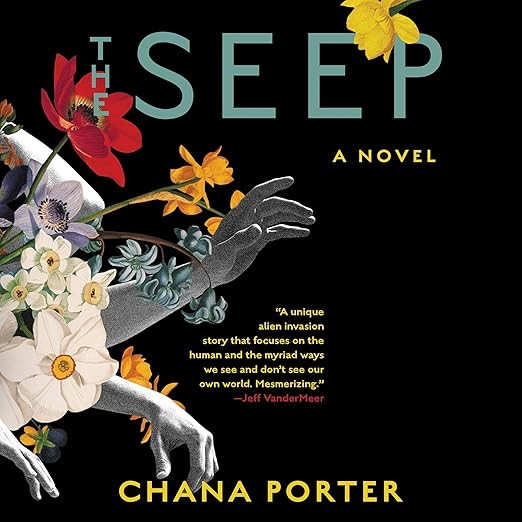
Trina FastHorse Goldberg-Oneka is fifty years old when the aliens arrive, and they arrive gently. That is the joke and the wound at the center of this audiobook: an invasion that improves everything. Capitalism collapses. Hierarchies dissolve. Anything imaginable becomes achievable, which sounds like paradise right up to the moment Trina's wife, Deeba, imagines being reborn as a baby with a better life ahead of her, uses the available technology to do exactly that, and goes. The utopia takes her by working precisely as advertised. What is left behind is a woman whose wife did not die.
Is The Seep Worth Your Time?
Sample and panel agree here, which almost never happens. The five written grades average 4.2 against a badge of 4.1 across 493 ratings, so for once the responses a browser can actually read are a fair representation of the pool standing behind them. That is worth knowing, because 4.1 is a low figure for a heavily promoted debut and the instinct is to assume the visible reviews must be unrepresentative. They are not. The division you can read on this page is the division in the pool, and it turns on a single question: whether the writing is equal to the idea.
Classification is this record's clearest failure. The only category attached is LGBTQ+, with no tags at all beside it. A novel whose premise is an alien entity, whose plot turns on a technology for rewriting a body, and whose own cover quote calls it an alien invasion story has been filed with no speculative classification whatsoever. Trina being a trans woman is central to the book and the category is not wrong; it is simply alone. The consequence is that the science fiction readers most likely to want this will never come across it while browsing.
The Best Parts of The Seep
Utopia is the setup rather than the subject, and the October 2022 five-star reaches that conclusion faster than the publisher's copy does. That response argues the book is far more concerned with identity than with the invasion or with what the Seep actually look like, and dismisses such questions as largely irrelevant: the Seep operate as a vehicle for transformation and a catalyst for change rather than as a species awaiting explanation. That is the right reading and it doubles as buying advice. Anyone who wants the aliens described, the technology specified or the mechanics worked out will come away frustrated, because the book has no interest in any of it.
Three hours and four minutes is the whole novel, which makes it one of the shortest full-length works of fiction on any shelf. The compression is deliberate and it is also the source of nearly every argument about the book. A short novel about grief has to move by ellipsis, with the reader supplying whatever the sentences leave out. Handled well, the effect is devastating. Handled impatiently, it reads as underwritten, and the identical passage can produce either verdict depending on how much credit a reader is prepared to extend. At this length the book asks for a great deal of it.
Before You Commit to The Seep
Prose is where the pool splits, and the February 2026 four-star makes the case in eleven words: a great story, just written really poorly. That is a remarkable grade to attach to that sentence. Someone who thought the writing failed still awarded four stars, which tells you how much work the premise is doing unaided, and it explains the shape of the badge better than a longer review could. Reservation and enthusiasm arrive together more than once in this column, frequently inside the same paragraph. This is a book people finish and then argue with.
Shakina Nayfack voices the whole thing, and across 493 ratings not one response mentions the recording. On a page this busy the absence is conspicuous, and it leaves the largest gap facing anyone choosing between formats. The book is a close account of bereavement written in a compressed, elliptical register, which is among the hardest things to read aloud: too much feeling and it turns maudlin, too little and the gaps register as indifference. At this length every choice is audible and none of them gets smoothed over by momentum. The sample settles the question inside five minutes.
Should You Listen to The Seep?
Speculative readers who want ideas rather than hardware are the audience, along with anyone who has ever wanted a utopia interrogated instead of celebrated. The book is genuinely unusual in that respect: it takes a post-scarcity, post-hierarchy world seriously, grants that the world works, and then asks what a person does with a loss the new order has rendered optional and therefore incomprehensible to everybody around her. Listeners who like their science fiction philosophical and their endings unresolved will find the running time extremely well spent, and it makes a strong first purchase for anyone testing short literary speculative fiction.
Bereavement is the one hard stop, and it comes from the page itself rather than from any advisory, because the record carries none. The September 2024 three-star opens with an instruction instead of a review: if you have lost a spouse, do not read this. The same response calls the book an excellent allegory of mourning and loss, and reports that it landed in ways that may never fully fade. That is the strongest recommendation and the strongest warning on the page, delivered in the same three sentences. Anyone in the first year of a bereavement should read it as written to them directly.
- Voice: One voice for a book that stays with a single person throughout, with no cast and nothing to break up the register.
- Big ideas: A benign invasion, grief with no vocabulary left for it, trans identity, utopia interrogated rather than celebrated
- Atmosphere: Compressed, surreal and quietly devastating
- Worth it?: An extraordinary premise and divisive prose, in three hours that will either wreck you or slide straight past.
Good to Know
Is three hours really the complete audiobook?
The listing gives three hours and four minutes as the full running time and flags no abridgement anywhere. That is genuinely short for a work sold as a novel, and the brevity is a stylistic decision rather than a cut, which is why the book moves the way it does.
Does this audiobook carry a content warning?
No. The record lists no advisory of any kind, and the only category attached to it is LGBTQ+. Given that the novel turns on the loss of a spouse, a heavy drinking binge and a quest undertaken in grief, that absence is considerably better known before starting than discovered halfway through.