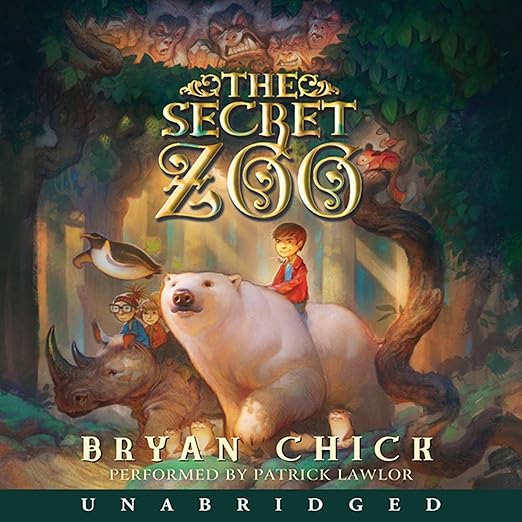
Bryan Chick's The Secret Zoo audiobook, the first book in the Secret Zoo series, begins with a premise Chick traced back to a question he asked at age nine: what if zoo exhibits had secret doors that let kids go inside and animals come outside? Patrick Lawlor narrates this 6-hour-and-18-minute production, and from the first chapter, the audiobook establishes Noah, his sister Megan, and their best friends Richie and Ella in the space it needs before the strangeness of the Clarksville City Zoo begins to bleed into their neighborhood. Megan notices the animals first: late at night, monkeys scaling the walls, searching for something the children cannot name.
Our Take on The Secret Zoo
Megan's disappearance early in the narrative transforms what might have been a gentle animal mystery into something with real urgency. Noah and his friends must follow a series of clues and sneak into the zoo, and what they find inside reframes everything they thought they understood about the animals and the enclosures they had watched from outside the fence. The premise the synopsis compares to The One and Only Ivan is instructive: Chick is working in the same territory of animals-with-interiority, but the narrative engine here runs closer to thriller than meditation. The children are protagonists rather than observers, and the zoo's hidden architecture places them inside the stakes.
Lawlor's narration is calibrated for the material. He does not play the child characters as cartoons, and he does not slow the pacing to explain emotional moments that Chick's prose handles efficiently on its own. Reviewer Andrew Johnson notes that the writing draws young readers in without losing them, and Lawlor's read respects that balance. He maintains energy across the full runtime without resorting to the exaggerated vocal performances that can make middle-grade audio feel performative. The mystery's escalation lands cleanly in audio because Lawlor holds a baseline seriousness even when the scenario is at its most implausible, which is the correct instinct for a story that asks children to take a secret zoo seriously as a real possibility.
Why Listen to The Secret Zoo
Two separate families reviewed this book as a shared listen, parent and child together, and that dual-audience quality is one of the audiobook's genuine strengths. Chick's prose is written for children but not written down to them, and Lawlor's narration avoids the patronizing register that causes adult listeners to check out of children's content. The mystery structure, the missing sister, the clues, the secret revealed through following rather than being told, holds adult attention as readily as a child's. Reviewer Lisa notes that she and her ten-year-old finished all five books in the series together, which is a clear endorsement of the world-building and pacing across the full arc.
The 6-hour runtime is well-suited to middle-grade attention spans and shared family listening. Long enough to develop characters and stakes, short enough to finish across a few car rides or evenings without losing momentum. The first book functions as a complete story with its own resolved central mystery while establishing the larger Secret Zoo world with enough texture that the series continuation feels like an invitation rather than an obligation. For families looking for an audio series to begin together, the self-contained first volume is a lower-commitment entry point than a thirty-hour box set, and Chick earns the reader's willingness to continue by resolving the core problem while leaving the world open. The audio format specifically suits the way Chick builds tension in the zoo sequences. The nighttime scene with the monkeys scaling the walls works differently when it arrives through Lawlor's narration than it does on the page; the audio removes the reader's control over pacing and delivers the strangeness of the zoo's nighttime behavior at exactly the speed Chick intended, which is one of the underappreciated advantages of audio for middle-grade mystery.
Weak Spots in The Secret Zoo
Reviewer A Rando notes that the book contains moments that are a bit scary for younger children, and that is worth flagging for parents of readers below the age of eight or nine. The stakes of Megan's disappearance are treated with real seriousness rather than softened for comfort, and the zoo's hidden world has elements that are deliberately unsettling. Chick writes fear honestly, which is why the resolution of that fear carries weight. Listeners expecting pure whimsy throughout may be surprised by the darker passages.
The first book also ends with the larger Secret Zoo architecture established but not fully explained. Some of the world's rules and the full scope of its hidden structure are deliberately withheld for later volumes. That is standard series design, but listeners who prefer completely self-contained stories should know that Chick leaves the larger mythology open. The central mystery of Megan's disappearance and the zoo's secret are resolved; what the Secret Zoo is and how far it extends remains a question the series continues to answer. Chick's approach here is structurally similar to the first books in successful middle-grade fantasy series, where the inaugural volume delivers a satisfying contained story while signaling that the world is substantially larger than the first story revealed. Whether that is a feature or a frustration depends entirely on the individual listener's relationship with open-ended series commitments.
The Right Listener for The Secret Zoo
Children aged eight to twelve and the adults accompanying them are the natural audience. Middle-grade fans of adventure and animal stories will find the pacing quick and the stakes genuine. Parents looking for a shared family listen that holds adult interest without condescending to children will find the combination of Lawlor's narration and Chick's plotting worth the full runtime. Not recommended as a standalone for listeners who find deliberate series continuation hooks unsatisfying.
A Few Questions About The Secret Zoo
Is The Secret Zoo audiobook appropriate for younger children or is it best for middle grade?
It is targeted at roughly ages nine to thirteen, grades four through eight. Some parents note mildly scary moments around the disappearance and the hidden zoo's more unsettling elements. Best suited for children eight and up, though sensitive younger readers may find some sections intense.
Does this audiobook stand alone, or do you need to continue the series?
It resolves the central mystery within its 6-hour runtime but leaves the larger Secret Zoo world open for continuation. Most listeners who finish it want the second book, though the first book tells a complete enough story to be satisfying on its own.
How does Patrick Lawlor handle the four main child characters in this audiobook?
Lawlor differentiates the four friends without resorting to exaggerated vocal performances. His strongest contribution is pacing, keeping the mystery moving at a speed that works for both young listeners and adults alongside them.
Is The Secret Zoo audiobook a good choice for a child who struggles to stay engaged with longer books?
Yes. At just over six hours, it is short enough to maintain momentum across multiple listening sessions without losing the thread, and the thriller-paced mystery structure keeps stakes visible throughout. The self-contained story makes it easy to start and finish without commitment to a longer arc.