Quick Take
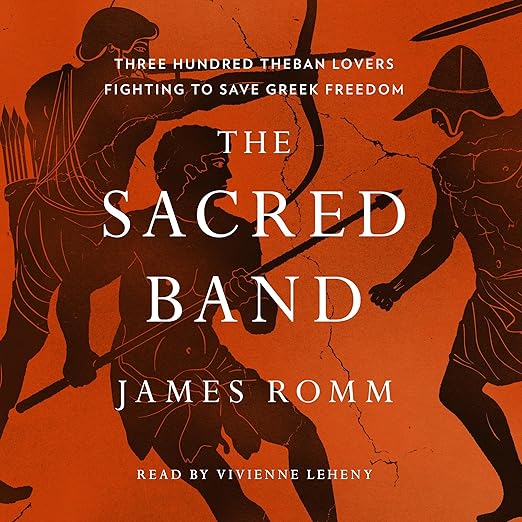
- Narration: Vivienne Leheny delivers Romm’s prose with clarity and pacing that suits the scope of ancient history, authoritative without becoming dry.
- Themes: love and military brotherhood in antiquity, the fragility of democratic freedom, the erasure of overlooked history
- Mood: Scholarly but propulsive, like the best popular history
- Verdict: A genuinely illuminating account of a neglected chapter in Greek history, made accessible without being dumbed down, recommended for anyone who thought they already knew the ancient world.
I came to The Sacred Band already reasonably comfortable with ancient Greek history, the Peloponnesian War, the Athenian democracy, Thermopylae. What I did not know, and what James Romm makes you feel the weight of immediately, is how thoroughly Thebes has been written out of that standard narrative. This audiobook corrected that oversight for me over the course of a long weekend, and I finished it feeling the particular satisfaction that comes from learning something that feels genuinely consequential.
The story centers on the Sacred Band, an elite Theban military corps composed of 150 pairs of male lovers. The organizational logic, that lovers would fight harder and die before disgracing each other, turns out to be more than a philosophical experiment. The Sacred Band went undefeated for four decades. Their destruction by Philip II of Macedon and his son Alexander at the Battle of Chaeronea in 338 BC effectively ended the era of Greek city-state freedom. When archaeologists rediscovered their remains in 1880, some of the skeletons were still lying in pairs with arms linked. That detail alone makes this history matter.
Our Take on Romm as a Popular Historian
James Romm has a gift for what one reviewer accurately called fluent, accessible prose. He does not simplify the complexity of fourth-century Greek politics, the ideological disputes between city-states, the shifting alliances, the role of Persian gold in financing Greek wars against Greeks, but he never lets that complexity calcify into a lecture. The book begins in 379 BC with a group of Theban patriots sneaking into an occupied city disguised in women’s clothing, and that opening scene establishes immediately that Romm intends to tell this as a story, not a survey.
Vivienne Leheny’s narration serves the material well. Ancient history of this kind lives or dies on the narrator’s ability to give proper nouns their weight without turning the experience into a pronunciation contest. Leheny handles names like Epaminondas and Pelopidas with the confidence that lets the listener absorb rather than stumble. The nine-hour runtime feels appropriate, substantial enough to develop the characters and context, compact enough to maintain urgency.
Why Listen to The Sacred Band Now
Questions about the relationship between love, loyalty, and civic duty are not strictly ancient. Romm makes clear that the Sacred Band represented a specific idea: that eros, sexual and emotional love, could be a political and martial force, not merely a private matter. The Theban experiment with democratic governance and the idea that soldiers who loved each other would defend freedom more fiercely than conscripts, these are not quaint footnotes. The book situates the Sacred Band within a broader argument about what happens to freedom when strongmen rise and city-states exhaust each other in factional warfare.
One reviewer noted that Romm does a wonderful job of immersing the listener in the story without sacrificing factual rigor. That balance is genuinely difficult to achieve in popular history, and this audiobook manages it. Another reviewer described the book as a page-turner made from complex and tortuous history, which is exactly what it is. Thebes at this moment in the fourth century BC was the leading power in Greece, not Athens, not Sparta, and that fact alone should make the story more widely known than it is.
What to Watch For in the Battle Sequences
The military history in this audiobook is specific and spatially clear. Romm takes care to explain formation tactics and the innovations that made Theban warfare so effective under Epaminondas, including the deep attack on one wing that demolished the Spartan military reputation at the Battle of Leuctra. Listeners without a military history background will not be lost, the context is always provided. Those who come in with some knowledge of hoplite warfare will appreciate the additional detail.
Who Should Listen to The Sacred Band
This is an audiobook for history readers who feel they have covered the Greek canon and want to go deeper, as well as for anyone interested in the intersection of sexuality, military culture, and politics in antiquity. It will also appeal to listeners drawn to LGBTQ history who want something grounded in serious scholarship rather than advocacy. Casual listeners looking for a light entry point into ancient Greece may find the density of names and political shifts challenging, though Romm does everything possible to ease that burden.
Frequently Asked Questions
Do I need prior knowledge of ancient Greek history to follow The Sacred Band?
A basic familiarity helps but is not required. Romm provides enough context to orient newcomers, though listeners who already know the broad outlines of Sparta, Athens, and Macedon will absorb the nuances more readily.
Does the audiobook discuss the homosexual dimensions of the Sacred Band explicitly, and how is it handled?
Yes, directly and with scholarly care. Romm treats the erotic culture surrounding the Sacred Band as a historical and social phenomenon, not a curiosity. The discussion of erastai and eromenoi (lover and beloved pairs) is contextualized within Greek norms of the period.
How does Vivienne Leheny handle the extensive Greek names and terminology?
Competently and consistently. She pronounces key names like Epaminondas and Pelopidas with authority, which allows the listener to build familiarity rather than being tripped up by unfamiliar sounds.
Is this audiobook more military history or cultural history?
Both, in roughly equal measure. The battle sequences are specific and tactically described, but Romm is equally interested in the political culture, the role of eros in public life, and the broader meaning of Theban democracy. Neither aspect overwhelms the other.