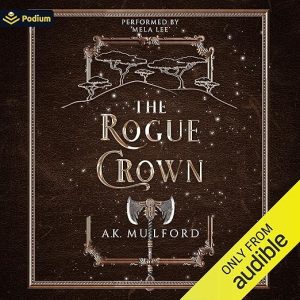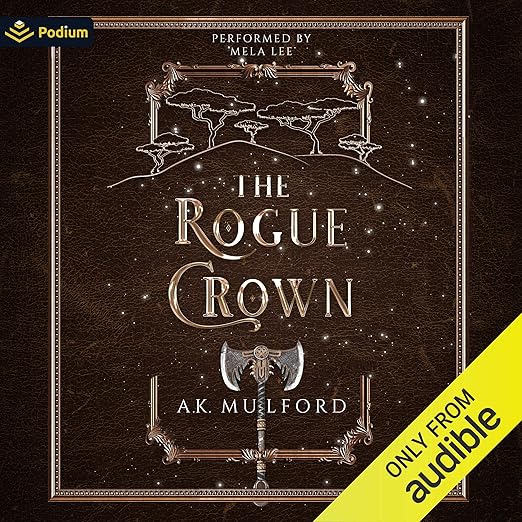
Can a fae warrior fated by prophecy to steal a crown actually choose who she loves instead? That's the tension A.K. Mulford stretches across this audiobook's fourteen and a half hours, the third entry in the Five Crowns of Okrith series. Fae warrior Briata Catullus, Bri to everyone who knows her, arrives at the Western Court investigating who murdered the Western Queen, and finds a colder reception than she expected: the fae here have heard the prophecy that she'll seize their throne, and nobody wants to make that easier for her.
What A.K. Mulford Delivers
The plot machinery here is doing real double duty. On one level, this is a murder-investigation-slash-political-thriller, with witch hunters actively hunting royal blood and Bri caught between defending a court that doesn't trust her and unraveling a genuine conspiracy. On another, it's a slow-burn romance between Bri and Princess Abalina Thorne, who's still grieving her mother and reluctant to let anyone, let alone her assigned bodyguard, into her confidence.
What keeps those two registers from fighting each other is how directly the synopsis names the actual stakes: Bri has a duty to the princess, a duty to the Western Court, and a duty to her own destiny, and then asks, pointedly, what about the duty to her heart. That's not incidental framing, it's the book's actual thesis, and the plot keeps circling back to force Bri to weigh those competing loyalties against each other rather than letting romance and duty coexist comfortably.
Reviewer Ash's praise stands out for a specific reason: series that rotate which characters carry the central romance from book to book usually struggle, and this reviewer singles out Mulford's ability to make each transition feel deliberate rather than diluting, with the slow burn between Bri and Lina cited as the current high point of a series Ash has grown steadily more attached to.
The witch hunters as an antagonist force deserve more credit than a simple obstacle role. Their specific motivation, hunting royal fae blood rather than pursuing some generic evil agenda, ties directly into the prophecy plot, which means the external threat and Bri's internal conflict over her own destiny are mechanically connected rather than running on separate tracks that happen to share a book.
Reviewer Michaela's description of Bri as her favorite Twin Eagle points to a piece of Okrith's worldbuilding worth naming directly: Twin Eagles appear to function as an elite warrior designation within this fae society, giving Bri's exile and current mission real institutional weight rather than treating her prophecy purely as an individual burden separate from any larger structure she belongs to.
What A.K. Mulford Gets Right
The bonus story included with this edition, The Witchslayer, adds real value beyond the main narrative, a genuine extra for listeners who want more time inside Okrith's world without waiting for the next full installment.
Narrator Mela Lee brings a demonstrated strength in handling structurally layered material with real tonal range, previously confirmed on a biography built around a genuinely complex character conceit. That same range, the ability to hold multiple emotional registers inside one performance without letting any of them flatten the others, translates well to a book balancing political thriller, grief, and slow-burn romance simultaneously.
Bri's return to the very court that exiled her over this same prophecy is where the book most rewards series investment. The emotional payoff of watching her walk back into hostile territory lands much harder if you already know what she lost getting exiled from it in the first place.
The Five Crowns of Okrith as a whole has built its reputation on exactly this kind of interlocking structure, where court politics, prophecy, and romance are never fully separable from each other. Listeners who enjoy fantasy series where the political stakes feel load-bearing rather than decorative will find that quality intact here, three books into the run.
This book also arrives squarely inside romantasy's current commercial moment, a genre boom built on exactly this combination: prophecy-versus-choice tension, morally complex fae courts, and a central relationship that has to fight for space against genuine political stakes. Mulford's series holds up well against that broader field specifically because the politics never feel like scaffolding built solely to justify the romance.
Where A.K. Mulford Loses Some Ground
Not every listener finds the pacing equally gripping. Reviewer Jackie's three-star review is candid about being just interested enough in the sapphic fantasy premise to keep going, while also finding it boring enough to drag her feet through certain stretches, a fair warning that the political intrigue and slow burn won't grip every reader at the same intensity.
This is explicitly book three of five, and the prophecy, court politics, and Bri's exile backstory all assume real familiarity with what happened earlier in the series. New listeners dropping in here without that context will likely find themselves working harder than necessary to track who resents Bri and why.
At fourteen hours and thirty-nine minutes, this is a substantial commitment even by romantasy standards, and listeners should know the romance itself is deliberately slow-burn rather than front-loaded, meaning patience is required before the Bri-and-Lina relationship becomes the book's central engine.
Listeners tracking spice level and content warnings across the romantasy genre should know this entry keeps its focus primarily on the slow-burn emotional arc between Bri and Lina rather than front-loading explicit content, consistent with a series more interested in earning intimacy through trust than delivering it early.
Audio adds a specific craft challenge to court-intrigue fantasy that print sidesteps: tracking who's speaking across a crowded scene of fae nobles, guards, and witch hunters relies entirely on Mela Lee's ability to keep each voice distinct without the visual cue of a name on the page. That's a harder sustained task than differentiating two romantic leads, and it's worth listening for specifically during the Western Court's larger group scenes.
Who Should Pick Up The Rogue Crown
Existing Five Crowns of Okrith readers are the clear audience, and this entry specifically rewards anyone who's been following Bri since her exile from the Western Court. Fans of sapphic fantasy romance built on real political stakes rather than romance-only plotting will find the murder investigation and witch hunter threat genuinely load-bearing, not just scaffolding for the relationship.
Skip it if you want a quick, standalone way into fae fantasy; this book leans hard on investment built across the first two entries, and the emotional weight depends on having that history. Listeners who prefer romance-forward pacing over slower political intrigue may also want to know upfront that the central relationship develops gradually rather than quickly.
Before You Press Play
- Voice: Mela Lee draws on a demonstrated ability to hold layered emotional registers together, well suited to balancing political thriller and slow-burn romance in one performance.
- Big ideas: prophecy versus free will, grief and reluctant trust, duty to a crown weighed against duty to the heart.
- Atmosphere: romantic and tense in equal measure, with real court-intrigue stakes underneath the slow burn.
- Worth it?: a satisfying continuation for existing Okrith fans, though not a fair entry point for series newcomers.