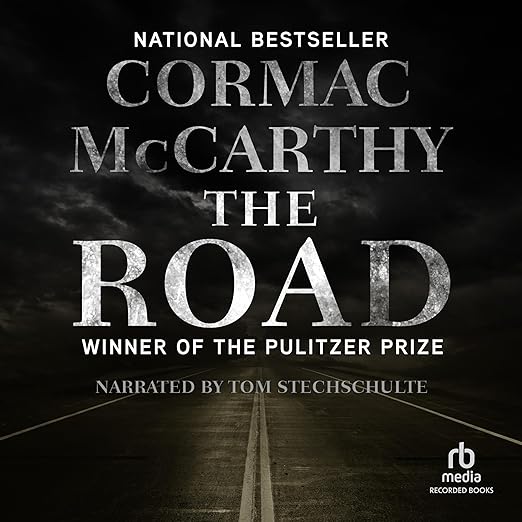
I finished The Road on a Sunday afternoon and did not immediately want to do anything. That is not a complaint. Cormac McCarthy's 2007 Pulitzer Prize winner is one of the few novels that earns its bleakness completely, that does not use despair as atmosphere or as a stylistic identity but as a structural argument about what human beings are actually made of when everything else has been taken away. I had read it before in print. Hearing it in Tom Stechschulte's narration is a different, and in some ways more demanding, experience.
The premise is as reduced as the world it describes: a father and his young son walk south through an ash-covered America after an unnamed catastrophe has extinguished nearly all life. That is the entire external plot. McCarthy's novel refuses the conventions of the post-apocalyptic genre: there is no resistance movement, no rediscovering of technology, no revelation of what caused the disaster. There are only two people walking, and the question the novel asks relentlessly is whether love can constitute a reason to continue when reason itself has become difficult to locate.
McCarthy's prose in The Road is unlike anything he wrote before or after. He abandons quotation marks for dialogue, strips punctuation to a minimum, and compresses description to the barest necessary element. One reviewer described it as bleak presenting at a level no other writer can match; another said that while reading it, they would never again believe a writer who casually used the word hopeless to describe a character's situation. Both reactions capture something true about what the novel does. McCarthy earns his devastation through precision. Every sentence is load-bearing.
The father-son relationship is where the novel's emotional authority lives. The boy was born after the unnamed event and has never known any other world; the father carries the memory of what the world was and cannot stop measuring the gap. The boy's moral instincts are the novel's argument: raised in a destroyed world, he consistently makes the more generous choice. The man is the protector; the boy is the ethical core. That inversion is quiet and precise and gives the bleakness its point.
The Strengths
Tom Stechschulte's narration is a significant part of why this audiobook endures. His delivery is flat in the way that McCarthy's prose is flat: stripped of theatrical emphasis, letting the weight of the words accumulate without performance. Some listeners resist this initially. The almost-monotone quality can feel cold when the material is so emotionally charged. But it reflects the prose accurately, and it creates space for the reader's own emotional response rather than directing it. The moments that break through Stechschulte's restraint carry enormous weight precisely because of the surrounding evenness.
McCarthy's prose rhythms, the biblical cadences of the long sentences that occasionally break the compression, are significantly easier to follow when heard rather than read. The audiobook makes audible what is sometimes invisible on the page: the deliberate use of rhythm and sound to create meaning. This is one of those texts that is genuinely enhanced by the audio format.
Things to Know Before Starting The Road
Several listeners found the ending abrupt, more abrupt than anticipated. McCarthy does not provide conventional resolution. The conclusion is open in ways that can feel either transcendent or incomplete depending on your relationship with literary ambiguity. If you need narrative resolution in the traditional sense, the final pages may frustrate. If you are comfortable with endings that gesture toward possibility rather than providing it, the ending is exactly the right close for the novel's concerns.
The Kirkus Reviews description, quoted in the synopsis, calls it a novel of horrific beauty where death is the only truth. That is accurate but slightly too neat. The novel's actual argument is that love persists even when death seems to be the only truth, which is why the ending is not purely despairing even at its most stripped down.
Recommended For
Readers who have avoided The Road because of its reputation for unrelenting darkness should know that the darkness serves a purpose and that the novel's emotional effect is not simple despair. It is one of the most precise explorations of parental love in American fiction, and the audiobook format makes that precision more accessible than the page sometimes does. Listeners who want comfort or entertainment should look elsewhere. Listeners willing to be genuinely affected by a book about what it means to persist in a world that provides no reason to should absolutely hear this.
Good to Know
Does Tom Stechschulte's flat narration style work for The Road, or is it too detached for such emotional material?
Opinion is divided, but the case for Stechschulte is strong. His restrained delivery mirrors McCarthy's stripped prose style and creates space for the listener's own emotional response. The moments of genuine feeling that break through the restraint hit harder than they would in a more conventionally expressive narration.
Is it necessary to have read other Cormac McCarthy novels before The Road?
No. The Road is his most accessible major novel in terms of reading experience, despite the bleak subject matter. Prior McCarthy experience enriches the reading but is not required.
What caused the catastrophe in The Road, and does the novel explain it?
McCarthy never reveals what happened. The novel deliberately withholds that information. The cause is not the point; the effect on human behavior and relationship is.
Is The Road genuinely as devastating as its reputation suggests, and is the audiobook format harder to sit with than the print version?
Yes on both counts. The audiobook format makes the prose rhythms more immersive, which intensifies the emotional experience. Listeners should be prepared for the full weight of the material rather than expecting it to feel diluted in audio form.