Quick Take
- Narration: Tim Curry is, simply, irreplaceable in this role, his theatrical darkness and precise comic timing transform Snicket's meta-narrator voice into something that exists in no other audiobook.
- Themes: Grief and resilience, institutional failure to protect children, dark humor as survival
- Mood: Gleefully bleak, with a narrator who keeps addressing you directly
- Verdict: The second book in a series that reveals its full ambition early, Tim Curry makes it essential listening even for those who have already read the print edition.
My first encounter with A Series of Unfortunate Events was the 2004 film, which I saw as an adult and thought was charming in a way that clearly owed everything to its source material's structure and very little to the film's own execution. Reading the books a few years later confirmed the suspicion: Lemony Snicket's series is funnier on the page, darker on the page, and stranger on the page than any adaptation has yet managed to capture. The audiobook with Tim Curry, which I came to most recently, is the one version that might actually be the superior delivery mechanism.
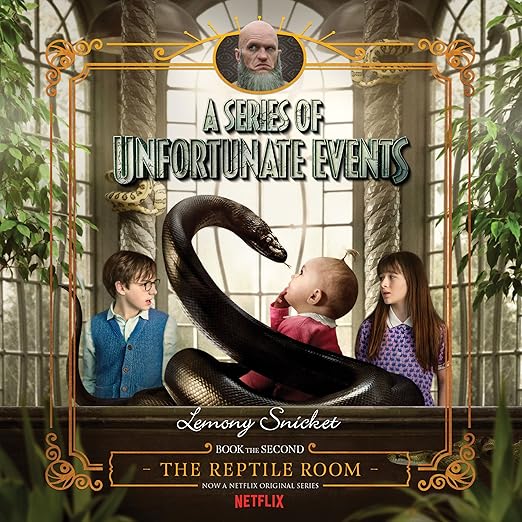
The Reptile Room is the second installment of the thirteen-book series, and it follows the Baudelaire orphans, Violet, Klaus, and Sunny, to their new home with their uncle Dr. Montgomery Montgomery, a herpetologist whose reptile room is full of extraordinary creatures and who, for the first few hours of listening, appears to be the genuine benevolent guardian the children have been desperate for. Snicket sets up this hope with extraordinary care precisely because he is going to dismantle it.
A Closer Look at The Reptile Room
What Snicket is doing in this series, and what becomes clearer with each book, is writing about the failure of adult institutions to protect children with a precision usually reserved for literary fiction. The Baudelaire orphans encounter banker after banker, guardian after guardian, official after official who are either incompetent, credulous, or actively malicious, and through it all, the children are expected to behave like children while solving problems that no adult will take seriously enough. It is a comedy of institutional failure, and Snicket never lets readers forget it.
The Reptile Room introduces the series' first genuinely likable adult in Uncle Monty, which means Snicket is also doing something darker: he is letting readers experience hope so that its removal lands with weight. The villain Count Olaf returns in disguise, and the children recognize him immediately while every adult remains oblivious. That gap between what the children know and what the adults refuse to acknowledge is the engine of the series' particular dread.
What Makes The Reptile Room Worth Hearing
Tim Curry's narration is the reason this audiobook has lasted as long as it has. Curry has spent decades playing characters who inhabit the space between funny and threatening, and Lemony Snicket's narrative voice lives in exactly that space. The narrator, who is also a character in the novels, a grieving man writing about events he wishes he could have prevented, requires a performer who can hold comedy and sorrow simultaneously without either canceling the other. Curry does this effortlessly.
His reading of Snicket's definitional asides, the moments where the narrator interrupts the story to define a word or phrase for young readers in ways that are simultaneously condescending, accurate, and funny, is particularly good. He adds a micro-beat of weariness before each one that suggests a narrator who has been doing this for too long and finds it both necessary and slightly exhausting. It is a choice that belongs entirely to Curry and it enriches every chapter.
Things to Know Before Starting The Reptile Room
The introduction of Dr. Montgomery's reptile collection is one of the more inventive chapters in the early series. Snicket describes the creatures with the same slightly terrifying affection a naturalist might bring to genuinely dangerous animals, and Curry gives each description the right weight of wonder mixed with unease. Pay attention to the Incredibly Deadly Viper, whose name is one of the series' earliest demonstrations of how Snicket uses language as a puzzle.
This is also the book where the series first introduces a character who will not survive to the end. That departure, handled without evasion, marks the moment when the series commits fully to its own darkness. Snicket does not protect his readers from loss. He prepares them for it, which is a kinder and harder thing.
Who Should Pick Up The Reptile Room
Children between the ages of eight and twelve who are ready for stories that take their intelligence seriously will find this series endlessly rewarding starting from book one. Adults who read the series as children and want to revisit it should start with the audiobook, Curry's performance adds a dimension the print edition cannot offer. Listeners who pick up The Reptile Room without having listened to The Bad Beginning will miss some of the context, though the book is functional as a starting point. Anyone who prefers stories that resolve neatly and protect characters from harm should know clearly that this is not that series.