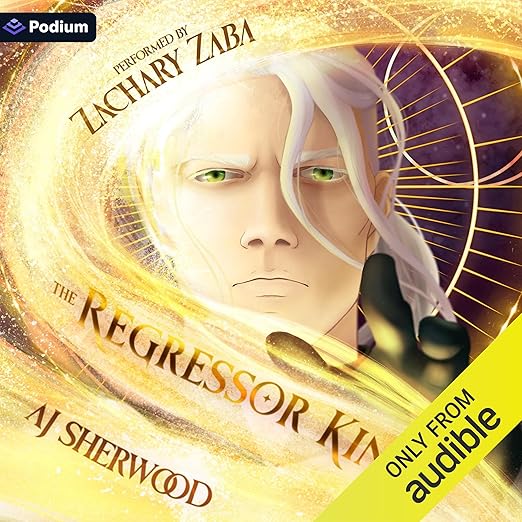
I started The Regressor King on a Friday evening planning to listen through the weekend, and I finished it somewhere around Sunday night with the specific kind of satisfaction that comes from a book that earns its length. AJ Sherwood's premise, a king negotiates with angels for a do-over after dying alongside the Demon King, refusing paradise because his Edwin is not included in the deal, is the kind of setup that could easily tip into wish-fulfillment fantasy without dramatic weight. It does not. This is a book that knows exactly how high its stakes are and makes you feel every one of them.
Zachary Zaba's narration is a significant part of why this works at audio length. The Regressor King runs over twenty hours, and the emotional arc of James's regression, reliving decisions that already broke him once while trying to rewire outcomes without revealing too much to the people around him, requires a narrator who can convey both the weight of foreknowledge and the fragility of hope. Zaba manages that balance without making James seem either omnisciently calm or melodramatically tortured.
James Only Wants to Reach Edwin Again
What distinguishes this from other time-loop or regression narratives is the specificity of James's motivation. He is not trying to save the world, though saving it becomes necessary. He is not trying to be a better king, though the regression forces him to reckon with his previous failures in that role. He is trying to get to Edwin. That singularity of purpose gives the narrative a center of gravity that keeps the court politics and apocalyptic threat sequences from feeling like distractions. They are obstacles between James and the thing he refused paradise to reclaim.
The court scenes are better constructed than the synopsis suggests. One reviewer described the plot as impressively complex without feeling muddy, which captures how Sherwood handles the political dimension. The intrigue is real, there are people who benefit from the previous timeline's outcome and who will work against James even without knowing why, but it never becomes so convoluted that the emotional story gets buried under it.
Twenty Hours Rebuilds a Courtship From Scratch
Because the relationship between James and Edwin is built rather than assumed. At twenty hours, Sherwood has room to develop the courtship properly, starting from before the crown rather than from the comfort of an established intimacy. That structural choice means the listener experiences the relationship developing in roughly the same emotional sequence James hoped for the first time and lost. The effect is that you arrive at the same emotional milestones James does, with the added knowledge that he is doing all of this for the second time and that failing again means losing Edwin permanently.
The tone manages to be genuinely funny in the early sections, one reviewer noted that the book opens with James annoying the feathers off an angel so badly that she summons a supervisor, which is an accurate and wonderful summary of the opening pages, while maintaining the high-stakes seriousness that the premise requires. That tonal management is harder than it looks, and Sherwood and Zaba both navigate it well.
The Political Plot Takes a Back Seat
One reviewer raised a fair structural observation: the overall plot, the Demon King threat, the political machinations, can feel secondary to the relationship story, particularly in the middle third. If you come to fantasy romance primarily for the world-building, there may be moments where you wish Sherwood had spent more time developing the external conflict. The book prioritizes emotional over mechanical complexity, which is the right call for what it is trying to be, but worth knowing going in.
The length is also worth flagging as a practical matter. At over twenty hours, this is a commitment. It rewards the investment, but listeners who prefer compact narratives may find the pacing occasionally deliberate in the mid-section. Those who specifically love slow-burn relationship development, and the regression structure means this is by definition a slow burn, since James cannot simply announce his feelings and his history, will find the length entirely justified.
Novik and Kingfisher Fans Will Feel Rewarded
MM fantasy romance readers who want a story with genuine emotional complexity and plot architecture to match. Fans of AJ Sherwood's previous work will already know what to expect in terms of voice and ambition. Readers who enjoyed Naomi Novik's A Deadly Education or T. Kingfisher's Paladin's Grace and want something with a stronger romantic center will find this a rewarding extension of that shelf. Those who prefer their fantasy romance light on political intrigue and heavy on scene-by-scene chemistry may find the balance here slightly less immediate than they want.
Before You Listen
Is The Regressor King a standalone or part of a series?
The book functions as a complete standalone, James and Edwin's story resolves within its pages. Sherwood has written other interconnected works in the same fantasy setting, but this entry does not require prior reading.
How explicit is the romantic content in the audiobook?
The book contains explicit MM romance content. Listeners who prefer their fantasy romance fade-to-black should know the relationship between James and Edwin is depicted directly rather than implied.
Does Zachary Zaba differentiate the supporting cast clearly enough to track across the 20-hour runtime?
Yes. Zaba gives the major supporting characters, the siblings, the political adversaries, the angel who becomes a recurring source of exasperation, distinct enough voices to remain identifiable. The cast is large but not unwieldy.
How much does the reader need to know about regression or isekai fantasy conventions to enjoy this?
No prior familiarity with the regression subgenre is necessary. Sherwood sets up the mechanics clearly in the opening chapters, and the emotional logic of the premise is self-evident. Genre veterans will recognize the structure, but it is not required knowledge.