Quick Take
- Narration: Elena Rey handles the documentary-style structure with quiet authority, moving between Sakunja’s voice and the expedition members’ stories without losing coherence.
- Themes: Redemption through witness, human connection on the frontier, the stories we carry into unknown terrain
- Mood: Contemplative and immersive, the kind of science fiction that moves at the speed of feeling rather than plot
- Verdict: A short, densely human Mars novel that prioritizes character backstory over action, rewarding for literary SF readers, potentially frustrating for those who want plot momentum.
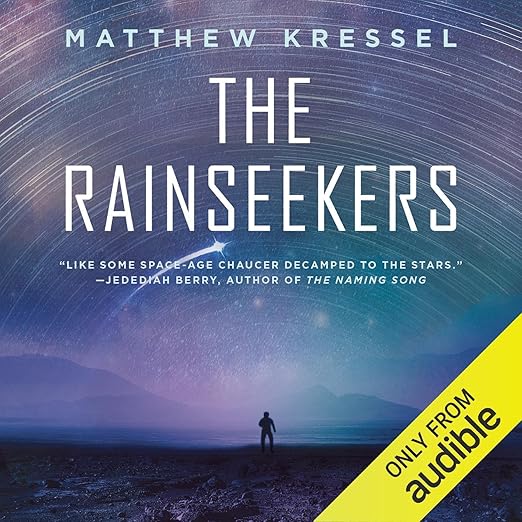
There is a specific kind of science fiction that uses its speculative setting almost as a pressure chamber, a contained environment where human stories can be examined more clearly than the familiar world allows. The Rainseekers is that kind of book. Matthew Kressel’s novella sends seventy-seven people across the surface of a terraformed Mars toward the Hephaestus Basin, where rain is about to fall for the first time in recorded human history on another planet. But the rain is not really the point. The people walking toward it are.
Sakunja Salazar has the frame story. She was a breakout Holo influencer who lifted her family from a tiny Mexico City apartment into the world of the rich and famous, then crashed back down on Mars as an alcoholic, addict, and has-been who thought her life was essentially over. She was rescued by a magazine editor who recognized her photography, and she has now joined this expedition as its documentarian. For the first time in her life, she is turning the spotlight on someone else, interviewing her fellow travelers about what brought them to this particular place and this particular moment. The stories she collects are the book.
Our Take on The Rainseekers
Kressel is working in a tradition that includes Ursula Le Guin’s focus on social texture and Ted Chiang’s preference for idea and feeling over action, and while The Rainseekers does not reach those heights, it shares their instinct that science fiction is most powerful when it uses its premises to ask questions about what it means to be human. The Mars setting is not background. Kressel’s worldbuilding is detailed and felt, with the kind of landscape description that one reviewer praised as painting the details of the Mars landscape with so much vividness. The choice to set this story during an expedition to witness a first rain positions the characters at a threshold, and Kressel uses that positioning carefully.
Elena Rey’s narration is sensitive to the book’s emotional range. The structure, which one critical reviewer accurately described as a series of short stories tied together by the mission, requires a narrator who can hold the frame story clearly while giving each interview subject their own texture. Rey does this well. The risk with a documentary structure is that it fragments rather than accumulates, and her narration maintains enough continuity that the individual stories build toward something collective.
Why Listen to The Rainseekers
The strongest argument for this audiobook is the quality of the individual character portraits. One reviewer called the characters beautifully crafted, heartbreakingly flawed and inspiring in their grit. Another described it as a book that makes you smile and breaks your heart. A third said it digs deep into backstories of complex characters while managing to be intelligent, immersive, and deeply moving. When that many readers respond with that register of feeling, something real is happening in the writing. The expedition members are people in the middle of private upheavals who have chosen a physically dangerous journey partly as an external enactment of interior need, and Kressel understands that motivation with nuance.
At just under five hours, the book fits into a long afternoon or a work commute over several days. It is Audible Studios original content released in February 2026, and the early review count is low but the positive response is strong.
What to Watch For in The Rainseekers
One reviewer flagged a meaningful disconnect between what the blurb promises and what the book delivers. The synopsis describes Sakunja interviewing her fellow travelers about what brought them to join the expedition, but the reviewer noted that only a few people are actually interviewed in depth. If you go in expecting the full documentary treatment the premise implies, the reality may feel like a limited sample. The frame is suggestive of a broader portrait than the book’s length allows it to fully execute.
The structure is also genuinely unconventional for science fiction. If you want forward momentum and external conflict, The Rainseekers resists. The danger of the expedition is present but rarely foregrounded. The book is organized around backstory and reflection rather than action, and readers whose patience for that mode is limited will feel the forty-one-minute runtime of each sitting stretch.
Who Should Listen to The Rainseekers
Readers who responded to Station Eleven’s focus on character survival over plot mechanics, or who enjoyed Kim Stanley Robinson’s The Martians for its intimate portraits of Mars as a human space, will find this in a similar register. Literary science fiction readers who want emotional depth and vivid setting over action will be well served. Listeners who prefer their SF structured around external conflict and propulsive plot should approach with adjusted expectations. The low rating count means there is still limited data on how the book lands across a wider audience, but the responses so far are substantive and positive.
Frequently Asked Questions
Is The Rainseekers a novel or a novella and does the short length feel complete?
At just under five hours, it is closer to novella length. Most positive reviewers describe it as feeling complete and satisfying, while one critical reviewer found the documentary premise underexploited given the available runtime. The length is appropriate to what Kressel is trying to accomplish, but some readers will want more.
How important is the Mars setting to the story or could this have been set anywhere?
The setting is integral. Kressel’s worldbuilding gives the Mars landscape specific character, and the occasion of witnessing the first rain on a terraformed planet is not incidental. The terraformation backstory and the physical demands of the expedition are woven into the character portraits throughout.
Does Elena Rey’s narration handle the shifting between Sakunja’s frame story and the expedition members’ stories effectively?
Yes. Reviewers who engaged positively with the book describe the experience as immersive, which suggests the narration maintains continuity through the structural shifts. The documentary format requires a narrator who can hold multiple voices without the story fragmenting, and Rey manages this.
How does Sakunja Salazar’s recovery arc intersect with the expedition’s goal of witnessing rain on Mars?
The parallels are thematic rather than plot-mechanical. Sakunja is learning to be a witness rather than a subject, and the expedition asks all its members to open themselves to an experience rather than to accomplish one. Her personal journey and the collective journey rhyme without the book making the connection too explicit.