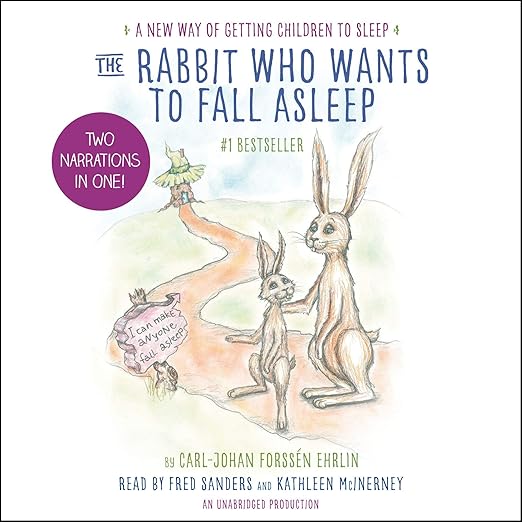
Roger the rabbit cannot fall asleep, so Mommy Rabbit walks him through the dark to visit Uncle Yawn, who, as his name suggests, knows exactly what to do about it. That gentle premise is the entire engine of this audiobook's technique, and it has worked well enough for long enough to become a genuine global bestseller among parents fighting nightly bedtime battles.
Carl-Johan Forssen Ehrlin, the Swedish behavioral scientist behind the book, built the story around a specific, repeated language pattern, deliberately paced phrasing, gentle suggestion, moments designed to prompt an actual yawn, rather than simply writing an appealing bedtime story and hoping it worked. This audiobook includes two full readings of the same text, one by Fred Sanders and one by Kathleen McInerney, both set against the same specially composed music, so parents can choose whichever voice actually lands with their own child.
The book has been translated into dozens of languages since its original Swedish publication, a scale of international adoption that is rare for a self-published parenting title, which is how Forssen Ehrlin's book originally reached readers before a major publisher picked it up.
First, the Big Picture
This is less a story to enjoy and more a tool to deploy, and the honest way to evaluate it is by that standard rather than as conventional children's entertainment. Roger's journey to see Uncle Yawn is deliberately simple and repetitive, because repetition and predictability are core to how the technique is supposed to work on a child's nervous system at the end of a long day.
Reviewer ECB describes a household of persistent problem sleepers, two children who have never slept easily, trying this as one more attempt after exhausting other options, and reviewer Lifelong Shopper describes a granddaughter who went from crying through the night to sleeping soundly after her parents adopted it as a routine. Both reviews frame this less as entertainment and more as a genuine intervention, which matches how the material itself is built.
Most bedtime picture books aim to entertain first and soothe second, if at all. This one inverts that priority entirely, and it is worth being explicit about what that means practically: do not expect narrative surprise, character development, or humor. Expect deliberate repetition, softened pacing, and specific word choices designed to be read a particular way, which is precisely why the same simple Roger-and-Uncle-Yawn story works for thousands of different children rather than needing constant novelty.
The synopsis calls this book child-tested and parent-approved, language that points to real trial use ahead of publication rather than a marketing flourish invented after the fact. For a technique-driven title like this one, that kind of testing claim matters more than it would for an ordinary story, since the entire premise rests on the language pattern actually producing the calming effect it promises across a wide range of children, not just working anecdotally for the author's own family.
What Makes The Rabbit Who Wants to Fall Asleep Worth Hearing
The choice between two narrators is a real, distinctive feature worth understanding before you buy. Fred Sanders and Kathleen McInerney bring different vocal textures to the same carefully engineered script, and since the entire premise depends on a specific child responding to a specific voice, having two full readings available rather than one is a meaningfully useful design decision most bedtime audiobooks do not bother with.
This is a case where the narrator functions as the delivery mechanism for a technique rather than as a performer interpreting a story for its own sake. The pacing, the pauses, the deliberately soporific rhythm are the product here, not incidental to it, which reframes what good narration even means for this specific audiobook compared to a typical picture book adaptation.
Families who respond to this technique often go on to try the companion title featuring a different animal protagonist built on the same underlying method, a sign that what works here is the language pattern itself rather than Roger specifically. That reusability across characters is itself evidence the technique, not the story, is doing the real work.
A Few Reservations
Not every family reports success, and it is worth taking that honestly rather than glossing over it. Reviewer mettamom gave this one star, openly skeptical of what she calls Swedish hypnosis, and reports that it simply did not work for her three-year-old despite genuine willingness to try anything. If your child resists any kind of structured bedtime routine on principle, this technique alone is unlikely to override that.
The framing as a near-hypnotic technique rather than a straightforward story may also read as gimmicky to skeptical parents, and it is fair to go in with tempered expectations rather than treating it as a guaranteed fix for serious sleep problems. It works well as one tool among several, not necessarily as a standalone solution.
The Right Listener for The Rabbit Who Wants to Fall Asleep
Parents deep in a genuine bedtime struggle, looking for a structured, repeatable technique rather than just another story, are the clear audience here. The choice of two narrators and the deliberately engineered pacing make it worth an honest trial even if you are skeptical going in, given how many other parents in these reviews describe real results.
Skip it if you want a purely narrative, entertainment-first bedtime story, since this is built around a specific relaxation method rather than storytelling for its own sake. For families willing to treat it as a genuine technique and commit to trying it as a routine rather than a one-off, the reported results here are hard to dismiss entirely.
It is worth distinguishing this from the wave of adult-oriented sleep and relaxation audio, ASMR tracks, meditation apps, ambient sound stories, that has become popular in recent years. Forssen Ehrlin's method predates most of that trend and was built specifically around a child's attention span and comprehension level, not simply scaled down from adult relaxation content, which is part of why it holds up as a genuinely age-appropriate tool rather than a novelty.
Before You Listen
What is the difference between the two narrators offered on this audiobook?
Fred Sanders and Kathleen McInerney each provide a complete separate reading of the same text and music, letting parents choose whichever voice their own child responds to best.
Does this audiobook's relaxation technique actually work to help children fall asleep?
Results are genuinely mixed. Several reviewers report real success after other methods failed, while at least one reviewer found the approach ineffective for her three-year-old.
Is the music included in this audiobook original?
Yes. The synopsis describes specially composed music using carefully selected tones designed to reinforce the story's relaxation technique, consistent across both narrator options.