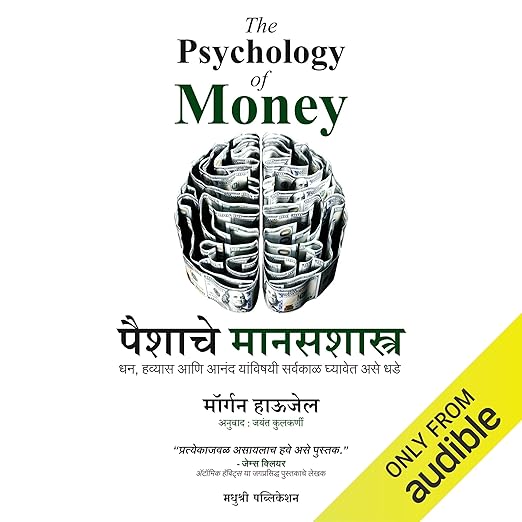
This Edition Speaks Marathi, Verify Before Buying
What actually determines whether someone manages money well? The conventional answer, more knowledge, better spreadsheets, stronger discipline, runs up against decades of behavioral research suggesting that something older and more personal is almost always the decisive factor. Morgan Housel's answer, that financial behavior is shaped by the specific history each person carries rather than by the information available to them, is the argument at the center of The Psychology of Money. Before going further, this audiobook requires an important clarification: the synopsis states explicitly that this edition is in Marathi, and the available reviews confirm this, with reviewer comments written in Marathi and the narrator listed as Sachin Suresh. If you are looking for the English-language audiobook of the same title, this is a distinct regional edition produced for a Marathi-speaking audience, and language verification before purchase is essential.
With that established: Housel's underlying argument translates effectively across languages because the core insight is about human nature rather than any specific financial market. The nineteen short stories format, each examining a different dimension of how people actually think about money at dinner tables and in meeting rooms rather than on spreadsheets, is structurally well suited to audio regardless of language.
Suresh Reads Money Lessons in Short Commutes
Sachin Suresh's narration serves the Marathi-speaking audience for whom this edition is produced. Listeners reviewing the edition confirm its utility, and the short-chapter format works particularly well in audio because each story functions as a discrete unit. You can absorb a complete idea during a short commute without being left mid-argument. That episodic quality is one of the format's genuine strengths, and it is amplified in audio rather than lost.
Housel's fundamental premise, that behavior is harder to teach than knowledge and that financial failure is almost never about not knowing the math, is one of the more useful reframes in popular personal finance writing. His examples draw from long human history rather than just recent market cycles, which gives the arguments durability that year-specific investment advice lacks. The stories about compounding, about luck and risk, and about why people who grew up in the Depression carried financial habits that were entirely rational for their experience but looked bizarre to later generations, all serve this broader claim about why individuals with identical financial knowledge end up with radically different financial outcomes.
One reviewer offers a concise Marathi-language summary of the book's value, noting its excellence in explaining the importance of money. That response, brief and specific, captures the quality Housel aims for: ideas that are genuinely clarifying, presented in a form accessible enough that a short note captures what you took from them.
Systemic Money Factors Get Left Out Here
This edition is a Marathi-language recording. That is the primary practical consideration for any listener who does not speak Marathi, and worth repeating because metadata mismatches between regional editions can create purchasing confusion. The English audiobook of The Psychology of Money exists and has extensive listener coverage; this is a distinct production for a distinct regional audience.
Housel's book has generated some criticism for prioritizing psychological framing over structural economic analysis. His argument is fundamentally individualist, focused on what each person can control in their financial behavior, and does not engage with systemic factors that shape financial outcomes differently across communities. This is a feature for readers who want actionable personal finance psychology and a limitation for those who want a more complete picture of how wealth is created and distributed in society.
Nineteen Essays Built on Luck, Risk, and History
The nineteen chapters structure means the book does not build toward a single unified argument the way a conventional nonfiction text does. It is more a collection of related essays than a developing thesis. Some readers find this liberating; others find it unsatisfying as a long-form argument. In audio the episodic format suits the medium well, and each chapter is brief enough that the overall runtime of under nine hours moves quickly rather than stalling.
Housel's most durable contribution in this book is probably his analysis of the role of luck and risk, and why people systematically misread both in their own financial lives. His observation that the same behavior that leads to success in one economic environment leads to failure in another, and that the people who succeeded often cannot distinguish their skill from their timing, cuts against the dominant self-help narrative of personal finance. It is not a comfortable argument for anyone who has built a narrative around their own financial decisions. But it is an honest one, and in audio it lands with the same quiet force it carries on the page.
What Housel offers that distinguishes this book from most personal finance writing is the historical scope of his examples. He is not citing last year's bull market or the most recent recession. He is drawing on the Depression generation's savings behavior, on Jesse Livermore's spectacular rise and ruin, on the difference between being a good investor and being a good investor at the right moment in history. That temporal span makes the arguments feel grounded in something larger than financial journalism, and it is part of why the book has found readers across different markets and in translation into multiple languages including, as this edition demonstrates, Marathi.
English Listeners Should Find a Different Edition
Marathi-speaking listeners interested in personal finance psychology will find this edition a clear and useful introduction to Housel's ideas. English-language listeners should search for the English edition of the same title rather than purchasing this one. For anyone engaging with Housel's work for the first time regardless of language: the book works best as a set of lenses for examining financial behavior rather than as a prescriptive guide. It is most valuable for people who have observed that knowing what they should do financially and actually doing it are not the same thing, and want a framework for understanding that gap and, potentially, narrowing it.