Quick Take
- Narration: Ellen Kushner reads her own first-person narration supported by a full cast including Felicia Day, Katherine Kellgren, and Neil Gaiman, a genuinely produced audio event, not just a reading.
- Themes: Gender and self-determination, swashbuckling coming-of-age, subversive fantasy society
- Mood: Witty, adventurous, and quietly radical
- Verdict: The Riverside series reaches a high point here with a production that treats audio as a distinct creative form rather than a delivery mechanism for text.
I finished The Privilege of the Sword on a Sunday afternoon when I had set aside an hour and ended up losing the entire day. That tends to happen with Ellen Kushner. There is something about the Riverside books that catches you in its logic, the internal consistency of a world where the right to carry a sword is social currency, where politics happen through duels and legal maneuvers rather than elections, and where the conventional social expectations for women are both clearly articulated and persistently undermined by every interesting character in the story.
This is the second book in the Riverside series, following Swordspoint, but Kushner and her production team are explicit that you do not need the first book to enter this one. Katherine, the protagonist, is a new character, and her perspective is genuinely fresh. She arrives in the city expecting a Jane Austen plot and finds her eccentric, litigious uncle Alec has entirely different plans for her education.
Our Take on The Privilege of the Sword
The premise sounds like a feminist fantasy checklist: girl forced into men’s clothes, trained to fight, must navigate a world not designed for her. But Kushner is far more interested in the specifics of Katherine’s psychology than in the symbolism of her situation. Katherine’s resistance to her new identity, her genuine grief over the balls and dresses she is not getting, her eventual ownership of her skill set, all of it is rendered with enough nuance that the transformation feels earned rather than inevitable. Reviewer Miz Ellen, who read both books, calls this subversive and fun, which is exactly right. It is a feminist novel in the sense that it takes women’s interiority seriously and places a girl’s development at the center of a swashbuckling world, but it earns those credentials through character work rather than declaration.
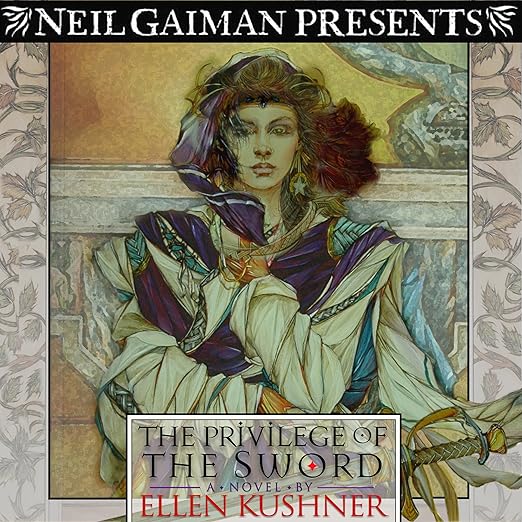
Neil Gaiman personally selected and produced this audiobook for his Neil Gaiman Presents label, casting the narrators and commissioning original music from composer Nathaniel Tronerud specifically for this production. That level of curatorial investment shows. Reviewer Armchair Shopper, who preferred this book to the first in the series, notes that the Mad Duke is revealed here as a man of honor, and Alec’s evolution across the series is one of the production’s most effective achievements.
Why Listen to The Privilege of the Sword
The full-cast format here is not a gimmick. Barbara Rosenblat handles the omniscient narration with the authority that earned her the Meryl Streep of audiodrama comparison cited in the production notes. Felicia Day voices Katherine, and her performance captures both the character’s exasperation and her growing confidence. Katherine Kellgren brings theatrical precision to Lady Artemisia, one of the story’s most interesting secondary characters. And Neil Gaiman himself appears in a cameo as the Rogues’ Ball Artist, which is exactly as charming as it sounds. The commissioned score gives the production an atmosphere that straight narration cannot replicate. Reviewer KG describes it as a swashbuckling adventure and notes the book offers genuine surprise at its turns, which tracks with the production’s success in maintaining narrative momentum across fifteen and a half hours.
What to Watch For in The Privilege of the Sword
Reviewer otherdeb notes that Katherine changes quickly early in the book, perhaps faster than feels fully naturalistic, and attributes it to either the character’s intelligence or the demands of a plot that needs to start moving. That is a fair observation. The first act compresses Katherine’s psychological shift in ways that readers of more leisurely literary fiction may find slightly rushed. The romance elements are present but not foregrounded, and some scenes of violence and emotional cruelty are depicted with enough directness to qualify as mature content. Kushner is not writing sanitized fantasy, and the city of Riverside is morally complex in ways that make it feel more alive than most fantasy settings.
Who Should Listen to The Privilege of the Sword
Fantasy listeners who have grown tired of worlds where gender dynamics feel lifted from medieval Europe without examination will find Riverside genuinely refreshing. Fans of witty, socially observant fiction who want adventure alongside the wit will feel at home. The full-cast production is exceptional enough to recommend to listeners who are normally skeptical of audiobooks but might respond to something produced with the care of a radio drama. Readers of Swordspoint should absolutely continue here. Those who require traditional heroic fantasy structures, or who are put off by LGBTQ themes woven naturally into the narrative, should know those elements are present throughout.
Frequently Asked Questions
Does The Privilege of the Sword need to be listened to after Swordspoint, or can it stand alone?
Kushner and the production notes confirm it stands alone, and Katherine is an entirely new protagonist. Readers who have not encountered Swordspoint will have no trouble following the story. That said, readers of the first book will have the pleasure of seeing Alec from a completely new angle.
What is Neil Gaiman’s actual role in this production?
Gaiman personally selected the book for his Neil Gaiman Presents audiobook label, cast the narrators, and produced the production. He also appears briefly as a performer in the Rogues’ Ball Artist role. His involvement is curatorial and creative, not incidental.
Is this suitable for younger listeners given the LGBTQ content and violence?
The production is intended for adult and older teen listeners. The violence is depicted with directness rather than graphic detail, and the LGBTQ elements are woven naturally into the world. Kushner does not sensationalize either, but the content is not pitched at younger children.
How much does the original music by Nathaniel Tronerud contribute to the listening experience?
Reviewers and production notes both emphasize the commissioned score as a genuine addition to the atmosphere. Unlike ambient sound effects that feel tacked on, Tronerud’s music was composed specifically for key scenes, which gives certain moments a theatrical texture that a straight narration would not achieve.