Quick Take
- Narration: Alana Kerr Collins handles the dual-POV romantic fantasy with energy and warmth, giving Clía a spirited voice that makes the training-arc sections particularly engaging.
- Themes: Proving yourself on your own terms, fake relationship turned real, the politics of royal alliance
- Mood: Bright and playful with genuine action stakes, romantasy comfort food with some bite
- Verdict: A debut that delivers its tropes with skill and charm, best suited to readers who love slow-burn rivals-to-lovers with a military academy setting.
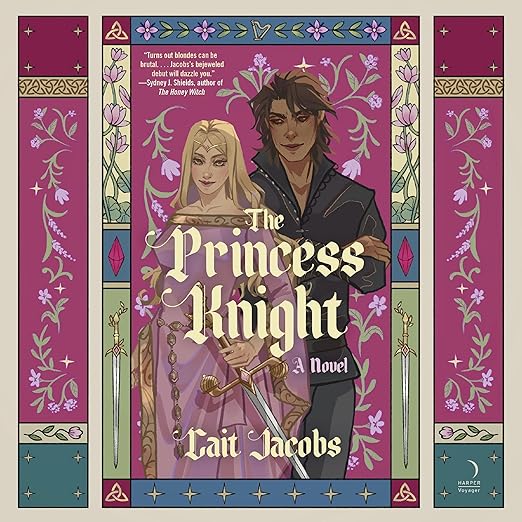
I picked up The Princess Knight on a recommendation from a reader who had come to romantasy through Sarah J. Maas and was looking for something lighter in tone but still willing to take its world-building seriously. That description turned out to be accurate and useful. Cait Jacobs’s debut fantasy sits at an interesting point in the current market for romantic fantasy: it has genuine warmth and comic sensibility, a heroine who is neither immediately competent nor a passive victim, and a hero whose emotional restraint actually makes sense given his history rather than functioning as a plot-delaying device. It is not a book that reinvents anything. But it executes what it is attempting with more skill than most debuts manage.
The setup: Princess Clía of Alainndore is publicly rejected by Prince Domhnall, who has decided she is too weak to be his queen. Rather than accept the humiliation and the political fallout for her kingdom, Clía follows him to Caisleán Cósta, a military academy with a brutal reputation, intending to prove herself worthy of the betrothal. What she does not anticipate is Ronan, a warrior who has fought hard for his place at the academy and has zero patience for a blonde princess who waltzes into the dueling arena like she is attending a garden party. The training arc that follows is where the book is strongest, and the gradual development of the Clía-Ronan dynamic has genuine texture.
Our Take on The Princess Knight
Jacobs’s strongest quality here is her handling of Clía’s arc. The princess is initially overconfident in ways that feel grounded in her background, she has been raised to believe charm and poise are sufficient currency, and the process of discovering she is actually not prepared for what she has walked into is portrayed with enough specificity to feel real. The physical training sequences are well-rendered, and reviewers consistently noted that Clía’s determination to prove herself was admirable without tipping into the kind of infallibility that flattens YA and romantasy heroines.
Ronan is perhaps slightly less developed, his emotional arc is more predictable, but the best-friend-is-the-rival’s-ex dynamic with Domhnall adds genuine complication to his position. He has genuine reasons beyond pride for keeping his distance from Clía, and the book takes those reasons seriously. The animal companion (Clía’s otter-like pet) is exactly as charming as it sounds and functions better in the narrative than comparable companions often do in romantasy.
Why Listen to The Princess Knight
Alana Kerr Collins is well-suited to this material. Her narration of Clía’s perspective has an energy and slight breathlessness that captures the character’s impulsiveness without making her annoying. She handles the training sequences with appropriate intensity and brings a warmth to the developing relationship between Clía and Ronan that serves the book’s emotional arc. The fourteen-hour runtime is substantial for a debut novel, and Collins sustains consistent energy across it, a real test for any narrator working with longer romantic fantasy.
The Harper Voyager production is clean and professional. The audio version benefits from Collins’s ability to differentiate the Irish-inflected names and place names in Jacobs’s world, Clía, Domhnall, Caisleán Cósta, without making them feel like obstacles. For listeners who sometimes find fantasy world names pulled out of the reading, this is a meaningful advantage of the audio format.
What to Watch For in The Princess Knight
Some reviewers flagged pacing unevenness, particularly in the middle section where the romantic development sometimes slows while side character material picks up. One reader noted that certain scenes were over-detailed while others moved too quickly and told rather than showed. That is fair criticism and it is worth naming: the book is not tightly edited. At fourteen hours, there are passages that could have been compressed without losing anything essential, and listeners who find romantic pacing frustrating when it plateaus may notice this.
There is also a worldbuilding question that several readers mentioned: the premise requires Clía’s kingdom to need this alliance badly enough that she would pursue it to a military academy, but the book does not develop the political stakes in enough depth to make that desperation fully convincing. Readers who want the romance to be embedded in a rich, coherent political world may find this thinner than expected.
Who Should Listen to The Princess Knight
This audiobook is well-suited to readers who love the military academy romantasy subgenre, the kind of story where physical challenge, rivals-to-lovers development, and court politics overlap. Fans of Fourth Wing will find the setting and dynamic familiar, though The Princess Knight is lighter in tone and lower in explicit content. It is also a strong choice for LGBTQ-tagged romantasy readers who want F/M romance that takes its heroine’s agency seriously without requiring a dark, grimdark backdrop.
Skip this one if you need your romantic fantasy to sustain tightly plotted political intrigue throughout, the world-building is pleasant but not rigorous. And if fourteen hours feels long for a debut, it is worth knowing upfront that the book earns its length in charm more than in density of plot.
Frequently Asked Questions
Is The Princess Knight appropriate for readers who prefer low-spice romantasy?
Yes. The Princess Knight is a clean romantic fantasy, there is genuine romantic tension and chemistry between Clía and Ronan, but the heat level is low. Multiple reviewers specifically praised this as a book they could share with a teen daughter without concern.
How does Alana Kerr Collins handle the Irish-inflected names and place names in the world-building?
Very well. Collins gives the names in Jacobs’s Irish-inflected world a natural, comfortable pronunciation without making them feel like set-pieces. For listeners who sometimes find invented fantasy names disruptive, the audio version is actually an advantage here.
Does the Domhnall-as-best-friend complication significantly affect the Clía-Ronan romance?
It adds meaningful texture without derailing the romance. Ronan’s loyalty to Domhnall gives his emotional restraint a specific grounded reason, which makes the slow-burn dynamic feel earned rather than arbitrary. It is one of the better structural choices in the book.
How does The Princess Knight compare to Fourth Wing for readers who loved that series?
The military academy setting and rivals-to-lovers dynamic will feel familiar to Fourth Wing readers, but The Princess Knight is lighter in tone, lower in heat, and less focused on political intrigue. It is a more comfortable read, the stakes feel real but not existential, and the humor is more present throughout.