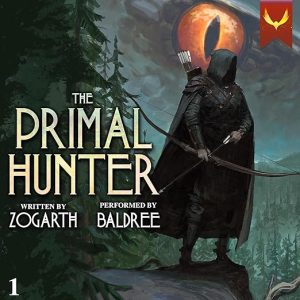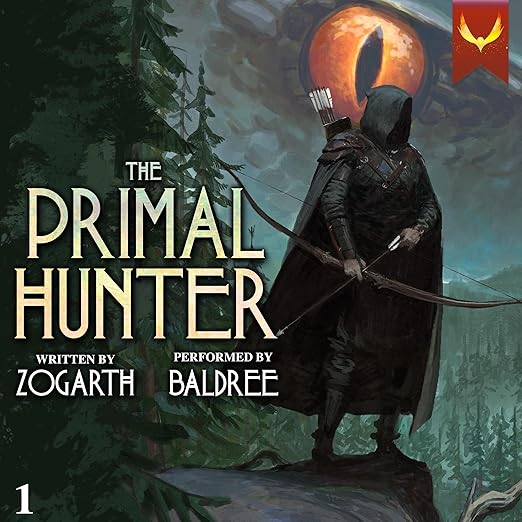
I came to The Primal Hunter through a conversation with someone who had never read LitRPG before and finished all fourteen available books in under two months. That's the kind of recommendation that makes me pay attention, because it describes something genuinely capturing rather than merely serviceable. Zogarth's series, which began with millions of views on Royal Road before moving to traditional publishing, delivers the genre's core satisfactions with enough narrative intelligence to justify the obsessive reading behavior it apparently produces.
The inciting event is brisk and confident. Jake, an office worker described as seemingly average, experiences the world being integrated into a larger multiverse during what appears to be an ordinary day. A tutorial system activates, colleagues falter, and Jake discovers that he is not, in fact, as ordinary as he seemed. The multiverse framework is a familiar LitRPG premise, but Zogarth's execution finds its distinction in how Jake is characterized: not as a hidden prodigy waiting to be activated, but as someone whose specific psychological makeup turns out to be uniquely suited to the new reality's demands.
Comfortable Alone, Never Waiting to Be Fixed
The progression system is detailed and internally consistent, which is the primary functional requirement for LitRPG. Levels, classes, professions, skills, dungeons, and loot are all present and developed with the rigor that the format demands. But what reviewer J. Hildebrandt notes as an "interesting take on the isekai gamelit genre" is more than mechanical novelty: there's a character psychology here that takes the loner archetype seriously rather than treating it as a temporary condition to be resolved by the power of friendship. Jake's comfort with solitude is framed as a genuine personality trait rather than a wound to be healed, which gives the story a different emotional texture than comparable series where integration into a team dynamic is the obvious redemption arc.
Reviewer Esther, who describes this as their first LitRPG after a reading history of Jane Austen and occasional science fiction, makes the most interesting testimonial in the reviews. The description of reading the series repeatedly while waiting for new volumes captures something real about how well-constructed LitRPG works: the world rewards revisiting because the progression system creates layers of foreshadowing and retroactive meaning that deepen on re-read.
Baldree Makes Jake Present, Never Performed
Travis Baldree is not incidentally good for this material. He is specifically excellent at it. His delivery of inner monologue, which LitRPG requires extensively, avoids both the flat recitation and the overperformed interiority that make weaker narrators of the genre hard to listen to. His Jake is present without being performed, which suits a protagonist defined by quiet competence rather than emotional volatility. At 20 hours and 9 minutes, the runtime is substantial, but reviewer Mellie B makes a useful observation for uncertain listeners: the slow start rewards persistence. The first portion of the book, during the tutorial, moves carefully. Once Jake begins developing autonomously, the pace accelerates considerably.
Generic Tutorial, Then Genuine Alchemy and Craft
Reviewer Mellie B's critique about the opening feeling derivative is worth acknowledging. Tutorial-phase LitRPG can feel generic because many series use structurally similar setups. Zogarth's differentiation comes primarily through characterization rather than mechanical novelty in these early chapters, which means listeners who need immediate plot distinction may feel the slow start more acutely. The payoff for patience is genuine, but it isn't instantaneous.
The alchemy component, which reviewer Michelle C. highlights enthusiastically, becomes a significant part of Jake's identity and progression style. For listeners who engage with crafting and professions in game-adjacent fiction, this is a selling point. For those who primarily want combat and dungeon-clearing, the alchemy sections are detailed but not obstructive.
Team Dynamics Take Patience to Fully Arrive
LitRPG readers who want a series with commitment to both mechanical detail and genuine character development will find this one of the better entries in the post-Royal Road wave. Listeners new to the genre who want to understand why it has attracted such a large dedicated readership will find this a more character-accessible entry point than some alternatives.
Listeners who want social dynamics and team-based progression from the start should be patient: reviewer Mellie B specifically looks forward to more interpersonal development in later volumes, which suggests this is a series that earns its ensemble cast gradually. If you need ensemble energy from book one, this particular series may frustrate early on.
At a Glance
- Read by: Travis Baldree is one of the best LitRPG narrators working, bringing relaxed authority to Jake's solo progression and enough range to distinguish a wide cast of supporting characters.
- At its heart: System integration apocalypse, solitary mastery vs. social connection, identity shaped by crisis
- Vibe: Propulsive and absorbing, with enough strategic detail to reward genre fans without overwhelming newcomers
- Short version: A strong debut in the apocalyptic LitRPG tradition that earns its place at the top of the Royal Road-to-audiobook pipeline, with Travis Baldree's narration elevating an already well-constructed story.
Good to Know
How does Travis Baldree's narration handle the statistical and system elements, like skill descriptions and level notifications?
Baldree handles them with the same measured confidence he brings to the rest of the narration, avoiding the robotic recitation style that makes some LitRPG audio difficult to follow. The system elements integrate naturally into the story's rhythm rather than interrupting it.
Is the alchemy subplot central to the main story or more of a side interest?
Alchemy becomes a significant part of Jake's professional identity and progression style, not a minor side note. Multiple reviewers highlight it as a distinctive element of the series. It contributes to the solo-progression aesthetic that distinguishes Jake from combat-primary LitRPG protagonists.