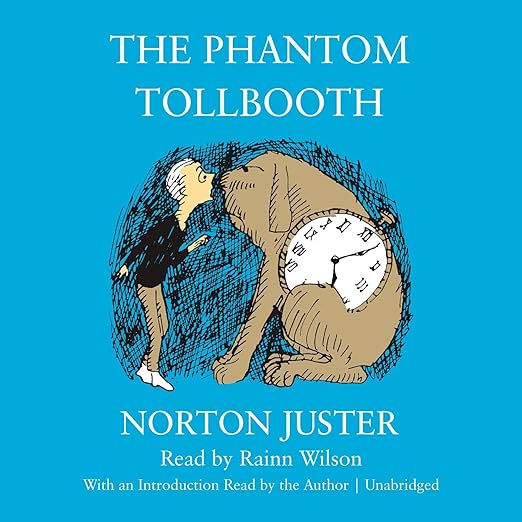
Five press quotes sit under this audiobook's description, and every one of them is praising a printed book. The New Yorker calls it humorous, full of warmth and real invention. The New York Times remembers reading it at ten and keeping the book report. Los Angeles Review of Books says the book lingers long after turning the final page. Entertainment Weekly promises you will marvel at its wit. Rainn Wilson is the person actually speaking for 4 hours and 41 minutes here, though no syllable of that jacket copy acknowledges a recording exists.
The Only Thing Separating This From Paper
Rainn Wilson's name shows up in the performer slot and in no other line here. No note on the performance, no word about the casting, no hint of why this particular voice was matched to a book whose central joke is that language behaves literally. Silence of that kind is ordinary on pages like this one. It is more conspicuous here than usual, because the choice of voice is the only thing separating this edition from the paperback those five quotes were written about in the first place.
Milo is bored, and boredom is the entire engine. A tollbooth appears in his room and he drives through it only because he has nothing better to do, and the Lands Beyond turn out to run on words taken at face value. You reach the Island of Conclusions by jumping. Time gets explained by a ticking watchdog named Tock. The quest is to rescue Rhyme and Reason, two abstractions treated as people who can be abducted, and somewhere along the way Milo works out that life is not dull after all.
Every visible grade on this listing is a five. All five written responses carry five stars while the badge above them reads 4.7, which means the ten votes total forty-seven points of a possible fifty and the three missing points came from people who wrote nothing. That is no scandal. It is a reminder that the column you can read is the flattering half of the sample, and that whatever the dissent consisted of, it left no text behind for you to weigh. Ten votes is a thin base for a badge in any case, and half of them are mute.
Wendell's Mommy Says the Label Is Wrong
Tock, the Island of Conclusions and the rescue of two abstractions are jokes that work better spoken than seen, because a pun has to be heard to land at full speed. Kir4Life singles out the language specifically, calling this a great story with fantastic vocabulary that can be enjoyed through the ages. A book running on the distance between what a word says and what it means has an obvious reason to exist as a recording, however little the description says about it.
Wendell's Mommy opens the column and spends the space arguing that the children's label on the cover is simply wrong. What the book actually is, by that account, is a collection of delightful play with words and numbers, puns and logic, profound insights and pure fun, written by somebody who was clearly not aiming at eight-year-olds alone. The entry breaks off mid-sentence while it is still naming what arrives with Milo's tollbooth, directions for assembly, a book of rules, maps, and then nothing.
Once you accept that the audience question is genuinely open, the runtime starts to help. 4 hours and 41 minutes is short enough for a family to finish across two evenings and unhurried enough to let the jokes register. Avid reader, writing from Singapore, reports a boy of five and a half who especially loves the part about the giant. Jeremy Rodden reaches instead for Alice's Adventures in Wonderland, arguing that this book turns the clever wordplay up a level higher than Alice does.
A Five-Star Slot Used to Name His Own Book
Mama_Saurus_Rex opens by wishing the book could be redone as a movie with today's technology, and then, after a passage about hidden messages in Disney films, writes the words this movie rendition of The Phantom Tollbooth is. The entry stops there. Whatever was under review may not have been this recording, and the cut falls exactly where the answer would have been, and the five stars attached to the whole thing are now impossible to interpret in either direction.
Jeremy Rodden signs off as Author and uses the opening lines to explain that the discovery came through a comparison somebody made in a review of that reviewer's own first Toonopolis book. The observation about Alice is sharp. The framing is still a working author using a five-star slot on somebody else's classic to name a title of their own, and once you have noticed it the grade reads a little differently. Nothing dishonest is happening, and the enthusiasm looks real enough, but five independent voices this is not.
Animals and Nature is the tag this listing hangs on the book. Tock is the one animal the description names, and the story is an allegory about language and attention. The same inattention shows up in the copy itself, which claims the story was first published more than fifty ago and never supplies the missing noun, so the date the description reaches for is the one piece of information it fails to deliver. Small errors, but they accumulate into a page that went out unproofread.
Nobody Here Has Heard This Recording
Children who enjoy being talked up to are the right audience, and so are adults who somehow missed the book and want a short way in. 4 hours and 41 minutes asks very little of an evening. The wordplay rewards attention without punishing the lack of it, and a listener whose mind wanders through the Island of Conclusions will still catch the joke the moment Milo jumps onto it. Families following along in a print copy will find the pace forgiving, and the short chapters make it easy to stop at a sensible place and pick the thread up the next evening without losing anybody.
Do not come to it for the animals the tag promises, and do not come expecting this listing to tell you how Rainn Wilson handles a book assembled out of puns, because not one person writing here gives any sign of having heard the recording. Come for Milo, for Tock, for a rescue mission aimed at two abstractions held prisoner somewhere past the Island of Conclusions. That part of the promise the description keeps.
Before You Press Play
- Narration: Rainn Wilson carries the whole thing alone, matched to a book whose jokes depend on hearing a word land wrong, and the listing adds not one word about the casting.
- Themes: literal-minded wordplay, boredom cured by curiosity, an allegory about paying attention
- Mood: Playful and quick, with a sly streak aimed over children's heads
- Verdict: A natural candidate for audio, sold by a page that quotes five print reviews and describes the recording nowhere.
Frequently Asked Questions
Can a young child follow this audiobook without help?
The wordplay works on two levels, so a young listener can follow Milo's quest through the Lands Beyond while missing half the puns. One response reports a boy of five and a half fixed on the giant. Another argues the book is not really a children's book. Expect questions, and expect to answer some.
Why does the listing quote only newspaper reviews?
Because the description was assembled out of the print edition's marketing. All five pull quotes, from The New Yorker through to Entertainment Weekly, praise a book you turn pages in, and two of them say so outright. Nothing here was written for the 2019 recording, leaving Rainn Wilson inside a credit field and outside every sentence of the copy.
Does the audiobook work for adults who missed the book as kids?
It suits that job well. The runtime is 4 hours and 41 minutes, the plot is a straight quest, and the jokes are pitched over a child's head often enough to hold an adult. The first respondent, a self-described 66-year-old, insists the children's label on the cover is simply wrong and makes a decent case.
Why is this filed under Animals and Nature?
No good reason surfaces in the record. A ticking watchdog called Tock is the sole creature anyone on this page mentions, and the story itself is an allegory about language and attention. The tag looks like a filing error, never a summary of the contents, worth knowing if a category browse is how you arrived at the page.