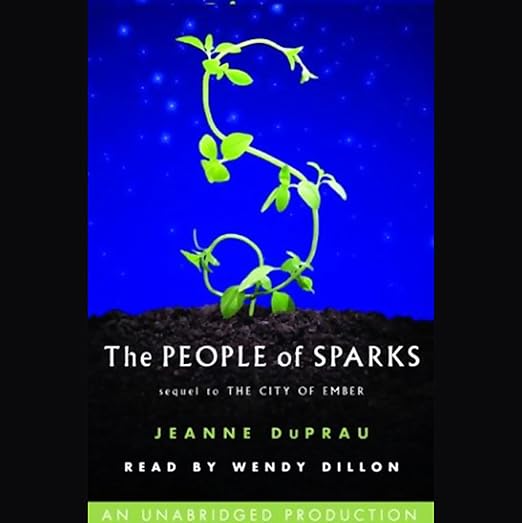
Picking up where The City of Ember ends, The People of Sparks follows Lina and Doon as they lead the Emberites up into a new world and into conflict with the town of Sparks that takes them in. This audiobook, part of The City of Ember series and narrated by Wendy Dillon, is produced by Listening Library, runs 7 hours and 55 minutes, and originally released in June 2004.
Reviewers here treat this less as a standalone book and more as a continuation to be measured against its predecessor. Several compare it directly to The City of Ember, and more than one concludes that this second book is actually the stronger of the two, a fairly unusual outcome for a sequel that has to carry an existing cast into an entirely new setting.
Sol's review, having read The City of Ember aloud to a six-year-old first, raises pointed questions about that first book's internal logic: canned food lasting two hundred years, no apparent vitamin deficiencies from generations spent underground. That same review then turns around and calls this sequel excellent for young readers specifically because it tackles real themes like resentment between groups and scarcity.
Leman's review notes that a film adaptation of The City of Ember was, in their words, 'a failure,' and doubts a Sparks movie will ever follow as a result. It's the reviewer's own judgment rather than confirmed information from the listing, but a detail worth knowing for anyone who encountered the film before the books.
More than two decades after release, this listing is still drawing new reviews as recently as this year, evidence the series keeps finding readers well past its original run. Jonathan's short review, dated December 2025, frames the whole book around a single cooperative message: working together accomplishes what division cannot.
Ben212's review, titled around recommending the book to ten-year-old fifth graders and adults alike, calls out a specific structural strength: the story presents two communities, Sparks and Ember, and shows how small misunderstandings between them threaten to unravel any chance of cooperation. That reviewer specifically frames it as an amazing message for kids without talking down to them.
The rating badge on this listing shows 4.6 from four recorded votes, while five written responses are actually visible in the column, a small mismatch between the counter and what's plainly on the page. Four counted votes for five people who clearly took the time to write something is worth knowing before leaning on the star figure too heavily.
Why It Works in Audio
For listeners who enjoyed the first book, or even those who found it slow, reviewers are fairly unanimous that this sequel improves on it. Ben212's review specifically expected the story to lose momentum after such a definitive first-book ending and was surprised to find this entry even stronger, crediting it with showing how small misunderstandings between communities can escalate into real violence.
Resentment between the underground Ember refugees and the aboveground people of Sparks over limited resources gives the book a clear, age-appropriate lesson about cooperation without feeling like a lecture, according to multiple reviews here. OpheliasOwn's review adds that the aboveground world itself, full of light and color, comes as a genuine shock after the dying city the Emberites just escaped.
The genre tag attached to this listing, Action & Adventure, undersells the book slightly given how much of the tension comes from social dynamics between two struggling communities rather than physical peril alone. Reviewers consistently describe the vandalism plot as a way into bigger questions about scarcity and fear of outsiders, not as the book's main draw on its own.
Weak Spots in The People of Sparks
This is a direct sequel, and the synopsis assumes listeners already know how Lina and Doon escaped Ember in the first place. New listeners should start with The City of Ember, since the setup here, resentment building in a town already straining to support its own population, depends on knowing what the Emberites just left behind.
Wendy Dillon's work as narrator goes unmentioned across all five reviews, which stay focused on plot, themes, and comparisons to the first book. Anyone choosing based on audio delivery specifically will need to sample the recording rather than lean on this review column.
Two of the five reviewers here specifically mention reading the series with children, Sol aloud to a six-year-old and Ben212 alongside kids already invested in the first book, which shapes the feedback here toward family listening. Solo adult readers get comparatively less direct representation in this particular review column.
Who Will Get the Most From It
Recommended for young listeners and families who already enjoyed The City of Ember, especially those who want a sequel that reviewers consistently rate as an improvement rather than a step down. It also works well for reluctant readers of the first book, since Sol's own account shows the sequel winning over someone who wasn't fully sold on where the series started.
It's a poor starting point on its own, since the vandalism plot and the tension between the two communities only land with the context the first book provides. Sol's review is proof that even a skeptical reader of the first book can come around on this one specifically.
At 7 hours and 55 minutes, this is a manageable follow-up listen for families working through the series together rather than a sprawling, multi-week commitment.
A Few Questions About The People of Sparks
Do listeners need to start with The City of Ember first?
Yes. The synopsis picks up immediately after Lina and Doon lead the Emberites out of the underground city, and the tension with the town of Sparks only makes sense with that background in place. Every review collected here also assumes familiarity with the first book rather than introducing its events.
Is this audiobook a direct sequel, or can it stand alone?
It's a direct sequel. The synopsis explicitly picks up where The City of Ember leaves off, following the same characters into a new setting and a new conflict. Reviewers treat it as part of a continuous story rather than a standalone entry, several comparing it point by point to the first book.
How old is this audiobook, and does it still find new listeners?
This audiobook originally released in June 2004, more than two decades ago. Despite its age, two of the five reviews collected here are dated within the last year, suggesting the series keeps attracting new listeners well past its original release window.